

The actions of TUI AG’s management and supervisory bodies are determined by the principles of good and responsible corporate governance.
The Executive Board and the Supervisory Board discussed Corporate Governance issues in financial year 2025. In this chapter, the Executive Board provides – also for the Supervisory Board – the report on Corporate Governance in the Company pursuant to Principle 23 of the German Corporate Governance Code (GCGC) and Sections 289f and 315d of the German Commercial Code (HGB).
Declaration of Compliance with the German Corporate Governance Code
As a stock corporation company under German law, TUI AG’s Executive Board and Supervisory Board are obliged to submit a declaration of compliance with the GCGC pursuant to section 161 of the German Stock Corporation Act.
Wording of the Declaration of Compliance for 2025
“In accordance with section 161 of the German Stock Corporation Act, the Executive Board and Supervisory Board hereby declare:
Since the last declaration of compliance was submitted in December 2024, the recommendations of the German Corporate Governance Code in its applicable version have been and will be fully observed”.
Place of publication: https://www.tuigroup.com/en/investors/corporate-governance/reports-and-declarations
Information on Corporate Governance
Functioning of the Executive and Supervisory Boards
TUI AG is a company under German law. A fundamental principle of German stock corporation law is the dual management system. This assigns the management of the Company to the Executive Board and the monitoring of management to the Supervisory Board. TUI AG’s Executive Board and Supervisory Board cooperate closely and in a spirit of trust for the benefit of the Company, with strict separation between the two bodies in terms of their membership and competences. Both bodies are obliged to ensure the continued existence of the Company and sustainable creation of added value in harmony with the principles of the social market economy. The Executive Board is responsible for providing information to the Supervisory Board. However, the Supervisory Board must ensure that it receives adequate information. The Executive Board shall inform the Supervisory Board regularly, promptly and comprehensively about all matters relevant to the Company, in particular strategy, planning, business development, the risk situation, risk management and compliance.
Compensation Report / Compensation System
The Compensation Report and the Independent Auditor ’s Report in accordance with section 162 of the German Stock Corporation Act, the compensation system for the Executive Board members pursuant to section 87a para. 1 and para. 2 sent. 1 of the German Stock Corporation Act and the decision of the Annual Shareholders’ Meeting pursuant to section 113 para. 3 of the German Stock Corporation Act regarding the compensation of the Supervisory Board members are published at https://www.tuigroup.com/en/investors/corporate-governance/remuneration-system-and-reports
Executive Board
TUI AG’s Executive Board comprised five members as at the balance sheet date 30 September 2025. It is responsible for managing the Company’s business operations in the interests of the Company. The work of the Executive Board is based on the German Stock Corporation Act, the Articles of Association, the terms of reference issued by the Supervisory Board and the resolutions of the Annual General Meeting. All members of the Executive Board are jointly responsible for the management of the Company. In addition, each member of the Executive Board is responsible for their own area of responsibility. The areas of responsibility of the Executive Board members are listed in a separate overview.
There should be a sufficient mix of ages among the members of the Executive Board. The age limit for Executive Board members is generally in line with the standard retirement age for statutory pension insurance.
The CVs of the members of the Executive Board are updated annually and published at https://www.tuigroup.com/en/investors/corporate-governance/management-information
Gender quote an average age of Executive Board members of TUI AG (30 Sep 2025)
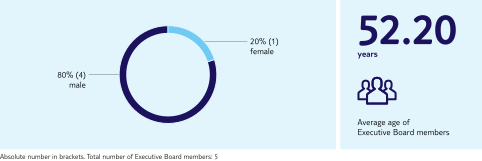
Further information on the composition of the Executive Board and the areas of responsibility of the Executive Board members can be found in the section “Financial year 2025”.
Supervisory Board
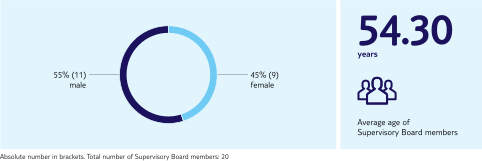
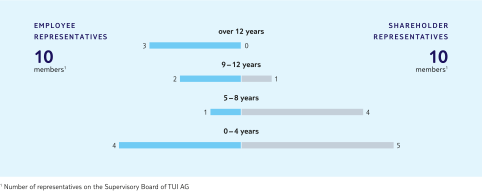
In accordance with the law and the Articles of Association, the Supervisory Board had 20 members at the balance sheet date, i.e. 30 September 2025. TUI AG is subject to the German Industrial Co-Determination Act (MitbestG). The Supervisory Board is therefore composed of an equal number of shareholder representatives and employee representatives. Employee representatives within the meaning of the MitbestG also include one executive employee (section 5 (3) of the German Works Constitution Act) and three trade union representatives. Prior to the Supervisory Board meetings, the representatives of the shareholders and employees meet in separate preparatory meetings.
In its function as the oversight body, the Supervisory Board continuously advised and monitored the Executive Board in the management of the Company in the past financial year 2025, as required by the law, the Articles of Association and its own Terms of Reference. The Supervisory Board is involved in strategy and planning, including the sustainability strategy and its implementation, as well as in all matters of fundamental importance to the Company. The Terms of Reference for the Executive Board require the approval of the Supervisory Board for major business transactions – such as the determination of the annual budget, major acquisitions and divestments. The Supervisory Board reviews the annual and consolidated financial statements, the combined management report of TUI AG and the Group, including reporting on non-financial topics and disclosures on EU taxonomy, as well as the sustainability report and the proposal for the appropriation of net retained profits. The Supervisory Board also meets regularly without the Executive Board.
The Supervisory Board's monitoring and advisory activities also extend in particular to sustainability aspects in the areas of environment, social affairs and corporate governance (ESG). The Supervisory Board receives regular reports from the Executive Board on the Group-wide sustainability strategy and the status of its implementation. As part of its monitoring function, the Supervisory Board deals with both the opportunities and risks for the Company resulting from social and environmental factors and the ecological and social impacts of its business activities. The Supervisory Board and the Audit Committee also deal with future regulatory requirements for sustainability reporting and are kept informed on an ongoing basis about relevant developments and the progress of implementation within the Company.
Further information on sustainability management can be found in the section Non-financial declaration of TUI Group.
The Chairman of the Supervisory Board coordinates the work in the Supervisory Board, chairs its meetings and represents the interests of the body externally. He is also willing, within reasonable limits, to discuss supervisory board-specific issues with investors. The dialogue of the Chairman of the Supervisory Board with investors took place within an appropriate framework in financial year 2025. The Supervisory Board and the Audit Committee have adopted terms of reference for their own work. The Terms of Reference of the Supervisory Board are available on the Company's website.
The Supervisory Board, after intensive deliberations in financial year 2025, resolved to propose to the Annual General Meeting of TUI AG that the size of the Board be reduced from 20 to 16 members. Numerous organizational and regulatory aspects were carefully considered in making this decision. With the reduction in size, the Supervisory Board aims to further enhance the efficiency of its work without compromising on diversity and expertise. The future composition of the Supervisory Board will continue to fully comply with the recommendations of the GCGC. The Annual General Meeting of TU AG approved the proposal to reduce the size of the Supervisory Board with a majority of 99.80%. The reduction will take effect at the conclusion of the Annual General Meeting in 2026.
The Supervisory Board had four committees in the reporting year. Their tasks, responsibilities and work processes comply with the requirements of the German Stock Corporation Act and the GCGC. The chairmen of the committees regularly report to the Supervisory Board on the committees' activities.
The Supervisory Board has formed a Presiding Committee from among its members, consisting of the Chairman of the Supervisory Board and his deputy, as well as four other members of the Supervisory Board to be elected by the Supervisory Board. The Presiding Committee prepares the Supervisory Board meetings and is responsible for matters relating to the Executive Board (including succession planning for the Executive Board, appointments, terms and conditions of employment contracts, Executive Board remuneration, proposals for the Executive Board remuneration system). Although the Presiding Committee is responsible for the concrete succession planning for the Executive Board, the Supervisory Board and the Executive Board jointly ensure long-term succession planning for the Executive Board. The Presiding Committee usually meets in advance of Supervisory Board meetings and as required.
The Presiding Committee consists of:
- Dr Dieter Zetsche (Chair)
- Sonja Austermühle (since 1 January 2025)
- Peter Bremme (until 31 December 2024)
- Dr Jutta Dönges
- Prof Dr Edgar Ernst (until 11 February 2025)
- Frank Jakobi
- Anette Strempel
- Joan Trían Riu (since 11 February 2025)
In addition, an Audit Committee is elected, which is also composed of eight members of the Supervisory Board. The Audit Committee supports the Supervisory Board in performing its supervisory function. It is responsible for reviewing the financial statements, monitoring the accounting process, the effectiveness of the internal control system, the risk management system and the internal audit system, as well as the audit of the financial statements and compliance. The accounting includes, in particular, the consolidated financial statements and the group management report, including the non-financial statement, interim financial information and the individual financial statements in accordance with the German Commercial Code (HGB). In addition, the Audit Committee is responsible for selecting the external auditor, whereby it also reviews the qualifications and independence of the auditor. Furthermore, the Audit Committee regularly assesses the quality of the audit.
The Audit Committee consists of:
- Dr Jutta Dönges (Chair, since 11 February 2025)
- Prof Dr Edgar Ernst (Chair, until 11 February 2025)
- Christian Baier
- Stefan Heinemann
- Frank Jakobi
- Coline McConville (since 11 February 2025)
- Mark Muratovic
- Stefan Weinhofer
- Dr Dieter Zetsche
The Nomination Committee, which consists exclusively of three representatives of the shareholders, nominates suitable candidates from among the shareholders to the Supervisory Board for election by the Annual General Meeting or for appointment by the court. The committee usually meets in connection with upcoming changes to the Supervisory Board of the Company.
The Nomination Committee consists of:
- Dr Dieter Zetsche (Chairman)
- Dr Jutta Dönges
- Prof Dr Edgar Ernst (until 11 February 2025)
- Joan Trían Riu (since 11 February 2025)
The Mediation Committee formed in accordance with Section 27 (3) of the German Co-Determination Act only meets if the necessary two-thirds majority of votes is not achieved when appointing or dismissing members of the Executive Board. The Mediation Committee did not need to be convened in financial year 2025.
The Mediation Committee consists of:
- Dr Dieter Zetsche (Chair)
- Frank Jakobi
- Sonja Austermühle
- Dr Jutta Dönges
Information on the composition of the committees is published at: https://www.tuigroup.com/en/investors/corporate-governance/supervisory-board-committees
Gender quote and average age of Supervisory Board members of TUI AG (30 Sep 2025)
Duration of appointment of the Supervisory Board members of TUI AG (30 Sep 2025)
As a rule, members of the Supervisory Board should not be older than 68 years of age (standard retirement age) when elected to the Supervisory Board.
For further details, please refer to the Report of the Supervisory Board.
The CVs of the Supervisory Board members are updated annually and published at https://www.tuigroup.com/en/investors/corporate-governance/management-information
Further information on Corporate Governance is continuously provided in the TUI ESG Investor Presentation available at https://cdn.sanity.io/files/b6xulh2p/production/ce9bf49eb18510575573f36d885847d01bd3e427.pdf
D&O insurance policy
TUI AG has taken out a D&O insurance policy for all members of the Executive Board and Supervisory Board, providing for a deductible for Executive Board members in accordance with the statutory requirements of the German Stock Corporation Act. The deductible amounts to 10% of the loss up to the amount of one and a half times the fixed annual compensation.
Competence Profile of the Supervisory Board
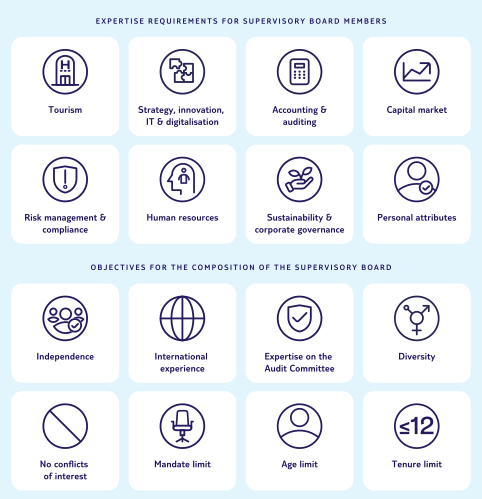
In accordance with recommendation C. 1 of the GCGC, the Supervisory Board has developed a competence profile for the board as a whole and specified targets for its composition. In financial year 2025, the competence profile has been reviewed and supplemented by a criterion regarding regular limit to the term of office of shareholder representatives. With regard to competencies, it is not expected that each individual member of the Supervisory Board possesses all the knowledge and experience listed in the competency profile. Rather, the Supervisory Board as a whole should cover the specified competencies. This also applies to sustainability topics that are of particular importance to the Company. The associated expertise is contributed by different members, ensuring that diverse perspectives and areas of expertise are reflected in the discussions. The current status of implementation of the competence profile can be found in the qualification matrix.
The current competence profile of the Supervisory Board is published at https://cdn.sanity.io/files/b6xulh2p/production/adb455985fe61e31f7e159bb396fb3c729cd87aa.pdf
Qualification matrix of the Supervisory Board
The status of implementation of the Supervisory Board's competency profile is disclosed below in the form of a qualification matrix. In financial year 2025, the methodology for preparing the qualification matrix was fundamentally revised. The qualification matrix now presented contains the individual competencies with a graded competency level for each Supervisory Board member. This enables a more differentiated and transparent presentation of the competencies available within the board.
The competency assessments are carried out on the basis of a structured self-assessment by the members of the Supervisory Board. A defined catalogue of criteria is used for this purpose, which contains detailed criteria and explanatory descriptions for each competency. The members of the Supervisory Board use this catalogue of criteria to make an independent assessment of their level of competence. The classification into the respective competence level is based on the number of criteria fulfilled for each competence. This also enables the results of the self-assessment to be compared within the Supervisory Board. Following the self-assessment, the Chairman of the Supervisory Board carries out a plausibility check against the CVs and other relevant information. In individual cases where information from the self-assessment could not be readily verified by the CV or other relevant information, the Chairman of the Supervisory Board would request any necessary evidence from the respective Supervisory Board member. This was not necessary for the present qualification matrix.
On this basis, the revised qualification matrix is a transparent and meaningful tool for assessing the extent to which the knowledge and experience specified in the Supervisory Board's competence profile are represented on the board. It also serves as a basis for the targeted further development of the board and the continuous optimisation of its composition.
| Individualised qualification matrix of the Supervisory Board of TUI AG (as of 30 September 2025) | ||||||||||
|---|---|---|---|---|---|---|---|---|---|---|
| Dr Dieter Zetsche |
Frank Jakobi |
Ingrid-Helen Arnold |
Sonja Austermühle |
Christian Baier |
Andreas Barczewski |
Dr Jutta Dönges |
Wolfgang Flintermann |
María Garaña Corces |
Stefan Heinemann |
|
| Membership | ||||||||||
| First appointment | 2018 | 2007 | 2020 | 2022 | 2022 | 2006 | 2021 | 2016 | 2020 | 2020 |
| Current appointment until | 2027 | 2026 | 2028 | 2026 | 2027 | 2026 | 2029 | 2026 | 2028 | 2026 |
| Duration of membership (in years, as of 30 Sep 2025) | 7 | 18 | 5 | 3 | 3 | 19 | 4 | 9 | 5 | 5 |
| Position | Chairman | Deputy Chairman | SHR | ER | SHR | ER | SHR | ER | SHR | ER |
| Committee membership | ||||||||||
| Presiding Committee | yes | yes | yes | yes | ||||||
| Audit Committee | yes | yes | yes | yes | yes | |||||
| Nomination Committee | yes | yes | ||||||||
| Diversity | ||||||||||
| Gender | m | m | f | f | m | m | f | m | f | m |
| Birth year | 5 May 1953 | 18 Feb 1962 | 5 Oct 1968 | 27 Feb 1978 | 6 Nov 1976 | 15 Aug 1967 | 9 May 1973 | 4 Dec 1969 | 4 Mar 1970 | 14 Apr 1979 |
| Age (on 30 Sep 2025) | 72 | 63 | 56 | 47 | 48 | 58 | 52 | 55 | 55 | 46 |
| Nationality | German | German | German | German | German | German | German | German | Spanish | German |
| International experience | yes | no | yes | no | yes | yes | yes | yes | yes | yes |
| Personal qualification | ||||||||||
| Independence1 | yes | N/A | yes | N/A | yes | N/A | yes | N/A | yes | N/A |
| No overboarding2 | yes | yes | yes | yes | yes | yes | yes | yes | yes | yes |
| Integrity, commitment, engagement | yes | yes | yes | yes | yes | yes | yes | yes | yes | yes |
| Professional qualification | ||||||||||
| 1. Tourism | ⏺ | ⏺ | ◕ | ◔ | ◕ | ⏺ | ◕ | ◕ | ◕ | ⏺ |
| 2. Strategy, innovation | ⏺ | ⏺ | ⏺ | ◔ | ⏺ | ◕ | ⏺ | ◔ | ⏺ | ⏺ |
| 3. IT, digitalisation | ◕ | ◕ | ⏺ | ◔ | ⏺ | ◔ | ◕ | ◔ | ⏺ | ⏺ |
| 4. Accounting | ◕ | ◕ | ◔ | ◕ | ⏺ | ◕ | ⏺ | ⏺ | ◕ | ◕ |
| 5. Auditing | ⏺ | ⏺ | ⏺ | ◕ | ⏺ | ◕ | ⏺ | ⏺ | ⏺ | ⏺ |
| 6. Sustainability reporting | ◕ | ⏺ | ◕ | ◔ | ⏺ | ◔ | ⏺ | ⏺ | ◕ | ◕ |
| 7. Capital market | ◕ | ⏺ | ◕ | ◔ | ⏺ | ◕ | ⏺ | ⏺ | ◕ | ◕ |
| 8. Risk management | ⏺ | ⏺ | ⏺ | ◕ | ⏺ | ◕ | ⏺ | ◕ | ◕ | ⏺ |
| 9. Internal control system | ◕ | ⏺ | ⏺ | ◕ | ⏺ | ◕ | ⏺ | ◕ | ◕ | ◕ |
| 10. Compliance | ⏺ | ⏺ | ◕ | ◕ | ⏺ | ◕ | ⏺ | ◕ | ◕ | ◕ |
| 11. Human resources | ⏺ | ⏺ | ⏺ | ⏺ | ◕ | ◕ | ◕ | ◔ | ⏺ | ⏺ |
| 12. Sustainability, Corporate Governance | ⏺ | ⏺ | ◕ | ◕ | ⏺ | ◕ | ⏺ | ◕ | ◕ | ⏺ |
| 1 In accordance with the GCGC, based on the assessment of the shareholder representatives on TUI AG's Supervisory Board | ||||||||||
| 2 Within the meaning of Recommendation C.4 and C.5 of the GCGC | ||||||||||
| ⭘ No knowledge; ◔ Basic knowledge, ◕ Good knowledge; ⏺ Expertise | ||||||||||
| Individualised qualification matrix of the Supervisory Board of TUI AG (as of 30 September 2025) | ||||||||||
|---|---|---|---|---|---|---|---|---|---|---|
|
Janina Kugel |
Johan Lundgren |
Coline McConville |
Helena Murano |
Mark Muratovic |
Anette Strempel |
Rainald Thannisch | Joan Trían Riu |
Tanja Viehl |
Stefan Weinhofer | |
| Membership | ||||||||||
| First appointment | 2021 | 2025 | 2014 | 2022 | 2021 | 2009 | 2025 | 2019 | 2021 | 2016 |
| Current appointment until | 2029 | 2026 | 2028 | 2027 | 2026 | 2026 | 2026 | 2028 | 2026 | 2026 |
| Duration of membership (in years, as of 30 Sep 2025) | 4 | 1 | 10 | 3 | 4 | 16 | 1 | 6 | 4 | 9 |
| Position | SHR | SHR | SHR | SHR | ER | ER | ER | SHR | ER | ER |
| Committee membership | ||||||||||
| Presiding Committee | yes | yes | ||||||||
| Audit Committee | yes | yes | yes | |||||||
| Nomination Committee | yes | |||||||||
| Diversity | ||||||||||
| Gender | f | m | f | f | m | f | m | m | f | m |
| Birth year | 12 Jan 1970 | 4 Oct 1966 | 21 Jul 1964 | 12 Jul 1966 | 29 Jun 1973 | 28 Nov 1966 | 27 Jul 1973 | 10 Jul 1983 | 24 Mar 1986 | 31 Aug 1974 |
| Age (on 30 Sep 2025) | 55 | 58 | 61 | 59 | 52 | 58 | 52 | 42 | 39 | 51 |
| Nationality | German | Swedish | Australian | Spanish | German | German | German | Spanish | German | Austrian |
| International experience | yes | yes | yes | yes | yes | no | no | yes | yes | yes |
| Personal qualification | ||||||||||
| Independence1 | yes | yes | yes | yes | N/A | N/A | N/A | no | N/A | N/A |
| No overboarding2 | yes | yes | yes | yes | yes | yes | yes | yes | yes | yes |
| Integrity, commitment, engagement | yes | yes | yes | yes | yes | yes | yes | yes | yes | yes |
| Professional qualification | ||||||||||
| 1. Tourism | ◕ | ⏺ | ◕ | ⏺ | ◕ | ⏺ | ◔ | ⏺ | ⏺ | ⏺ |
| 2. Strategy, innovation | ⏺ | ⏺ | ⏺ | ⏺ | ◕ | ⏺ | ◕ | ⏺ | ⏺ | ◕ |
| 3. IT, digitalisation | ◕ | ⏺ | ⭘ | ◔ | ◔ | ⏺ | ⭘ | ◕ | ◕ | ◔ |
| 4. Accounting | ◔ | ◕ | ⏺ | ◕ | ◔ | ◔ | ◕ | ◕ | ◕ | ◔ |
| 5. Auditing | ◕ | ⏺ | ⏺ | ⏺ | ⏺ | ◕ | ◕ | ◕ | ◕ | ◕ |
| 6. Sustainability reporting | ⏺ | ⏺ | ⏺ | ⏺ | ◕ | ⏺ | ⏺ | ◔ | ◕ | ◕ |
| 7. Capital market | ◕ | ⏺ | ⏺ | ⏺ | ◕ | ◔ | ◔ | ◕ | ⏺ | ◕ |
| 8. Risk management | ⏺ | ⏺ | ⏺ | ⏺ | ◕ | ◕ | ◕ | ◕ | ◕ | ◔ |
| 9. Internal control system | ◕ | ⏺ | ◕ | ⏺ | ◕ | ⏺ | ◔ | ◔ | ◕ | ◔ |
| 10. Compliance | ⏺ | ⏺ | ◕ | ⏺ | ⏺ | ⏺ | ◕ | ◕ | ◕ | ◕ |
| 11. Human resources | ⏺ | ⏺ | ⏺ | ⏺ | ⏺ | ⏺ | ◕ | ◕ | ⏺ | ⏺ |
| 12. Sustainability, Corporate Governance | ⏺ | ⏺ | ⏺ | ⏺ | ◔ | ⏺ | ⏺ | ◔ | ◕ | ◕ |
| 1 In accordance with the GCGC, based on the assessment of the shareholder representatives on TUI AG's Supervisory Board | ||||||||||
| 2 Within the meaning of Recommendation C.4 and C.5 of the GCGC | ||||||||||
| ⭘ No knowledge; ◔ Basic knowledge, ◕ Good knowledge; ⏺ Expertise | ||||||||||
Independence of the Supervisory Board members
As of the balance sheet date, the Supervisory Board on the shareholder side has nine independent members according to their assessment. The names of these members are listed in the qualification matrix.
In its assessment, the Supervisory Board considered in particular the aspects set out below:
At TUI AG, Mr Joan Trían Riu (Riu Hotels S.A., 1.1% of the voting rights as of 30 September 2025) is linked to a major shareholder. In this context, he is considered a non-independent.
Prof Dr Ernst was a member of the Supervisory Board of TUI AG from 9 February 2011 to 11 February 2025. Until his departure, the Company considered Prof Dr Ernst to be independent from the Executive Board and the Company.
The Company has no controlling shareholder.
Members of TUI AG's Audit Committee with expertise in accounting and auditing (Recommendation D.3 of the GCGC)
Prior to the departure of Prof Dr Ernst from the Supervisory Board on 11 February 2025, the Company had three members of the Audit Committee of TUI AG with expertise in the fields of accounting and auditing. Currently, there are two members.
Dr Jutta Dönges has expertise in the field of accounting and in the field of auditing due to her professional career and in particular because of her function as CFO at Uniper SE as well as managing director of the Federal Republic of Germany – Finance Agency GmbH (until 31 October 2022) as well as due to her several years of membership in domestic supervisory boards.
Further information, in particular on her activities in these areas, can be found in her curriculum vitae on the Company's website https://cdn.sanity.io/files/b6xulh2p/production/c3145c8db035373dc9651ee620d22d45fa4627fa.pdf
Her expertise in the field of accounting also includes, in particular, knowledge and experience in the application of accounting principles and internal control and risk management systems. Her expertise in the field of auditing includes, in particular, knowledge and experience in the auditing of financial statements. This includes sustainability reporting and its audit.
Mr Christian Baier has expertise in the field of accounting and in the field of auditing due to his professional career and in particular due to his function as CFO of Covestro AG and Metro AG (until July 2023).
Further information, in particular on his activities in these areas, can be found in his curriculum vitae on the Company's website https://cdn.sanity.io/files/b6xulh2p/production/949eedc37413e3e3b674ea2e51195524de1931b5.pdf
His expertise in the field of accounting also includes, in particular, knowledge and experience in the application of accounting principles and internal control and risk management systems. His expertise in the field of auditing also includes, in particular, knowledge and experience in the auditing of financial statements.
Since Covestro AG as well as Metro AG have also been publishing a non-financial statement for several years, which is prepared taking into account the Global Reporting Initiative (GRI) standards on sustainability reporting and the UN Global Compact, his expertise in the field of auditing also includes sustainability reporting and its audit.
Information on compliance with the participation requirement for appointments to the Executive Board and minimum proportions for appointments to the Supervisory Board; targets in accordance with Section 76 (4) of the German Stock Corporation Act for the proportion of women in the two management levels below the Executive Board
Pursuant to the German Stock Corporation Act at least one woman and at least one man must be members of the Executive Board of listed companies with more than three Executive Board members that are subject to equal co-determination. TUI AG complied with this requirement with the membership of Ms Sybille Reiss in the reporting period.
45% of the Supervisory Board members were women and 55% were men at the balance sheet date. The Supervisory Board was therefore compliant with section 96 (2) sentence 1 of the German Stock Corporation Act.
In accordance with Section 76 (4) of the German Stock Corporation Act (AktG), the Executive Board has resolved that the proportion of women in the first management level below the Executive Board and in the second management level below the Executive Board should be 30% each. The target date for both targets has been set at 30 September 2026.
In order to achieve this objective, TUI AG has introduced various measures in recent years aimed at increasing the proportion of women in the long term. These include the targeted promotion of women in talent programmes and increased outreach in the recruitment process. In addition, it is planned that at least one woman will be included on the shortlist when filling positions in the Senior Leadership Team. Despite these initiatives, the professional suitability and qualifications of applicants remain the decisive criterion when filling vacant positions. The measures are already having an effect: in the second management level, the proportion of women is 38%, which is above the previous year's figure. In the first management level below the Executive Board, however, the proportion remains at 21%, which is in line with the previous year's level.
Self-assessment of the Supervisory Board
The Supervisory Board and its committees regularly review, either internally or with the involvement of external consultants, how effectively the Supervisory Board as a whole and its committees fulfil their duties.
The second-last self-assessment was conducted internally at the end of September 2020. For this purpose, an anonymous questionnaire was distributed to all members, in which they could give their assessment of the effectiveness of the working methods of the Supervisory Board and its committees. The Presiding Committee and the Supervisory Board have subsequently dealt with the results and derived measures from them. These primarily concerned the work of the Supervisory Board, the organisation of the meetings and the main topics that the Supervisory Board dealt with in more detail.
The last self-assessment took place in 2024 and was conducted externally by the consulting firm ECBE (European Centre for Board Effectiveness GmbH). The Supervisory Board discussed the results and the measures to be derived from them in detail at its meeting on 19 September 2024. The results show a professional and, in essential aspects, effective body. Above all, the Supervisory Board is characterised by a high level of performance. The current composition of the body, with a broad and balanced mix of skills, is perceived as a key strength. The atmosphere for discussion in the Supervisory Board is described as professional, open, appreciative and confidential. In particular, the cooperation with the Executive Board is perceived as open, trusting and goal-oriented. In light of the challenges of recent years, the further development of the business model and the global economic environment, various areas of potential for the work of the body have also emerged, which were addressed and implemented during the year. The potential for improvement that has been identified includes, among other things, the increased inclusion of external expertise on selected topics in the meetings. In addition, suggestions have been put forward to further increase the efficiency of the work of the body, including its committees and meetings. The results of the self-evaluation also show that the onboarding process and the training and development measures should be critically reviewed and new concepts added. In financial year 2025, the Supervisory Board addressed the measures identified in the self-assessment at each of its meetings. These measures were implemented step by step over the course of the year. Particular emphasis was placed on systematically tackling the identified potential and continuously strengthening the work of the committees employing targeted measures.
Onboarding
In financial year 2024, a structured onboarding concept was introduced for the Supervisory Board of TUI AG. To support the effective and efficient onboarding of new members, the Supervisory Board relies on structured onboarding processes. These include comprehensive information materials, introductory meetings with members of the Executive Board, and instructions on regulatory requirements and company-specific topics. The objective is to provide new members with a swift and thorough understanding of the board’s duties as well as the Company’s business activities and strategic direction. Following the onboarding, the new members also receive a questionnaire to evaluate the quality of the process and provide input for its further development.
Further details on the measures implemented in financial year 2025 for the onboarding of Supervisory Board members can be found in the Supervisory Board Report.
Training and development concept and measures
In financial year 2024, a structured training and development concept was introduced for the Supervisory Board of TUI AG. The aim is to continuously develop the professional competencies of its members and to support them as effectively as possible in fulfilling their responsibilities. In addition to internal information sessions on strategic and operational topics, external training courses are also generally offered, particularly on regulatory requirements. The measures are tailored to individual needs and are carried out taking into account the Supervisory Board’s competence profile and qualification matrix. Members of the Supervisory Board can actively participate in shaping the content of the training programme by submitting topic suggestions and providing feedback on completed formats. This ensures that the training and development programme is continuously developed and aligned with the needs and interests of the board.
Further information on training and development measures for members of the Supervisory Board carried out in financial year 2025 can be found in the Supervisory Board Report.
Conflicts of interest
The members of the Executive Board and the Supervisory Board are obliged to promptly disclose any potential conflicts of interest to the Chairman of the Supervisory Board and the Chairman of the Management Board. Processes have been established to handle such conflicts, ensuring that appropriate measures are taken to maintain proper and independent corporate governance. In addition, Executive Board members are subject to comprehensive non-compete clauses throughout the duration of their appointment. They may only take on secondary employment with the approval of the Supervisory Board.
In the past financial year 2025, no conflicts of interest arose that were disclosed to the Chairman of the Supervisory Board or the Executive Board. None of the Executive Board or Supervisory Board members have a board role or a consultancy contract with one of TUI’s competitors.
Shareholders and Annual General Meeting
TUI AG shareholders exercise their co-determination and monitoring rights at the AGM, which takes place at least once a year. The AGM takes decisions on all statutory matters, and these are binding on all shareholders and the Company. For voting on resolutions, each share confers one vote.
All shareholders registering in due time are entitled to participate in the AGM. Shareholders who are not able to attend the AGM in person are entitled to have their voting rights exercised by a shareholder association, one of the representatives provided by TUI AG and acting on the shareholders’ behalf in accordance with their instructions, or some other proxy of their own choosing. Shareholders also have the opportunity of authorising the representative provided by TUI AG via the web or by postal vote in the run-up to the AGM. Shareholders can, moreover, register for electronic dispatch of the AGM documents.
The invitation to the AGM and the reports and information required for voting are published in accordance with the provisions of the German Stock Corporation Act and provided in German and English on TUI AG’s website. During the AGM, the presentations by the Chairman of the Supervisory Board and the Executive Board members can be followed live over the Internet.
Risk management
Good corporate governance entails the responsible handling of commercial risks. The Executive Board of TUI AG and the management of the TUI Group have comprehensive general and company-specific reporting and monitoring systems available to identify, assess and manage these risks. These systems are continually developed, adjusted to match changes in overall conditions and reviewed by the auditors. The Executive Board regularly informs the Supervisory Board about existing risks and changes to these risks. The Audit Committee deals in particular with monitoring the accounting process, including reporting, the effectiveness of the internal control and risk management systems and the internal auditing system, compliance and audit of the annual financial statements. The chairman of the Audit Committee reports to the Supervisory Board on the work of the committee at the next Supervisory Board meeting at the latest.
More detailed information about risk management in the TUI Group is presented in the Risk Report. It also contains the report on the accounting-related internal control and risk management system required in accordance with the German Commercial Code (sections 289 (5), 315 (2) no. 5 HGB).
Please refer to the Risk Report for further details.
Transparency
TUI provides immediate, regular and up-to-date information about the Group’s economic situation and new developments to capital market participants and the interested public. The Annual Report and the Interim Reports are published within the applicable timeframes. The Company publishes press releases and ad hoc announcements, if required, on topical events and any new developments. Moreover, the company website at www.tuigroup.com provides comprehensive information on TUI Group and the TUI share.
The scheduled dates for the principal regular events and publications – such as the AGM, Annual Report and Interim Reports – are set out in a financial calendar. The calendar is published well in advance and made permanently accessible to the public on TUI AG’s website.
Directors’ dealings
The Company was informed by Mr Sebastian Ebel, Mr Mathias Kiep, Mr Peter Krueger, Ms Sybille Reiss and Mr David Schelp of notifiable purchase and sale transactions of TUI AG shares or related financial instruments by directors (directors’ dealings or managers’ transactions) concerning financial year 2025. Details are provided on the Company’s website.
Since financial year 2025, the members of the Executive Board have been required to acquire shares of TUI AG in a defined amount and to hold them for the duration of their term of office. Members of the Supervisory Board are not obliged to hold shares of TUI AG. Further details can be found in the Executive Board’s remuneration report.
Purchase and sales transactions by members of the boards are governed by the Group Manual Share Dealings by Restricted Persons, approved by the Executive Board and the Supervisory Board, alongside corresponding statutory provisions. Above all, this provides for an obligation to approve transactions in financial instruments of TUI AG by members of the Executive Board, the Supervisory Board or the Group Executive Committee as well as by persons on the insider lists.
Accounting and auditing
TUI AG prepares its consolidated financial statements and consolidated interim financial statements in accordance with the provisions of the International Financial Reporting Standards (IFRS) as applicable in the European Union. The statutory annual financial statements of TUI AG, which form the basis for the dividend payment, are prepared in accordance with the German Commercial Code (HGB). The consolidated financial statements are prepared by the Executive Board, audited by the auditors and approved by the Supervisory Board. The interim report is discussed between the Audit Committee and the Executive Board prior to publication. The consolidated financial statements and the financial statements of TUI AG were audited by Deloitte GmbH Wirtschaftsprüfungsgesellschaft, Hanover, the auditors elected by the 2025 Annual General Meeting. The audit was based on German auditing rules, taking account of the generally accepted auditing standards issued by the German Auditors’ Institute as well as the International Standards on Auditing. It also covered the risk detection system.
Please refer to the Auditor's report for further details.
The Audit Committee has agreed with the auditor that the latter will immediately inform the Audit Committee about all findings and issues of importance for its tasks which come to the knowledge of the auditors during the performance of the audit. Furthermore, it was agreed with the auditors that they inform the Supervisory Board or the Audit Committee and include a note in the audit report if, during the performance of the audit, any facts were identified that indicate an inaccuracy in the Declaration of Compliance regarding the recommendations of the GCGC issued by the Executive Board and Supervisory Board. There were no grounds to provide such information in the framework of the audit of financial year 2025.
Diversity concepts for the composition of the Executive Board and Supervisory Boards
Diversity concepts for the Executive Board and Supervisory Board
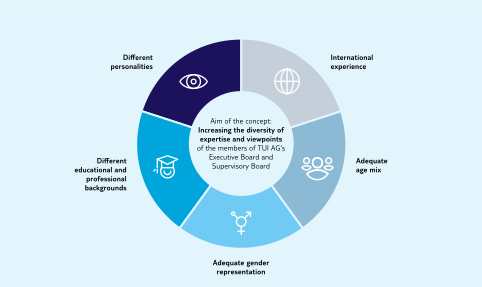
Diversity concept for the composition of the Executive Board
The following diversity concept for the composition of the Executive Board was updated in financial year 2025 and the current version is published on the company's website.
The diversity concept of TUI AG’s Executive Board aims to ensure that the composition of the Executive Board is as diverse as possible in order to contribute to sustainable corporate development. Diversity on the Executive Board ensures that different perspectives are included in decision-making processes and that innovativeness is strengthened. Diversity includes aspects such as the appropriate representation of genders and a sufficient age mix as well as different, complementary educational and professional backgrounds and experience in an international environment.
When selecting members of the Executive Board, the Supervisory Board considers the following aspects in particular:
- Personality, leadership skills and integrity of the Executive Board member.
- The members of the Executive Board should have extensive management experience, preferably gained abroad.
- The Executive Board as a whole should have extensive expertise and long-standing experience in the tourism sector.
- The Executive Board as a whole should have long-standing experience in the areas of strategy, innovation, IT and digitalisation, sustainability, sales, finance, risk management and human resources.
- With regard to gender, the Executive Board is composed of at least in accordance with the legal requirements.
- There should be a sufficient age mix among the members of the Executive Board. The age limit for members of the Executive Board as a rule coincides with the standard retirement age under the statutory pension insurance scheme.
Goals of the diversity concept for the composition of the Executive Board
Inclusion of genders in Executive Board work is on the one hand an expression of the conviction of the Supervisory Board that mixed-gender teams lead to the same or better outcomes as teams with representation from only one gender. But it is also the logical continuation of the gender diversity measures implemented by the Executive Board within the wider company, which aim to increase the proportion of women in leadership roles. These measures are only to be applied and implemented in a credible manner if the Executive Board does not consist solely of male members (‘proof of concept’).
A variety of professional and educational backgrounds is necessary on the one hand to properly address the tasks and obligations of the law, the company’s articles of association and its terms of reference. In addition, it is the view of the Supervisory Board that they are a guarantee of ensuring diverse perspectives on the challenges and associated approaches to overcoming them that are faced in the day-to-day work of the company. International management experience is of particular importance. Without such skill and experience with integrating, leading and motivating global teams, it is impossible to take into consideration the different cultural backgrounds of managerial staff and the workforce as a whole.
The standard retirement age on the one hand enables incumbent members of the Executive Board to contribute their professional and life experience for the good of the company for as long a time as possible. On the other hand, adherence to the standard retirement age is intended to promote regular rejuvenation of the board.
Implementation of the diversity concept for the composition of the Executive Board; Long-term succession planning for the Executive Board
A key aspect of applying the diversity concept to the composition of the Executive Board is inclusion of the Supervisory Board within the corporate organisation, as is prescribed by law, the company’s articles of association and its terms of reference. This ensures the Supervisory Board is familiar with the strategic, economic and actual situation of the company.
In its role as supervisor of the management of the Executive Board, the Supervisory Board of TUI AG makes decisions on the allocation of business responsibilities within the Executive Board, appointments to the Executive Board and thus also workforce and succession planning within the Executive Board in line with recommendation B.2 of the GCGC. As part of that workforce and succession planning, the Presiding Committee or the Supervisory Board itself regularly meets with the Executive Board or its members to discuss suitable internal succession candidates for Executive Board positions (short-term, medium-term and long-term scenarios). The contract terms and renewal options for current Executive Board members are discussed, as well as possible successors. As part of these Supervisory Board and Committee meetings, or in preparation for them, members of the Supervisory Board have the opportunity to meet up with so-called high potentials within the Group in a professional and personal setting. The Presiding Committee and Supervisory Board make their own deliberations about these matters and also discuss them in the absence of the Executive Board. This includes evaluation and possible inclusion of external candidates for Executive Board positions in the selection process. If needed, external consultants support the Supervisory Board in the preparation and implementation of concrete succession decisions. In all of these deliberations, the above-mentioned diversity aspects of Executive Board appointments play a part in the decision-making of the Supervisory Board. Long-term succession planning is primarily oriented towards the corporate strategy and takes into account the diversity concept defined by the Supervisory Board. The Supervisory Board also asks the Executive Board to report on current progress and implementation of family-friendly concepts and concrete measures for promotion of women (e. g. at least one woman on the final shortlist for any new or replacement appointments to roles within the senior leadership team).
Results achieved in financial year 2025
The current composition of the Executive Board meets all the requirements of the diversity concept. The Executive Board members cover a comprehensive range of knowledge and experience as well as educational and professional backgrounds and have international experience. With Ms Sybille Reiss as a member of the Executive Board, the Executive Board includes one female member. Different age groups are represented on the Executive Board. More information on all members of the Executive Board can be found in the CVs on the Company's website and in the communication on the occasion of the appointment decisions of the Supervisory Board.
Diversity concept for the composition of the Supervisory Board
The following diversity concept for the composition of the Supervisory Board was updated in financial year 2025 and the current version is published on the company's website.
The diversity concept of TUI AG's Supervisory Board aims to promote a diverse and balanced composition of the Supervisory Board. Diversity contributes to a comprehensive understanding of the company's business matters and thus supports the effective monitoring of management. In addition to aspects such as appropriate representation of genders or a sufficient age mix, diversity also includes different, complementary educational and professional backgrounds as well as experience in an international environment. In its competence profile, the Supervisory Board has defined objectives for its composition that are aimed at diversity. These include, for example, internationality and industry expertise, which entail different educational and professional backgrounds. The application of the German Employee Co-Determination Act also makes a significant contribution to the diversity of educational and professional backgrounds on the Supervisory Board. With regard to gender, the Supervisory Board is composed of at least in accordance with the legal requirements. As a rule, Supervisory Board members should not be older than 68 years when elected to the Supervisory Board. The Supervisory Board thereby aims to achieve a broad age structure within the board as a whole.
Goals of the diversity concept for the composition of the Supervisory Board; Implementation of the diversity concept for the composition of the Supervisory Board
The goals set with regard to the composition of the Supervisory Board reflect the demands placed on the advisory and supervisory body to perform its task in a globally operating company with a challenging competitive environment. For example, multicultural and international experience is just as important as knowledge of the value and success drivers of the sector. In all of this, the impact and cultural features of the so-called stakeholder approach of a social market economy must be taken into account, which is ensured by the codetermination of employee representatives on the Supervisory Board as well. For the shareholder side on the Supervisory Board, the Nomination Committee also ensures that targets are met with regard to the composition of the Supervisory Board. The Supervisory Board also undergoes a self-assessment, which includes aspects of its composition.
The Supervisory Board has complied with the requirements regarding its composition, which stipulate a minimum representation of 30% for both women and men. As of 30 September 2025, women made up 45% of the Supervisory Board.
The selection of new Supervisory Board members is carried out in accordance with the statutory requirements of the German Stock Corporation Act and taking into account the recommendations of the GCGC. In this context, the Supervisory Board’s adopted competence profile and diversity concept are also considered to ensure a balanced composition of the board – in terms of professional qualifications as well as diversity, experience, and independence.
The Nomination Committee of the Supervisory Board is involved in preparing election proposals for the Annual General Meeting and for court appointment. As part of this process, the committee assesses the suitability of potential candidates based on the overall skills profile and the target profile for the composition of the Supervisory Board. Potential conflicts of interest are also carefully reviewed.
The recommendations of the GCGC for a transparent and comprehensible nomination process are observed. The overarching goal is to ensure effective oversight and strategic advice to the Executive Board by means of a Supervisory Board that is appropriately and competently composed, thereby supporting the Company’s long-term development.
Results achieved in financial year 2025
The Supervisory Board is of the opinion that it meets the composition targets and fills out the competence profile and the diversity concept. The status of implementation of the competence profile, diversity concept and composition targets has been published in the form of a qualification matrix.
The competence profile of TUI AG’s Supervisory Board is published at https://cdn.sanity.io/files/b6xulh2p/production/adb455985fe61e31f7e159bb396fb3c729cd87aa.pdf
Please see the Qualification matrix for further details.
The diversity of professional and educational backgrounds of the individual members of the board is also evident from the CVs of Supervisory Board members published on the corporate website.
https://www.tuigroup.com/en/investors/corporate-governance/management-information
Description of the main features of the internal control and risk management system
TUI Group's internal control system comprises all systematically designed rules within the Group that serve to methodically manage operational, financial and compliance-related risks. These rules may result from published statements or take the form of policies, work instructions, process descriptions or risk control matrices. A Group-wide framework is in place for the creation, approval, revision and communication of rules. With its Integrity Passport, TUI Group commits to implementing its Group-wide Code of Conduct that sets minimum standards and provides guidance on how to deal with ethical and legal challenges in day-to-day work, and provides orientation for conflict situations.
On that basis, the business units define an appropriate framework of processes and rules where necessary for the criticality of the process in question. These rules may vary from business unit to business unit as the process of processing the transactions involves different systems, workflows or volumes. For certain risks, addressed through a uniform Group framework, TUI has established central functions, operating as a “second line” for their area, in order to create appropriate Group-wide standards and support or monitor implementation of these standards.
A Group function has also been established for the area of sustainability. For years, TUI Group has collected certain sustainability-related indicators for management and reporting purposes in the framework of separate sustainability reports or the non-financial statement. A reporting software specifically introduced for environmental non-financial data points allows a sufficiently disaggregated and secured recording of information and builds the foundation of the sustainability related internal control system.
Further explanations are provided in the Non-financial declaration in section Risk management and internal control system in relation to the sustainability reporting process (GOV-5)
To ensure that our businesses are scalable, almost all business processes are supported by IT solutions. Where possible and appropriate, we use the controls integrated in these applications or services. This offers greater security and efficiency in implementation compared with manual controls. The IT solutions themselves are protected by a Group-wide framework of general IT controls. The internal control system is completed by a set of manual process controls to prevent or detect errors.
We have a clear approach for identifying and mitigating information security risks. TUI undergoes external auditing, has an IT security risk insurance policy in place and provides a training and compliance programme. The Executive Boards sees that the Audit Committee is regularly updated above TUI’s risk position on this topic.
In the case of business processes, the respective process owners are responsible for the effectiveness of the controls put in place; in the case of Group-wide control frameworks, the respective second line is responsible. Depending on the risk assessment, they use a different degree of monitoring intensity.
As an independent third line, Internal Audit reviews business processes, including IT solutions, according to its own risk assessment and provides recommendations to enhance the effectiveness and efficiency of processes and controls.
The Supervisory Board of TUI AG, in particular the Audit Committee, is involved in TUI Group's internal monitoring system with process-independent auditing activities.
Our Risk report presents the key elements of our risk management system.
The internal control system and the risk management system are dynamic systems that are continuously adapted in response to changes in the business model, the nature and scope of business transactions or responsibilities. As a result, there is potential for improvement in terms of both the appropriateness (lack of suitable controls) and the effectiveness (inadequate execution) of controls, both from the reviews carried out by the second line, from internal audit engagements, and from the audit activities of the external auditor. In addition, potential for improvement may also arise from compliance incidents. In our overall assessment of these management systems, we find that none of the potential improvements identified in the period under review speak against the appropriateness and effectiveness of the two management systems. However, there can be no absolute certainty, despite the internal control and risk management systems in place, that the controls will detect every single process weakness or, in particular, that newly emerging material risks will always be immediately identified and effectively addressed.
TCFD index
TUI AG has structured its climate-related reporting in line with the recommendations of the Task Force on Climate-related Financial Disclosures (TCFD) in the past two financial years. This structure has established itself as an internationally recognised framework and is actively sought after by investors, rating agencies and other stakeholders.
With the introduction of the Corporate Sustainability Reporting Directive (CSRD) and the European Sustainability Reporting Standards (ESRS), TUI AG has further developed its reporting. The ESRS standards largely integrate the TCFD recommendations, particularly in the ESRS E1 ‘Climate Change’ standard.
To increase transparency and comparability, the existing TCFD structure will continue to be used. A reference matrix shows how the individual TCFD recommendations are assigned to the corresponding ESRS passages. This ensures that both regulatory requirements and international expectations are met.
| Reference TCFD - Non-financial Declaration | ||
|---|---|---|
| Recommended Disclosure | Reference Annual Report 2025 (Combined non-financial declaration of TUI Group) | |
| Governance | a. Describe the board’s oversight of climate-related risks and opportunities |
GOV-1 – The role of the administrative, management and supervisory bodies; GOV-2 – Information provided to and sustainability matters addressed by the Company's administrative, management and supervisory bodies |
| b. Describe management’s role in assessing and managing climate-related risks and opportunities |
ESRS 2 GOV-1 – The role of the administrative, management and supervisory bodies; ESRS 2 GOV-3 – Integration of sustainability-related performance in incentive schemes; ESRS 2 GOV-3 E1 – Integration of sustainability-related performance in incentive schemes; ESRS 2 GOV-2 – Information provided to and sustainability matters addressed by the Company's administrative, management and supervisory bodies; ESRS 2 IRO-1 – Description of the process to identify and assess material impacts, risks and opportunities |
|
| Strategy | a. Describe the climate-related risks and opportunities the organization has identified over the short, medium, and long term |
ESRS 2 IRO-1 – Description of the process to identify and assess material impacts, risks and opportunities; ESRS 2 SBM-3 – Material impacts, risks and opportunities (IROs) and their interaction with strategy and business model; |
| b. Describe the impact of climate-related risks and opportunities on the organization’s businesses, strategy, and financial planning |
ESRS 2 SBM-3 – Material impacts, risks and opportunities (IROs) and their interaction with strategy and business model; ESRS E1-1 – TUI Group decarbonisation roadmap; ESRS E1-2 – Management approach (Management of the impacts from CO2e emissions from own operations and the value chain, Management of risks from impacts of climate change and climate change adaptation); ESRS E1-3 – Actions (TUI Airline, Cruises, Hotels & Resorts, TUI Musement); ESRS E1-4 – Targets (TUI Airline, Cruises, Hotels & Resorts); ESRS E1 SBM-3 – Material impacts, risks and opportunities and their interaction with strategy and business model |
|
| c. Describe the resilience of the organization’s strategy, taking into consideration different climate-related scenarios, including a 2°C or lower scenario |
ESRS 2 SBM-3 – Material impacts, risks and opportunities (IROs) and their interaction with strategy and business model; ESRS E1 SBM-3 – Material impacts, risks and opportunities and their interaction with strategy and business model |
|
| Risk Management | a. Describe the organization’s processes for identifying and assessing climate-related risks | ESRS 2 IRO-1 – Description of the process to identify and assess material impacts, risks and opportunities; |
| b. Describe the organization’s processes for managing climate-related risks |
ESRS E1-2 – Management approach (Management of the impacts from CO2e emissions from own operations and the value chain, Management of risks from impacts of climate change and climate change adaptation); ESRS E1-3 – Actions (TUI Airline, Cruises, Hotels & Resorts, TUI Musement); ESRS E1-4 – Targets (TUI Airline, Cruises, Hotels & Resorts); ESRS E1-1 – TUI Group decarbonisation roadmap; ESRS E1 SBM-3 – Material impacts, risks and opportunities and their interaction with strategy and business model |
|
| c. Describe how processes for identifying, assessing, and managing climate-related risks are integrated into the organization’s overall risk management | ESRS 2 GOV-5 – Risk management and internal control system in relation to the sustainability reporting process | |
| Metrics and targets | a. Disclose the metrics used by the organization to assess climate-related risks and opportunities in line with its strategy and risk management process |
ESRS E1-6 – GHG-Emissions; ESRS E1-3 – Actions (TUI Airline, Cruises, Hotels & Resorts, TUI Musement); ESRS 2 GOV-3 – Integration of sustainability-related performance in incentive schemes; ESRS E1-1 – TUI Group decarbonisation roadmap; ESRS E1-4 – Targets (TUI Airline, Cruises, Hotels & Resorts); |
| b. Disclose Scope 1, Scope 2, and, if appropriate, Scope 3 greenhouse gas (GHG) emissions and the related risks | ESRS E1 E1-6 – GHG-Emissions | |
| c. Describe the targets used by the organization to manage climate-related risks and opportunities and performance against targets |
ESRS E1-4 – Targets (TUI Airline, Cruises, Hotels & Resorts); ESRS E1-1 – TUI Group decarbonisation roadmap; |
|