

Interview with Sebastian Ebel
“We are opening up new source markets all over the world.”TUI is so much more than a conventional tour operator. We cater for the entire value chain in tourism and now we intend to position the company as a platform-based leisure brand. Artificial intelligence will drive this – and so will the trust our customers place in the products and services we offer.
Mr Ebel, how do you measure the success of the TUI Group?
Our course is clear: TUI is committed to sustainable, profitable and global growth in all areas. We delivered on this in the past financial year. TUI had a successful year in a challenging environment. And we will maintain our focus for 2026 as well.
People value their holidays and the experiences they bring. With TUI, they are placing their trust in a strong and well-known international brand that stands for quality, service and unique holiday experiences. We create the best time of the year for our guests. Our teams do everything they can to justify our guests' trust, from providing advice in travel agencies to our hotels and ships to the service at the holiday destination.
We are growing strongly, particularly in the Holiday Experiences business segment – our hotels, cruises and our excursions and experiences. Our hotel portfolio is growing in all parts of the world. In China and South-East Asia alone, we now have 24 hotels under our own brands, with 29 more planned. We see further growth potential in Africa. We already have a strong presence in North Africa with our hotel brands, but are now also expanding our clusters in West and East Africa, for example with the first TUI Blue in Gambia and further RIU and Jaz resorts in Zanzibar. At the same time, we are also looking to the Americas. Here, we want to attract new guests from the region to our holiday experiences with new hotel projects. This also reduces the seasonality of our business. This clearly shows that TUI is growing globally.
The Markets + Airline business unit is undergoing a transformation: we offer our own products via our global platforms, ensuring good utilisation of our assets. We are tapping into new source markets, making TUI less dependent on our traditional markets in Europe. This means we are reaching additional customer groups in other parts of the world who are already familiar with our brand: guests from Asia, South America, Southern Europe and Eastern Europe. This is part of our growth strategy.
And finally, you can also see it in the balance sheet: we have significantly reduced our debt further and are well positioned after challenging pandemic years.
Where does the growth in the holiday experiences segment come from?
The Holiday Experiences segment encompasses hotels, including our strong brands Robinson, Riu, TUI Magic Life and TUI Blue, Jaz, The Mora and Royalton. But it also encompasses cruises, including TUI Cruises and Hapag-Lloyd Cruises, our Marella fleet in the UK and TUI Musement, which focuses on excursions, activities and transfers.
I have already talked about hotel growth. It is great to see that our hotel brands are generating demand across all customer segments worldwide, while at the same time average customer satisfaction is exceptionally high. We already have 70 more hotels in the growth pipeline – these are firmly signed.
Demand for cruises also remains strong. With Mein Schiff Relax, we introduced a new class of ship last year, and guest feedback has been very positive. Its sister ship, Mein Schiff Flow, will arrive in June 2026. With 19 cruise ships in our fleets, the success story in this area continues. Incidentally, two more ships have already been ordered for 2031 and 2032.
Musement also sold 10.6 million excursions for the first time last year. The local teams, combined with our digital service offering, guarantee strong customer retention and high loyalty.
TUI wants to become a Global Curated Leisure Marketplace – what does this strategy entail?
We are already much more than a traditional tour operator. We cover the entire tourism value chain – from travel agencies to airlines, cruise ships and hotels, and of course the experiences on site. Each brand has its own distinctive core; these brands and products are our calling card to our guests.
Our goal is to position TUI as a leisure brand: our own exclusive and differentiated products, such as our hotel and cruise brands, represent TUI and have loyal customers. We combine these proprietary products with strong offerings from third-party providers, distributed globally via shared platforms. This approach helps us to broaden the TUI brand: in future, customers will no longer associate the name TUI only with their annual holiday, but also with city breaks, leisure activities, individual excursions or charging electric vehicles. We already offer this today at hotels and at the TUI Campus in Hanover. The wider selection will make us relevant to more customers.
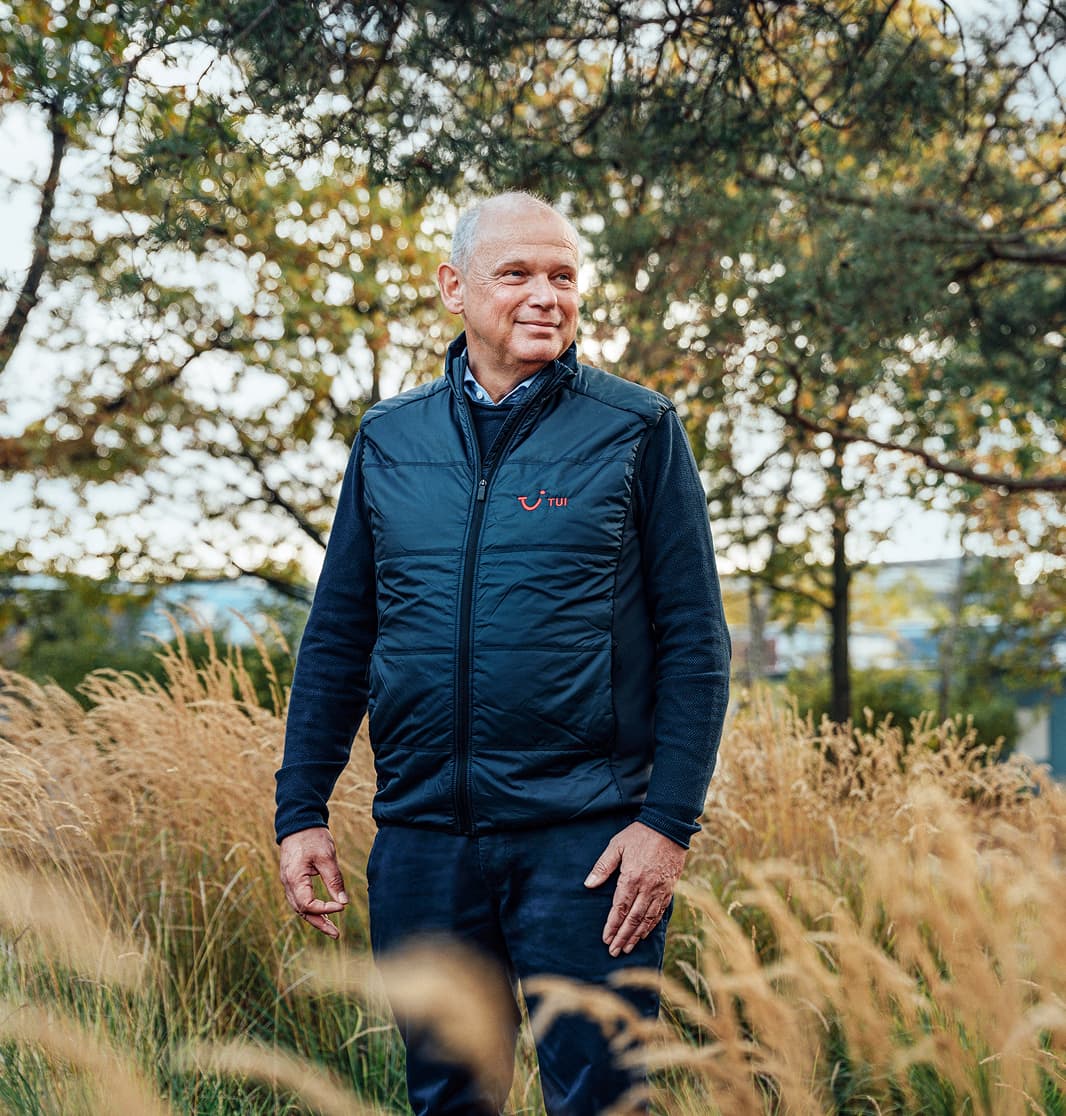
“We are already much more than a traditional tour operator.” Sebastian Ebel, CEO of TUI AG
What role will artificial intelligence play in tourism?
For us, AI is not a topic for the future, but already a real turbocharger for TUI today: whether it's personalised offers, dynamic pricing, more efficient processes in airlines and hotels – or in the TUI app. We rely on AI to help our customers travel better and us work even better. The development and introduction of generative AI is fundamentally changing the travel industry. TUI's strategy focuses on making our content both “AI-visible” and “AI-bookable” in order to benefit from this change.
And let me be clear: personal advice is and will remain important. We benefit from the strong travel sales of travel agencies. In addition, we also cooperate with AI platforms such as Mindtrip, which issue personal recommendations and then make them bookable via TUI.
Can AI replace travel agencies in the long term?
A resounding no. For TUI, the importance of travel agencies is not diminishing. Customers often book very high-quality trips at travel agencies, and they do so very early on. We have around 1,200 of our own travel agencies throughout Europe and many thousands more TUI agencies and mobile travel consultants. Most recently, for example, we opened our first TUI shop in Mexico; our customers appreciate the convenience and proximity.
Brick-and-mortar sales are an important pillar of our business. Travel agencies are part of our success story – that is the case now and will remain so in the future. Qualified advice and the experience of travel experts are valuable to guests and to us. Our travel agencies stand for quality, competence, service and trust. People and AI work together. They are not mutually exclusive.
Incidentally, our employees rate our approach very positively: in our latest employee survey, we achieved top marks for employee engagement and participation rates.
TUI has been growing since the end of the pandemic and has even raised its guidance for the past financial year. What drivers made this possible?
First and foremost, of course, our colleagues in more than 100 countries around the world. They are the face of TUI, accompanying our customers from the moment they book to the moment they return from their holiday. This is made possible by our unique integrated business model, which covers the entire tourism value chain. With more than 450 hotels under the TUI hotel brands, we are the largest holiday hotel company internationally. Our tour operators are a strong sales force and ensure high occupancy rates. This shows how well both business areas work together and create value within the TUI ecosystem.
Another success factor is our strict cost and financial policy in recent years. The major levers this year are the strong earnings contributions from our own products – i.e. Hotels & Resorts, Experiences and Cruises – plus consistent yield management in the tour operator and airline business. We have also tapped into new customer markets and segments.
Since the pandemic, we have met or exceeded our forecasts year after year. We want to continue growing in the coming years and have set ourselves the goal of increasing earnings by an average of seven to ten per cent per year – even in the current difficult market environment. We deliver reliably. That is very important to us as a team.
Regarding the strategic partnership with Oman: What exactly are destination clusters – and how does Oman fit in?
Destination clusters are regions that we develop with our various hotel brands and in which we manage flights, hotels and experiences together – with high efficiency and outstanding customer satisfaction.
Successful examples from the past can be found in North, West and East Africa – including Cape Verde and Zanzibar – but also in the Caribbean. Oman will be a new cluster for us – and the example of Oman shows why TUI is a unique development partner for destinations.
Starting in winter 2028, we will jointly open five hotels in the Dhofar region, bring cruise guests from our three companies Mein Schiff, Hapag Lloyd Cruises and Marella, and offer excursions. We jointly own the property company, and TUI operates the hotels: a Riu hotel, a Robinson Club, a TUI Blue hotel, and hotels of the Jaz and The Mora brands. Not only can we build and manage hotels, we can also ensure high occupancy rates. Oman recognises the potential. At the same time, the Omani development company OMRAN is becoming a long-term shareholder in TUI – this will generate growth outside the traditional markets. They are investing at €9.50 per share, which is more than the current stock market price. We have already proven how successful this approach is in many regions of the world – and have created thousands of local jobs as a result.
What global uncertainties remain – is TUI resilient?
Of course there are challenges: geopolitics, extreme weather, fuel and currency risks. But we are now more robust, less seasonal and able to react quickly: our corporate structure is more diversified, we have good platforms and we manage capacity flexibly – this makes us more resilient in the face of competition. We can build on this for the future.
TUI also focused on its balance sheet last year – a convertible bond was repaid early...
Absolutely. We repaid the 2021 convertible bond ahead of schedule, which reduces our interest burden, improves our debt situation and gives us more flexibility for investments. This is also underlined by the increased credit ratings from all major rating agencies in the last financial year. Growth is only possible with financial strength.
“Growth is only possible with financial strength.” Sebastian Ebel, CEO of TUI AG
What role does sustainability play in TUI's strategy?
Sustainability is not a nice-to-have for us – it is part of our DNA. We have set ourselves ambitious targets – for example, to reduce CO₂ emissions in hotels by half by 2030 compared to 2019, ideally much more. We invest in technology, energy efficiency and local partners – because it also makes economic sense. Projects such as our solar farms in Turkey are clearly a business case, as we can supply our hotels nationwide with sustainable electricity – we now operate such solar parks in many destinations. TUI is active on a broad front: in 2025, for example, we were able to reduce single-use plastic per guest night by 19 per cent and used bio-LNG for the TUI Cruises fleet for the first time. We were awarded the top grade of A for the first time in the renowned CDP climate ranking. Our ambitious emission targets are, of course, reviewed by the Science Based Targets Initiative. This also underlines that we are serious about our commitment.
“Sustainability is not a nice-to-have for us – it is part of our DNA.” Sebastian Ebel, CEO of TUI AG
TUI is increasingly cooperating with other well-known lifestyle brands such as smart and Hummel – and now sponsors sporting events. What is behind this? And what else can we look forward to in 2026?
Such partnerships open up new worlds for us: with smart, for example, we are focusing on e-mobility and charging infrastructure for our guests – and smart customers can get the TUI edition of an electric vehicle.
Cooperation such as with Hummel – we are designing a joint collection and are jointly involved in 6-a-side small-field football – links the brand, travel offers, experience and reach. This is a goal that we will continue to pursue in 2026.
TUI is a very well-known brand, but it needs to become more emotional. A good example of this is the TUI Marathons. TUI is the title sponsor of marathon events around the Mediterranean – so far in Rhodes, Cyprus and Mallorca. This connects guests and locals of all generations, extends the season and allows us to sell additional trips to sports enthusiasts. We are seeing growth rates of up to 35% year-on-year among runners, and we sold out early in Mallorca. We will continue to pursue this approach.
In short, we can further expand our range of leisure and experience offerings. Ultimately, this is a win-win-win situation: for our customers, our partners and TUI itself.