

Material impacts, risks and opportunities (IROs) and their interaction with strategy and business model (ESRS 2, SBM-3)
The table below provides an overview of the results of our double materiality assessment of material impacts, risks and opportunities for issues relating to consumers and end-users.
| G1 Business conduct | ||||
|---|---|---|---|---|
| Subtopic | Impact / Risk / Opportunity | Time horizon | Position | Description |
| Corporate culture | Opportunity | Short-, medium- and long-term | Own operations | A strong Integrity & Compliance culture can help to promote people’s commitment and motivation, recruit and retain highly qualified talents and reduce risks and costs arising from breaches of rules. |
| Political influence and lobbying activities | Positive impact | Medium- and long-term | Own operations | TUI’s transparent and registered political engagement and lobbying in the tourism sector includes the promotion of specific political measures, rules or interests shaping tourism in the long run. |
| Whistleblower protection | Risk | Short-, medium- and long-term | Own operations | Infringements of the German Whistleblower Protection Act and the EU Directive on the Protection of Persons who Report Breaches of Union Law can result in fines, publication of confidential information and reputational damage. Appropriate protection can strengthen stakeholders’ trust. |
| Anti-corruption and anti-bribery | Positive impact | Short-, medium- and long-term | Own operations | Preventive measures and anti-corruption and anti-bribery rules contribute to an ethical and transparent business model. |
TUI’s ambition is to be a role model for responsible governance in the tourism sector. Integrity, legally compliant behaviour and transparency towards stakeholders such as guests, employees, business partners and investors are key elements of our corporate culture, contributing significantly to our reputation and our goal of securing the long-term success of our business.
For these reasons, TUI’s Compliance Management System aims to promote integrity and prevent potential misconduct, to make liability risks manageable for TUI and its employees, avoid penalties and fines, and thus protect the Company's reputation. Integrity & Compliance is a fundamental component in TUI’s governance structure and is supported by corresponding processes and control mechanisms across the Group.
Our actions to promote legally compliant and ethically responsible business practices include, in particular:
- Advising employees on core compliance issues such as sanctions, corruption, bribery, and fair competition
- Performing risk analysis on these core compliance topics
- Raising awareness of Integrity & Compliance through communication campaigns
- Providing training programmes
- Implementing actions to ensure acting in accordance with our commitment to integrity as set out in our Integrity Passport – the TUI Code of Conduct
- Ensuring the necessary exchange of information between local management and the Integrity & Compliance team
- Reporting regularly to the Group Executive Committee and the Audit Committee of the Supervisory Board
Managing business conduct (G1-1)
Compliance Management System
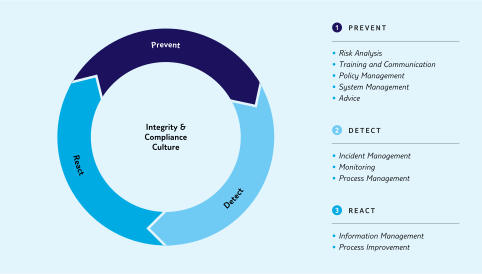
TUI Group’s Compliance Management System is based on a risk management approach. It is built around three pillars: prevent, detect and react, which in turn, comprise a variety of measures and processe . Our Compliance Management System defines pilot and standard operation and the documentation of roles, responsibilities and processes in these areas. The focus of our work is on preventive risk management in order to identify potential infringements of laws, rules or internal policies early on and to systematically rule them out. The core areas of the Compliance Management System are anti-corruption, fair competition and trade sanctions.
The system applies across TUI AG and all companies majority-owned, directly or indirectly, by TUI AG, whether domestic or foreign, and any other shareholdings where management control directly or indirectly lies with TUI AG (‘Managed Group Companies’). Implementation of the Compliance Management System is recommended for companies where the management control does not lie with TUI AG (‘Non-Managed Group Companies’).
Integrity & Compliance Structure
The Chief Compliance Officer, who reports directly to the Chief People Officer and Labour Director on the Executive Board, is responsible for drawing up, maintaining and developing the Compliance Management System. He is supported by the central Integrity & Compliance department, forming part of Legal, and its Group Director. The Group Director is responsible for designing and improving the Compliance Management System with the support of a team. Dedicated operational Compliance Officers exist for all regions and segments of TUI Group. They are in close contact with local management, who remain responsibile for observing all Compliance rules in the respective Group company.
Managing the impacts, risks and opportunities
TUI Group addresses the following topics in its management approach:
- Strategies in relation to business conduct policies and corporate culture
- Whistleblower protection
- Political influence and lobbying activities
- Prevention and detection of corruption and bribery
Management approach 1: Strategies in relation to business conduct policies and corporate culture
(IRO-1)
Our Integrity & Compliance culture is a fundamental component in our ambition to be a role model for responsible governance in the tourism sector. It influences the behaviour of our employees and their attitude toward complying with applicable rules. Our culture is based on our corporate values and the fundamental attitude and behavior of our managers - from management to the Executive Board and Supervisory Board of TUI AG (‘tone from the top’). It is expressed, in particular, in our corporate value ‘Trusted’, which appeals to our employees’ personal responsibility and their honesty and sincerity in handling guests, fellow employees and other stakeholders. TUI’s understanding of Compliance extends beyond respecting laws and regulations, as we shift our Company’s culture away from a purely rule-based approach towards a living culture of integrity. It is the responsibility of the TUI Group's management bodies to stipulate and monitor legally compliant conduct in exercising our business activities and in handling employees.
TUI is a signatory to the UN World Tourism Organisation (UNWTO) Global Code of Ethics and prohibits any form of bribery or corruption including kickbacks, creating a framework for ethical business conduct. These values are anchored in our Integrity Passport and are additionally passed on to our suppliers through the contractual inclusion of the Supplier Code of Conduct, which requires them to comply with international anti-corruption conventions and national anti-corruption regulations, such as the provisions of the UN Global Compact, the UK Bribery Act 2010, and the US Foreign Corrupt Practices Act 1977.
Through its Integrity & Compliance culture, TUI promotes ethical and sustainable behaviour beyond its own business activities, extending it into the supply chain and the entire tourism sector.
Management approach 2: Whistleblower protection
The whistleblower system is a key element of responsible governance at TUI. That is why TUI offers employees across the Group the opportunity to report suspected infringements of laws, environmental or human rights-related due diligence obligations or the principles anchored in the Integrity Passport anonymously and without reprisals. In order to protect whistleblowers from negative consequences, TUI has established internal rules, which are stipulated in the Integrity Passport and the Group Works Agreement on the Whistleblower System. In accordance with the requirements of the German Supply Chain Due Diligence Act and the EU Whistleblowing Directive, the system is also open to external parties outside TUI Group. It is provided by an independent third party and available worldwide. Encryption software ensures that any reports submitted remain anonymous. Access to the electronic whistleblowing system is available to all employees on the intranet. Information for third parties is provided on TUI’s website (https://www.tuigroup.com/en/whistleblowing). In addition, a mailbox is available for e-mail submissions (compliance@tui.com), providing a channel for direct contact with the Integrity & Compliance team.
Incoming reports are consistently followed up in the interests of all stakeholders and the Company. TUI’s top priority is to ensure confidentiality and handle information discreetly to protect whistleblowers. All reports from the whistleblower system and the email inbox are picked up by the Integrity & Compliance Team and, depending on the facts of the case, investigated and processed in consultation with various departments. . The individuals entrusted with conducting proceedings, including those relating to incidents in connection with the management, are generally required to be impartial, independent, and not bound by instructions, as well as to maintain confidentiality, ensuring that the investigators are separate from the management chain. Further details on the handling of whistleblowing are set out in the rules of procedure, which are available on the local intranet and on TUI’s website (https://www.tuigroup.com/en/whistleblowing). Personal data submitted to us via the electronic whistleblowing system are treated in accordance with our data retention requirements. Mandatory training and ongoing communication measures serve to ensure that employees are aware of the whistleblowing system.
Information from the whistleblowing system is included in the quarterly report to the Group Executive Committee and the annual report to the Audit Committee.
Management approach 3: Political influence and lobbying activities (G1-5)
In the framework of its lobbying activities, TUI advocates aspects related to sustainable tourism, aiming to create a positive impact on the global tourism market. In implementing these activities, TUI pursues ethical practices and ensures transparency in order to uphold public confidence and prevent corruption. Moreover, TUI does not give any – financial or non-financial – contributions to policymakers. As there are no specific directives dealing exclusively with lobbying and political engagement, it is crucial to ensure that all employees respect the values anchored in the Integrity Passport and are familiar with the internal Group Policies on Gifts and Hospitality and on Fair Competition in order to ensure transparency and integrity in TUI’s business operations.
Overall, TUI Group’s strategic targets and ambitions relating to political engagement and lobbying activities focus on maintaining integrity, transparency and ethical business practices as well as protecting TUI Group’s reputation and shareholder confidence.
Implementation of these principles and TUI Group’s strategic direction are primarily driven by the representatives of its administrative, management and supervisory bodies. None of the members of TUI’s administrative, management and supervisory bodies held a position in public administration or with regulators in the two years preceding their appointment.
TUI is listed in the lobbying registers for Germany and the EU. This registration enhances transparency and enables TUI to contribute actively towards designing sustainable, responsible tourism policies.
Information on the lobbying registers is also publicly available on our website https://www.tuigroup.com/en/policy
| Lobby register | ||
|---|---|---|
| Register | Name | Register number |
| EU-Transparency Register | TUI AG | 654909925315-71 |
| Lobby Register of the German Bundestag | TUI AG | R001264 |
TUI Group’s political and lobbying activities are aligned to specific legislative processes and regulatory requirements in the source markets and destinations. Although there is no overall, measurable target for these activities, they create many different opportunities to reinforce the Company’s positive impact in a targeted manner. Balanced political engagement can support the development and implementation of national and regional policies and regulations in the EU. In this way, TUI helps to create a beneficial business environment and actively drive the sustainable development of the tourism sector further ahead.
This strategic alignment is also reflected in a number of lobbying activities pursued by TUI in contributing actively towards shaping sustainable tourism policies:
Alternative fuels
TUI calls for an accelerated use of alternative fuels (such as bio-LNG in the cruising sector) by setting effective incentives for airlines and cruise lines.
Blending quotas
TUI supports blending quotas for sustainable fuels (SAF), but calls for support measures for producers and political pressure to promote blending quotas outside the EU.
Accelerating shore power supply systems
TUI calls for faster global expansion of infrastructure to supply large cruise liners with shore power in port and for the formulation of strategies for green electricity.
Implementing uniform PtL blending quotas within the EU (Germany)
TUI calls for the abolition of the strict blending quota for Power-to-Liquid (PtL) fuels applicable in Germany from 2026, which goes beyond the quotas applicable within the EU.
Reforming the Single European Sky
TUI calls for Single European Sky (SES) reforms to be pushed ahead by the EU Commission.
Transparency and comprehensive customer information
TUI calls for clear and transparent rules and conditions for package tours and an obligation for online platforms to proactively inform their customers in clear language about the scope of protection when they make a booking or purchase individual services.
Management approach 4: Prevention and detection of corruption and bribery (G1-3)
TUI Group pursues a comprehensive, uniform zero-tolerance approach to corruption and bribery, which is applied consistently across TUI Group’s regions and segments. TUI has introduced processes and actions designed at helping to prevent and detect corruption and bribery.Appropriate Group Policies have been implemented that focus on the prevention of corruption and bribery and promote compliant behavior by providing guidance on how to deal with the most important legal and integrity issues in day-to-day work practice, hence contributing to fair and legally compliant conduct in business operations. This approach is manifested in the Integrity Passport and the Supplier Code of Conduct. Both documents set out the general principles of integrity and ethical behaviour expected from all employees and suppliers. They expressly prohibit any form of bribery and other forms of corruption, including ’grease payments’. They also explain where suspected infringements can be reported and provide links to the TUI Speak Up Line, enabling people to report incidents anonymously.
TUI SpeakUp Line (https://secure.ethicspoint.eu/domain/media/en/gui/112626/index.html)
The Integrity Passport, the Supplier Code of Conduct and all Group Policies are approved by the Executive Board. Group Policies are binding for all employees in Managed Group Companies.
Information for employees is available on the intranet or on the corporate website at (https://www.tuigroup.com/en/compliance and https://www.tuigroup.com/en/responsibility-and-positions/humans-rights).
In addition, information for external third parties is available on TUI Group’s website at (https://www.tuigroup.com/en/compliance and https://www.tuigroup.com/en/responsibility-and-positions/humans-rights).
The Group Policy on Gifts and Hospitality, too, sets out detailed guidance on when giving and receiving gifts and hospitalities can be considered appropriate. It emphasizes the importance of transparency by stipulating that gifts and hospitalities are to be documented in the Gifts and Hospitality Register and formulating the requirement that prior approval must be obtained for gifts and hospitalities involving public officials.
Moreover, Integrity & Compliance provides a ‘compliance clause’ for inclusion in agreements and contracts. The clause contains the above-mentioned anti-corruption and anti-bribery obligations and passes them on to our suppliers.
In addition, managers and directors are surveyed annually about conflicts of interests to ensure that potential conflicts are made transparent and can be resolved if necessary.
At regular intervals, a risk analysis is carried out at selected TUI Group companies, covering topics such as corruption and bribery. The results of these analyses are discussed with the responsible management, and risk-mitigating actions are derived and implemented.
Reports of potential incidents of corruption and bribery are investigated in cooperation with other relevant departments. Findings from the investigations are used to enhance the Compliance Management System, adjust the relevant processes and thus prevent systemic misconduct. The results of the investigations are regularly reported to the Group Executive Committee and the Supervisory Board by the Group Director Audit.
The online training programme on the Integrity Passport, which explains integrity and the underlying corporate values, is mandatory for all employees. The topics of anti-corruption and the appropriate handling of gifts and invitations are also addressed in order to raise risk-oriented awareness of the respective challenges. For the recipients refresher training is mandatory two years after completion. Information on completion rates in the training is included in the quarterly report to the Group Executive Committee and the annual report to the Audit Committee.
Apart from training programmes, TUI also uses other communication formats to convey the importance of Compliance. These formats include articles, short videos and information material provided via the Integrity & Compliance website on the Group’s internal intranet.
The Compliance Management System is regularly audited by the Group Audit department. The audit findings contribute to the further development and improvement of the Compliance Management System.
All measures, including those relating to the prevention and detection of corruption and bribery, are regularly reported to the Group Executive Committee and the Audit Committee of the Supervisory Board and are discussed at the meetings of the Group Risk Oversight Committee.
The greatest risks are faced by key management personnel and employees working in the destinations (Around 89% of employees are addressed by the Integrity Passport training programme; it is not offered to pilots and cabin crew.)
In the completed financial year, there were no incidents of corruption or bribery leading to a conviction or fine.
Due to a lack of reliable benchmarks and measurable performance indicators, it is currently not possible to define any specific targets. We continually work towards developing meaningful KPIs and integrating them in the reporting. We are committed to consistently complying with legal requirements and internal policies in order to detect risks early on and avoid potential infringements that might harm the Company.