

General basis for preparation of the non-financial declaration (BP-1)
This non-financial declaration was prepared on a consolidated basis for TUI Group as a whole. The scope of consolidation applied by TUI is the same as for the consolidated financial statements. This non-financial declaration therefore comprises TU AG and all subsidiaries included in consolidation.
For further information, please refer to the section Principles and methods of consolidation in the Notes
Climate change-related disclosures additionally included TUI Cruises as a joint venture between TUI AG and Royal Caribbean Cruises Ltd. in relation to the targets. Reference to the inclusion is provided in the relevant sections. All disclosures in this statement refer to financial year 2025, i.e. the period from 1 October 2024 to 30 September 2025. In preparing the non-financial declaration, both the upstream and downstream value chains were included in the analysis of material impacts, risks, and opportunities, as well as in the identification of relevant management approaches, actions and targets. The impacts, risks, and opportunities arising from the double materiality assessment in relation to the value chain are presented in the sections dealing with the relevant topics in this statement.
TUI has not omitted any information relating to intellectual property, know-how, or the results of innovation. Furthermore, TUI has not made use of the exemption from disclosure as provided for in articles 19a (3) and 29a (3) of Directive 2013/34/EU, which relates to future developments or matters.
The non-financial declaration was based on application of part of the European Sustainability Reporting Standards.
For further information on the scope of application, please refer to the section Disclosure requirements included in ESRS and covered by TUI Group’s Non-financial declaration (IRO-2).
Disclosures in relation to specific circumstances (BP-2)
Application of targets and metrics in the section Climate change (E1)
In section ESRS E1-6 TUI uses the same scope of consolidation for Scope 3 calculations as for Scopes 1 and 2. All emission categories are calculated using recognised methods in accordance with the Greenhouse Gas Protocol's Corporate Value Chain (Scope 3) Standard, primarily using the spend-based and average value methods. To improve accuracy and data quality, TUI is working to continually increase the use of primary data. The scope of the Science Based Targets (SBT), as specified in section ESRS E1-4, differs from the scope of consolidation of the metrics specified in ESRS E1-6. For TUI Airlines, the ESRS and SBT scope are aligned. For Cruises, TUI Cruises (Mein Schiff and Hapag-Lloyd fleets) remain in scope for SBT but are considered out of scope for ESRS. Marella Cruises remain in scope for SBT and are also included in scope for ESRS. TUI River Cruises are out of scope for SBT (not operational in 2019 base year) but are included in scope for ESRS. For Hotels the SBT scope remains unchanged (owned, managed and leased hotels in the TUI Hotels & Resorts portfolio) but hotels that do not align with the financial consolidation approach are out of scope for ESRS reporting.
Reporting in accordance with TCFD (Task Force on Climate-related Financial Disclosures)
Over the past two financial years, TUI AG’s climate-related disclosures were reported in accordance with the recommendations of the Task Force on Climate-related Financial Disclosures (TCFD). That reporting structure has become a globally recognised framework actively requested by investors, rating agencies and other stakeholders.
In 2025, TUI AG developed its reporting further with its first-time application of the European Sustainability Reporting Standards (ESRS) as the framework for its non-financial declaration. The Standards, in particular ESRS E1 Climate Change, largely reflect the TCFD’s recommendations.
The TCFD Index reference matrix in the Corporate governance report assigns the individual TCFD recommendations to the corresponding passages in the Standards, ensuring compliance with both regulatory requirements and international expectations.
The first-time application of the CSRD in financial year 2025 resulted in changes in the presentation of sustainability disclosures versus previous years’ reporting.
In 2023, a climate risk analysis was carried out as part of TCFD reporting. The time horizons underlying that analysis differed from those used for the double materiality assessment. The results of the climate risk analysis were re-examined in the materiality assessment carried out in the financial year under review, using the time horizons specified in the CSRD, and validated to determine their current relevance. Following validation, the time horizons applied correspond to those defined by the ESRS.
Disclosures under the EU Taxonomy Regulation (EU) 2020/852
In financial year 2025, the internal reports forming the basis for calculating revenues for economic activity 2.1 ‘Hotels, holiday, camping grounds and similar accommodation’ were comprehensively redesigned. To ensure year-on-year comparability, the revenues for financial year 2024 were adjusted accordingly. Furthermore, these revenues have been adjusted to eliminate duplicate entries that were included in the previous year.
Incorporation by reference
The following disclosures were incorporated in this non-financial declaration by reference.
- Disclosures according to ESRS 2 SBM-1 – Description of the business model, strategy and value chain is incorporated in the Non-financial declaration by reference.
- Disclosures according to ESRS E1-3 Climate change mitigation actions are incorporated to the Risk report by reference.
Governance
The role of the administrative, management and supervisory bodies (GOV-1)
TUI Group’s administrative, management and supervisory bodies include the Executive Board and the Supervisory Board. The Supervisory Board advises and monitors the Executive Board in the management of the Company. The Supervisory Board is responsible for appointing the members of the Executive Board. The Executive Board represents the Group in all legal and business matters. The Executive Board and the Supervisory Board closely cooperate in managing and supervising the Company. Overall responsibility for managing the Company rests with the Executive Board. All members of the Executive Board are jointly responsible for the management of the Company. In addition, each member of the Executive Board is responsible for their own area of responsibility.
For further information on individual members of the Executive Board and Supervisory Board, please refer to the chapter Corporate governance in the section Supervisory Board and Executive Board and our website
https://www.tuigroup.com/en/investors/corporate-governance/management-information
As at 30 September 2025, the Executive Board and Supervisory Board were composed as follows:
| Executive and non-executive members of the administrative, management and supervisory bodies | ||
|---|---|---|
| Executive and non-executive members of the administrative, management and supervisory bodies | Executive Board | Supervisory Board |
| Number of executive members | 5 | 0 |
| Number of non-executive members | 0 | 20 |
Definitions, assumptions and calculation methods:
- The management and supervisory bodies are the Supervisory Board and the Executive Board of TUI AG.
- The Executive Board of TUI AG consists of executive members, while the Supervisory Board of TUI AG consists of nonexecutive members.
The composition of the Supervisory Board is based on the German Industrial Co-Determination Act (MitbestG) and the Articles of Association of the Company. With ten representatives each, the Supervisory Board is therefore composed of an equal number of shareholder representatives and employee representatives as at 30 September 2025. Employee representatives within the meaning of the MitbestG include one executive employee (section 5 (3) of the German Works Constitution Act) and three trade union representatives.
As at 30 September 2025, women accounted for 20% of Executive Board members (one female, four male). On the Supervisory Board, women accounted for 45% of the members (nine female, eleven male). Independent members account for 45% of the Supervisory Board members. Nine shareholder representatives on the Supervisory Board are classified as independent from the Group, its Executive Board and its majority shareholder. In accordance with Recommendation C.1 of the German Corporate Governance Code (DCGK), the Supervisory Board has developed a skills and expertise profile for the Supervisory Board as a whole and has established targets for the composition of the Board.
Together the members of the Supervisory Board cover all the skills, knowledge and experience considered to be essential with regard to TUI Group’s business activities.
These include:
- Experience relevant to the tourism sector
- Strategy, innovation
- IT, digitalisation
- Accounting
- Auditing
- Sustainability reporting
- Capital market
- Risk management
- Internal control system
- Compliance
- HR
- Sustainability, corporate governance
The qualification assessment of the Supervisory Board members is carried out through a structured self-assessment based on a detailed set of criteria. The results are made comparable and then validated against CVs and other information by the chair of the Supervisory Board. In the event of any uncertainties, evidence may be requested, which was not necessary for the current qualification matrix.
For further information on the qualification matrix, please refer to the section Qualification matrix of the Supervisory Board in the Corporate governance Report.
For further information on the current status of implementation of the qualification profile, please refer to
https://cdn.sanity.io/files/b6xulh2p/production/9504b5f820486042aebadb3b79247263ed692f11.pdf
All members of the Executive Board have experience relevant to TUI’s sectors, products, services and geographical locations, as well as other expertise relevant to their responsibilities. Sustainability is a task affecting various areas - environmental, social and governance (ESG) - and thus different areas of responsibility of Executive Board members. In order to ensure that the expertise of the Executive Board covers the material impacts, risks and opportunities facing the Company, particular attention is paid to ensuring that members have access to additional sources of knowledge. In particular, the Executive Board makes use of the opportunity to consult specialised experts in order to obtain in-depth analyses and recommendations on specific ESG issues as needed. These measures strengthen the Executive Board’s ability to develop and implement a sound strategy comprehensively addressing the Company’s sustainability goals.
The need for the Board to reflect different educational and professional backgrounds arises from the obligation to conduct business in accordance with the law, the Articles of Association and the Terms of Reference. In addition, the backgrounds of the Executive Board as a whole and its individual members should reflect the following key components:
- The Board members should have long-standing management experience, preferably also gained abroad.
- The Board as a whole should have comprehensive expertise and long-standing experience in tourism.
- The Board as a whole should have long-standing experience in the areas of strategy, innovation, IT and digitalisation, sustainability, distribution, finance, risk management and HR.
For further information, please refer to the section Diversity concepts for the composition of the Executive Board and Supervisory Board in the Corporate governance report.
Responsibilities and roles
Various committees and individuals are responsible for monitoring sustainability-related impacts, risks and opportunities at TUI. The ultimate responsibility for managing, monitoring and supervising sustainability-related impacts, risks and opportunities lies with the Executive Board and the Group Executive Committee. While the Group Sustainability Team is in charge of operational implementation, the management and supervisory bodies are regularly informed and set the strategic direction.
Governance and reporting
TUI Group has a governance structure in place that determines roles and responsibilities, specified in greater detail in the Annual Report including the Sustainability Report. The Chief Financial Officer (CFO) oversees the reporting process.
Building competences and expertise
The sustainability-related expertise of the members of the Executive and Supervisory Boards is continually upgraded by participating in dialogue formats on sustainability development and discussions with the Group Sustainability team and external experts.
Governance and sustainability management
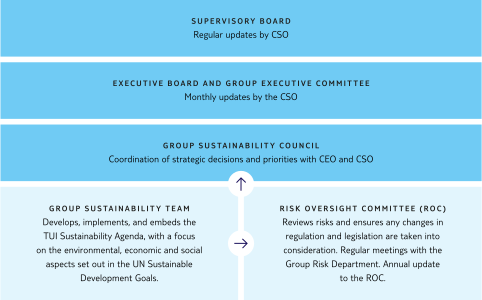
Supervisory Board
The Supervisory Board monitors the incorporation of sustainability aspects into corporate planning, in particular with regard to the composition and remuneration of the Executive Board and the sustainability-related competence of the committees.
Audit Committee
The Audit Committee of the Supervisory Board is in charge of monitoring accounting, the effectiveness of the internal control and risk management system, the audit of the financial and sustainability reports and compliance.
Executive Board and Group Executive Committee
Overall responsibility for sustainability and associated decision-making lies with TUI AG’s Executive Board. The Group Executive Committee (GEC) manages TUI’s business strategically, sets the long-term objectives for sustainable development and ensures implementation of the Sustainability Agenda. The Chief Executive Officer (CEO) is responsible for monitoring sustainability management.
Chief Sustainability Officer (CSO)
The Group Director Corporate & External Affairs, a member of the Group Executive Committee, assumes the role of Chief Sustainability Officer (CSO) and reports directly to the CEO. The CSO is in charge of developing and managing the sustainability strategy and provides monthly progress updates to the Executive Board and the GEC as well as regular updates to the Supervisory Board.
Sustainability Council
The Sustainability Council decides on priorities and projects for the TUI Sustainability Agenda. Managers report on progress made in achieving targets, particularly in relation to science-based targets, and agree on any further steps that may be necessary. The Council is headed by the CEO and CSO and provides regular reports to the relevant bodies.
Group Sustainability Team
The Group Sustainability Team develops, implements and manages the Sustainability Agenda in line with the environmental, economic and social aspects set out in the UN Sustainable Development Goals. It reports to the CSO and supports the operational implementation of the sustainability strategy.
Group Risk Oversight Committee
The Risk Oversight Committee reviews sustainability-related risks, taking account of any changes in legislation, and closely cooperates with the Risk department. It provides an annual update on the risk situation.
Information provided to and sustainability matters addressed by the Company’s administrative, management and supervisory bodies (GOV-2)
The Sustainability Council, the Group Executive Committee, the Supervisory Board and the Audit Committee of the Supervisory Board deal with sustainability aspects at regular meetings. The CSO provides a monthly update on material impacts, risks and opportunities, the implementation of due diligence in sustainability and the results and effectiveness of management approaches, actions, metrics and targets adopted to address them to the Executive Board, with regular updates submitted to the Supervisory Board. Moreover, the Executive Board is regularly updated about the key sustainability risks in the framework of the Group’s risk management process in order to be able to oversee the Company’s strategy and its decisions on major transactions. The Risk Oversight Committee (ROC) reviews and assesses the impacts, opportunities and risks arising within the Group and reports all material developments and changes to the Executive Board.
TUI’s corporate strategy and risk mitigation measures are aligned to the material impacts, risks and opportunities identified, as outlined in the relevant management approaches. Where relevant, trade-offs with other corporate decisions are taken into account. All material impacts, risks and opportunities were presented to the Audit Committee of the Supervisory Board.
Integration of sustainability-related performance in incentive schemes (GOV-3)
TUI Group’s remuneration systems are based in particular on the recommendations of the German Corporate Governance Code (GCGC) and the requirements of the German Stock Corporation Act. The remuneration of the Executive Board comprises a long-term (long-term incentive, LTI) and a short-term (short-term incentive, STI) remuneration component.
Progress delivered towards certain sustainability targets is included in the STI as an ESG factor. A deliberate choice was made not to incorporate an ESG component in the LTI. Integrating an ESG factor in the STI facilitates tracking annual progress towards the strategic milestone plan, which simplifies target-setting and reduces the complexity of the system.
The ESG factor consists of three equally weighted sub-targets set by the Supervisory Board for the relevant financial year as Environmental (e.g. reduction of CO2 emissions), Social (e.g. employee satisfaction) and / or Governance (e.g. promotion of compliance/integrity) targets. As a result, sustainability-related metrics are included in the general remuneration systems.
The following three sustainability-related targets were included in the ESG factor for financial year 2025:
- Delivering reductions in CO2 emissions of the airline, hotels and cruises based on the targets of TUI’s Sustainability Agenda 2030
- Increasing customer satisfaction
- Increasing employee satisfaction
At financial year-end, the Supervisory Board carries out an evaluation of target achievement and determines a multiplier between 0.8 and 1.2 as the ESG factor. In financial year 2025, the Supervisory Board determined an ESG factor of 1.1 for the active members of TUI AG’s Executive Board based on target achievement in all three sub-areas. In financial year 2025, the proportion of the Executive Board's variable remuneration linked to sustainability-related targets ranges between 9.1% and 10%.
For further details on the remuneration system, please refer to the Remuneration report.
In the framework of short-term variable remuneration (STI), the Net Promoter Score reflects the increase in customer satisfaction, as outlined in the chapter on Consumers and end-users. Employee satisfaction is reflected in the metric used in the Engagement Index of the annual Employee Survey, as outlined in the chapter on Own workforce.
The metrics relating to reductions in the CO2 emissions of TUI Airline include Scope 1 and 3, category 3 emissions. For TUI Hotels & Resorts Scope 1 and 2 emissions are considered. They are in line with the targets outlined in E1-4, described in the chapter on Climate Change (E1).
For further details, please refer to the section Climate change (E1).
As the STI programme uses a multiplier, the proportion of variable remuneration and total remuneration dependent on sustainability-related targets and metrics cannot be expressed in one fixed percentage but can only be calculated for the respective year in which the STI is paid.
The terms of incentive schemes for the Executive Board are approved and updated by the Supervisory Board. The Supervisory Board conducted the annual review of the appropriateness of the Executive Board remuneration.
Integration of sustainability-related performance in incentive schemes (ESRS 2 GOV-3 E1)
The sub-target for greenhouse gas emission reductions relevant to remuneration is aligned with the targets reported in the chapter Climate Change (E1). Due to the inclusion of a multiplier in the remuneration system, the percentage of acknowledged Executive Board remuneration dependent on climate-related considerations ranges between 1.3% and 1.9%, depending on the total remuneration granted and owed for financial year 2025.
For further details, please refer to the Remuneration report, II.3 Remuneration granted and owed within the meaning of section 162 (1) sentence 1 AktG in financial year 2025.
Statement on due diligence (GOV-4)
The section below explains how the main features and stages of the due diligence process, as described in ESRS 1, Section 4, are incorporated into this non-financial declaration.
| Main features and stages of the due diligence process | |
|---|---|
| Main features of the due diligence process | Reference |
| a) Integration on due diligence into governance, strategy and business model | ESRS 2, SBM-1, SBM-2, SBM-3 and the management approaches outlined in the topic-related chapters |
| b) Integration of stakeholders in all elements of due diligence | ESRS 2, SBM-2 and the relevant chapters S1, S2 and S4 |
| c) Determination and assessment of negative impacts | ESRS 2, IRO-1: Corresponding disclosures on management approaches outlined in the topic-related chapters |
| d) Measures taken to manage negative impacts | Details in particular in each topic-related chapter |
| e) Tracking the effectiveness of these efforts and communication | Details on targets and target supervision in each topic-related chapter |
Risk management and internal control system in relation to the sustainability reporting process (GOV-5)
Binding sustainability reporting at TUI follows an established procedure under which various functions, in particular Group Sustainability and Group Human Resources, have prepared the annual non-financial declaration under the aegis of Group Financial Accounting & Reporting to date.
We are aware that the inherent risk of error has increased due to the novelty and dynamism of the regulations and the resulting ambiguities in the interpretation of the rules, as well as the new data points to be collected. In response to this, during implementation we focused risk management primarily on materiality assessment, data availability and appropriate reporting. As there was little experience in the market with the extensive new reporting requirements, especially at the start of the project, we regularly sought support from external consultants for assurance purposes.
A key aspect of risk mitigation was the preparation of a draft report at an early stage between March and May 2025. This enabled us to derive a number of focus points to ensure ESRS-compliant reporting as per 30 September 2025, at the end of the financial year under review. In drafting the report itself, we also observed the market and drew conclusions regarding the content and granularity of our own reporting. We provide information on the integration of sustainability risks into the Group-wide risk management system under IRO-1.
The non-financial internal control system (n-ICS) is less formalised. For the first-time preparation of the CSRD report, we mapped and documented the existing control system. The goal is to integrate the core controls identified into the existing minimum control system for financial reporting. The focus is on quantitative data points, as qualitative information is quality-assured within the framework of several reporting loops.
The core n-ICS framework consists of the electronic reporting systems for E- and S-related data. These are subject to the regulatory framework governing general Group-wide IT controls, such as access controls, functional separation, processing controls, protections against intentional and unintentional falsification of data and documents, and controls relating to service provider management.
Group Audit played an advisory role in establishing and developing the n-ICS and contributed to the framework by auditing the reporting systems and the determination of specific metrics. n-ICS development going forward will focus on the formalisation of data collection and reporting processes for the quantitative data points.
This established governance system was used to prepare for the extended sustainability reporting requirements. The progress delivered in the project and the next steps were discussed at monthly management meetings involving the relevant divisional heads. Ultimate responsibility lies with the CFO, who was kept regularly updated.
Progress reports were presented to the Audit Committee at its meetings in November 2024, May 2025 and, after the end of the financial year, in November 2025.
Strategy
Business model and value chain (SBM-1)
For data point ESRS 2 SBM-1 40 a) i/ii, please refer to the section on TUI Group reporting structure in Corporate profile and the chapter TUI Group strategy
For data point ESRS 2 SBM-1 40 a) iii Geographical breakdown of the workforce, please refer to the standard Own workforce (S1), table Breakdown of employees by country
TUI offers the services outlined in the section on Corporate Profile for millions of customers across the entire customer journey. The service portfolio covers the entire range of tourism offerings, i.e. package holidays, components, hotels, flights, tours, experiences and car rental. We strive to live up to our claim “Excellence in Leisure Experiences” at every point of contact with our guests, in both the physical and the digital world.
In order to secure business operations across the entire customer journey, TUI depends on cooperation with suppliers from different sectors, mainly supplying:
- Hotels and Resorts: land, buildings, power, water, food and beverages as well as other materials and products required for hotel operation and facilities
- Cruises: ships, fuel, food and beverages as well as other materials and products required to operate and equip cruise liners
- TUI Musement: vehicles, equipment, fuel, buildings, excursions and experience offerings, tour reps and other inputs from various suppliers
- Markets + Airline: aircraft, fuel, food and beverages as well as other materials and products required to operate and equip aircraft
- All other Segments: power, buildings, water, technical equipment, office facilities
We work with a wide range of business partners to create TUI Group’s products and services. Inputs are sourced from a global supplier base, and TUI also works directly and indirectly with a wide range of business partners in the downstream value chain. Key suppliers include the manufacturers and suppliers of the above-mentioned inputs. In addition, TUI depends on cooperation and agreements with governments, authorities, trade unions and other stakeholders such as civil aviation, maritime, environmental, health and safety authorities, industry associations and other parties. Depending on the availability, quality and price of raw materials, TUI Group sources these from various regions and countries.
The Group offers its products and services to many different customers and intermediaries, including holidaymakers, cruise passengers, hotel guests, customers looking for local experiences, tour operators, travel agencies and online platforms. Distribution is carried out through direct marketing as well as B2C and B2B channels. Downstream, TUI works in particular with waste management companies in operating its own hotels, cruise ships and hotels, and with other providers of tourism services.
TUI Sustainability Agenda and TUI People Strategy (SBM-1)
TUI Group’s Sustainability Agenda, published in financial year 2023, remained in force in financial year 2025.
TUI’s ambition is to play an active role in shaping a more sustainable future for tourism across all three dimensions of sustainability – social, environmental and economic. We use our scale and influence for the sustainable transformation of the tourism industry. We understand sustainable transformation as an opportunity.
Our Agenda is founded on three priorities: We aim to empower people in the destinations and TUI employees to drive the sustainable transformation actively (People). We aim to reduce TUI’s ecological footprint (Planet). We aim to partner with others to launch initiatives for the sustainable transformation of our sector (Progress). Our three P’s – People, Planet and Progress – are supported by 15 focus areas with key goals, objectives and initiatives. Our Sustainability Agenda seeks to address the major challenges we will face in the coming decades, in particular climate change.
Our Sustainability Agenda supports the United Nations’ Sustainable Development Goals (SDGs) – 17 global goals to fight inequality, end poverty and protect our planet by 2030 – and defines appropriate measures to contribute to their achievement. The tourism value chain is closely linked with many different sectors. This enables us to influence progress on many SDGs, with a particular focus on 13 of these goals.
Apart from the Sustainability Agenda, TUI pursues its People Strategy to create a framework enabling employees to deliver their best performance and work successfully as a team. Our vision is to be digital, engaging and inclusive.
Digital: We use digital tools to ease the workload for our employees, promote innovation and enhance efficiency.
Engaged: We invest in the development of our employees and empower our leaders.
Inclusive: We acknowledge difference and bring global and local teams together.
We have adopted a mission defining our relevant areas of action in order to implement our strategy. This creates a framework enabling our employees to deliver their best performance and be successful as a team.
The material impacts, risks and opportunities are reflected in TUI’s Sustainability Agenda, People Strategy and business model. The relevant elements of the strategy comprise, in particular, the goals of the management approaches outlined in the respective topic-related chapters. Wherever appropriate, the key challenges facing TUI are included in the detailed descriptions of impacts, risks and opportunities. Critical solutions and projects are addressed through management approaches, specific metrics, targets or core measures.
Our targets include, in particular, science-based emissions reduction targets, which have been outlined in detail in the present report. Additional targets have been established for other aspects of TUI’s Sustainability Agenda.
For further details on TUI’s Sustainability Agenda and its targets, please refer to the section Climate change (E1).
For further details on the People Strategy and its targets, please refer to the section Own workforce (S1).
TUI’s key services in relation to our sustainability targets are our flight, cruise and hotel offerings, for which we have established science-based targets to reduce emissions in the framework of our Sustainability Agenda.
Interests and views of stakeholders (SBM-2)
TUI engages in regular dialogue with stakeholders through various formats. TUI’s key stakeholders include:
- Employees and employee representatives
- Guests and customers
- Business partners
- Capital market participants (investors, banks)
- Political decision-makers
- Communities affected and civil society
- Nature, as a silent stakeholder (indirectly)
- Users of sustainability statements
Our stakeholder dialogue takes place, above all, in the following formats:
- Employees and employee representatives: various formats including employee meetings, the TUI Europa Forum, employee surveys, the intranet and various online formats, town hall meetings, meetings with employee representatives and other internal events
- Customers and guests: various formats including TUI’s customer service, the TUI app, travel agencies, local employees and social media channels
- Business partners: various formats including sales departments, purchasing departments and key account management
- Investors and capital market participants: various formats including the Annual General Meeting, investor conferences, analyst meetings, one-on-one meetings and Capital Markets Day
- Public decision-makers: various formats including public affairs departments
- Communities and civil society: various formats including surveys, trade fairs, engagement projects
In addition, the SpeakUp Line, TUI’s whistleblower system, is available to all stakeholders.
The dialogue formats differ, depending on the relevant stakeholder group, and are organised by the relevant internal departments to reflect the specific purpose.
The purpose of our stakeholder engagement is to understand different perspectives, discuss potential mutual effects and learn from one another. Dialogue with customers and guests, in particular, is essential for TUI Group’s business success as it enables us to live up to our claim at every point of contact with our guests, in both the physical and the digital world. Our business success and continued operation also hinge on dialogue with banks, investors, shareholders, journalists and politicians in order to secure TUI’s market presence and stable financial position.
The outcomes gleaned from our various formats of stakeholder engagement are regularly integrated into the development and management of our business activities. In particular, this feedback from stakeholder engagement is taken into account in decision-making based on the management approaches outlined in the relevant chapters.
The stakeholders’ perspectives were fed into the materiality assessment by internal representatives (please refer to IRO-1) operating with the stakeholders in their work environment. TUI takes account of stakeholder perspectives when implementing the management approaches and actions outlined in the relevant chapters.
Interests and views of TUI’s own workforce
The interests, views and rights of employees, including respect for their human rights, are an essential element in shaping TUI’s People Strategy and business model. To ensure that their perspectives are considered in decision-making processes, TUI engages in regular dialogue with its employees and their representatives in different formats, including employee meetings and employee surveys.
Interests and views of employees along the value chain
TUI takes account of the interests, views and rights of employees in the value chain through structured risk analyses that identify risks relating to human rights and the environment. A Supplier Code of Conduct ensures that business partners comply with fundamental requirements relating to human rights, working conditions and environmental protection. The TUI SpeakUp Line enables employees to report any concerns anonymously. Moreover, TUI engages in multi-stakeholder initiatives in order to incorporate stakeholder perspectives when updating measures.
Interests and views of consumers and end-users
The interests, views and rights of customers and guests travelling with TUI, including respect for their human rights, are an essential element in shaping TUI’s Sustainability Agenda and business model. To ensure that their perspectives are taken into account in decision-making processes, TUI engages in regular dialogue with customers and guests through various formats including personal exchange and satisfaction surveys.
The Supervisory Board, the Executive Board and the Group Executive Committee are briefed at regular meetings by members of the Executive Board, the CSO or other Group or company directors about the views and interests of stakeholders in relation to sustainability-related impacts. The reporting lines follow the established governance system.
Material impacts, risks and opportunities (IROs) and their interaction with strategy and business model (SBM-3)
TUI has identified and assessed actual and potential negative and positive material impacts, risks and opportunities. These IROs are presented in a table at the start of each of the thematic chapters E1 Climate Change, S1 Own Workforce, S2 Workers in the Value Chain, S4 Consumers and End-Users and G1 Business Conduct, in the section Material impacts, risks and opportunities and their interaction with strategy and business model (ESRS 2 – SBM-3) and are subsequently outlined in detail. Specific financial impacts of the key risks and opportunities on TUI Group’s financial position result in particular from regulatory measures such as the EU Emissions Trading System (EU ETS). The expansion of the scope of the EU ETS to cover aviation has caused additional costs to obtain emissions certificates, directly impacting the operating result. Moreover, operating state-of-the-art low-emission aircraft types such as Boeing 737 Max requires substantial investments, which are reflected in the Company’s financial position and underline its strategic alignment to long-term greenhouse gas emissions reductions. The actions initiated serve to reach the climate-related targets in accordance with the Science Based Targets Initiative (SBTi) by 2030. Due to its strategic emissions reduction and refleeting measures, TUI Group is resilient and well prepared for regulatory and physical climate risks. While the short-term impacts on its financial planning are immaterial, TUI Group continually monitors and assesses the medium- to long-term uncertainties.
Management of impacts, risks and opportunities
Description of the process to identify and assess material impacts, risks and opportunities (IRO-1)
For financial year 2025, TUI Group conducted a double materiality assessment (DMA) in accordance with ESRS 1. The DMA identified and evaluated sustainability-related impacts, risks and opportunities for TUI Group. It incorporated the expertise of various departments, experts and the management of TUI Group. TUI Group conducted the DMA according to the procedure outlined below.
Object of the DMA
To establish a basis for the DMA, activities, agents and relationships were analysed across TUI Group’s entire value chain. The value chain was examined for impacts, risks and opportunities with regard to all sustainability aspects deriving from ESRS 1, AR 16.
For a description of the value chain, please refer to the section ESRS 2 Business model and value chain (SBM-1) and the section Corporate profile.
The representatives of the segments, experts and managers included in the assessment were either stakeholders directly or indirectly affected by TUI Group’s value chain or users of the non-financial declaration.
For a description of the stakeholders, please refer to the section Interests and views of stakeholders (SBM-2).
To appropriately prioritise relevant activities within its business operations and value chain when identifying impacts, risks and opportunities, TUI Group drew on insights derived from earlier assessments and the design of its business model. This methodology facilitates a sound and strategic assessment, taking account of both operational and long-term perspectives.
As a tourism group, TUI Group focuses its assessment above all on three key areas considered to be particularly critical because of their relevance and their impact on sustainability and business risks:
- The focus of the assessment is on emissions, as the Airline plays a key role in driving the Group’s CO2 emissions and therefore constitutes a central springboard for measures aiming to promote climate change mitigation and reduce environmental pollution.
- Service orientation and customer focus play a key role in TUI Group’s business model. As it is a global tourism player, TUI Group’s employees interact with many customers across different regions. Understanding the social impacts, including on diversity, working conditions, employee satisfaction and customer satisfaction, is essential to preserve the corporate image and ensure long-term stakeholder retention.
- As the business activities are globally aligned, a robust governance structure has to be in place. The focus is primarily on transparency, ethics and compliance with international standards in order to minimise risks and ensure stakeholder trust.
By prioritising the above areas, TUI Group focused its double materiality assessment on aspects of key relevance both for sustainability reporting and for the Group’s strategic direction.
Identifying and assessing impacts, risks and opportunities
TUI Group carried out the materiality assessment in a two-step process, integrating both operational and strategic perspectives:
identification and assessment by technical experts
In a first step, technical and segment experts from different parts of the organisation identified relevant IROs in the Group’s own activities and along its value chain. The assessment was based on defined criteria, including scale, likelihood, relevance for stakeholders as well as any potential dependencies of individual topics. Determination of these dependencies was preceded by an analysis of risks or opportunities potentially generated by impacts or dependencies. The perspectives of external stakeholders were indirectly taken into account through the internal representatives involved in the assessment. There were no direct consultations.
Validation, aggregation and focus
The comprehensive results of the technical examination were subsequently reviewed by management. The aim of this step was to validate the identified IROs, cluster them by topic and focus on their strategic relevance for the Group as a whole. In the process, a number of topics initially assessed as material were deemed immaterial in the Group context and were therefore not included in the final materiality evaluation. This focus ensures that non-financial reporting is aligned with major and relevant sustainability issues.
The consolidated results of the materiality assessment were presented to the Executive Board and the Supervisory Board and form the basis for selecting the contents to be reported in the Group’s non-financial declaration.
assessment criteria
Positive impacts were assessed according to their scale and scope. Negative impacts were additionally assessed according to their remediability. For potential impacts, likelihood was also considered. All criteria were assessed on a scale from 1 to 5. The likelihood criterion is based on TUI Group's risk management system.
In the case of potential impacts on human rights, the severity of the impact takes precedence over likelihood, which means that it is treated as an actual impact regardless of the likelihood of the event.
A materiality score was calculated on the basis of the criteria applied. The score was calculated as the sum of the scale, scope and remediability values (negative impacts), multiplied by the likelihood (for potential impacts). The score ranges from 0 to 15. Impacts scored at 8 or more are considered to be material for the non-financial declaration.
Sustainability risks are not prioritised over other business risks. All risks and opportunities were assessed in accordance with their scale and likelihood and multiplied to calculate the materiality score, resulting in a score between 1 and 4. Risks and opportunities scored at 3 or more are considered to be material for the non-financial declaration. The threshold values from the general risk management system were used for reference purposes.
The integration of the identified material risks into the Group-wide risk management system has not yet been completed. Responsibility for managing impacts, risks and opportunities lies with the relevant business areas.
For further information on risk governance, please refer to the Risk report.
As a component of this non-financial declaration, the materiality assessment is integrated into internal controls and decision-making processes. Ultimate responsibility lies with the Executive Board of TUI Group. The double materiality assessment is reviewed on an annual basis. The next review will take place in financial year 2026.
Materiality assessment in relation to climate change (E1)
As part of its materiality assessment, TUI identified and assessed the environmental impact of TUI Group and its upstream and downstream value chain. The assessment followed the methodology described above and was based on reported greenhouse gas emissions (Scopes 1, 2 and 3).
TUI also conducted a qualitative and quantitative climate scenario assessment in financial year 2023 to gain a better understanding of the potential business risks and opportunities related to climate change and to review its strategy and financial planning in order to enhance resilience. The results of that assessment are validated annually and continue to apply to TUI Group. The assessment identified short-, medium-, and long-term climate-related risks and opportunities. TUI defines “short-term” as the period up to 2030 (aligned with its science-based targets), “medium-term” as the period up to 2040, and “long-term” as the period up to 2050 (the date by which TUI aims to achieve net-zero emissions across its entire business operations and supply chain). This assessment is based on a number of assumptions relating, for example, to changes in the intensity and frequency of weather-related events, technological developments, energy and carbon price trends and the evolution of knowledge about global warming.
The determination of climate-related physical risks was based on the effects of climate change, including event-driven acute change such as storms, fire and flooding and long-term chronic change such as rising temperature.
A high-emission scenario was examined to assess the impacts of significant changes in the physical climate, based on Representative Concentration Pathway 8.5 (IPCC RCP 8.5) as set out by the Intergovernmental Panel on Climate Change (IPCC) and the Stated Policy Scenario of the International Energy Agency (IEA), which assumes global warming of around 4.3 °C by 2100.
The assessment took into account the assets and business activities of TUI Group subject to risks and evaluated their sensitivity and exposure to gross physical risks.
Climate-related transition risks were determined by taking into account the socio-economic consequences of climate change in connection with the transition to a low-carbon economy, including political, legal, technological and market-related risks.
This assessment was founded on a low-emission scenario to assess the impact of significant socio-economic changes required to achieve a low-carbon economy, drawing on IPCC RCP 2.6 and the IEA’s Net Zero Scenario, which envisages global warming of approximately 1.5 °C by 2100.
The assessment took account of all assets and business activities subject to risks of TUI Group, evaluating their sensitivity and exposure to transition risks and opportunities.
TUI’s climate-related risk assessment and the above-mentioned scenarios underlying it took account of the following key drivers, as these have direct impacts on operating costs, investment decisions and strategic direction:
- Political and regulatory developments: Introduction and expansion of CO2 pricing mechanisms and new energy and emissions targets for energy-intensive industries.
- Macroeconomic trends: Assumptions about global growth, energy consumption and emission pathways.
- Technological developments: Availability and costs of alternative fuels (e.g. SAF, green methanol) and technologies (e.g. dual-fuel engines).
- CO2 price forecasts: Based on IPCC SSPs (Shared Socioeconomic Pathways) and NGFS (Network for Greening the Financial Systems) models.
- The scenario analysis is based on modelled assumptions and external data sources and is inherently subject to uncertainty. In particular, the following limitations apply.
- Future-related uncertainties: The analysis is not a forecast but a model-based assessment of potential developments.
- Model limitations: The tools used to quantify risk are based on simplified assumptions and have limited depth of detail and auditability.
- Data availability: Location data (geographic coordinates) for hotels, airports and cruise itineraries were used where available. Where data was lacking, the nearest airports were used.
- Scope limitations: Individual business areas and emission sources were excluded if no significant climate-related risks or opportunities were identified.
Materiality assessment in relation to pollution (E2)
The materiality assessment in relation to pollution was based on the assessments of experts from segments, specialist fields and management. The assessment prioritised the TUI Airline, Cruises and Hotels & Resorts segments and their respective value chains, as they entail greater potential environmental impacts and risks than other business activities. A location analysis was not performed.
Materiality assessment in relation to water and marine resources (E3)
The materiality assessment in relation to water and marine resources was based on the assessments of experts from segments, specialist fields and management. Consultations with affected communities were not conducted. A location analysis was not performed.
Materiality assessment in relation to biodiversity and ecosystems (E4)
The materiality assessment in relation to biodiversity was based on assessments of experts from segments, specialist departments and management. It examined the entire value chain, including all ecosystem services, to assess environmental impacts, transition risks and physical and systemic risks potentially arising from dependencies. In addition, a location analysis was carried out on the basis of geographic data using the Integrated Biodiversity Assessment Tool (IBAT).
The experts examined whether any of the Company’s sites are located in or close to areas of relevance to biodiversity and whether any of the associated activities cause any degradation of natural habitats or disturbance of species for which protected areas have been designated. The assessments show that TUI, as a tourism group, operates hotels in the vicinity of biodiversity-sensitive areas. TUI Hotels in the vicinity of biodiversity-sensitive areas are characterised by a compact footprint, structured operational practices and integration into existing infrastructure. Compared with other commercial usage, the impact on biodiversity is immaterial and easily controllable. No significant impacts, risks or opportunities have been identified.
Materiality assessment in relation to resource use and circular economy (E5)
The materiality assessment in relation to resource use and the circular economy was based on the assessments of experts from segments, specialist fields and management. No further analyses or consultations with affected communities or location assessments were conducted.
Materiality assessment in relation to business conduct (G1)
The materiality assessment in relation to business conduct was based on the assessments of experts from segments, specialist fields and management. The focus was, in particular, on Group-level governance structures, business activities in the segments, global supply chains and business processes.