

Macroeconomic, industry and market framework
Macroeconomic development
| Development of World Output | ||
|---|---|---|
| Var. % | Projection 2025 | 2024 |
| World | + 3.2 | + 3.3 |
| Eurozone | + 1.2 | + 0.9 |
| Germany | + 0.2 | - 0.5 |
| France | + 0.7 | + 1.1 |
| UK | + 1.3 | + 1.1 |
| US | + 2.0 | + 2.8 |
| Russia | + 0.6 | + 4.3 |
| Japan | + 1.1 | + 0.1 |
| China | + 4.2 | + 5.0 |
| India | + 6.6 | + 6.5 |
| Source: International Monetary Fund (IMF), World Economics Outlook, October 2025 | ||
During calendar year 2025, the global economy initially proved resilient, but signs of a slowdown prevailed as the year progressed: temporary stimuli such as advance investments subsided, while uncertainty and political tensions increasingly weighed on growth. Advanced economies were characterised overall by uncertainty, geopolitical tensions and weaker investment appetite. In Europe, government investment, higher spending on infrastructure and defence, and a backlog of reforms had a particular impact on economic development. Emerging economies benefited from more stable economic policy conditions but remain vulnerable to external shocks and the increasing fragmentation of world trade.1
Key exchange rates and commodity prices
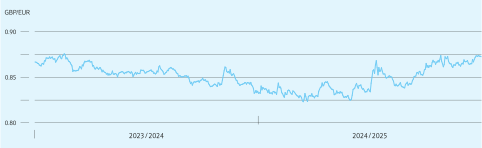
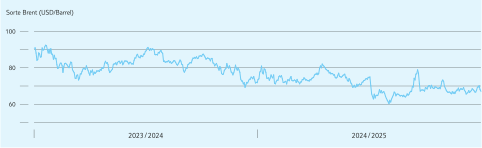
TUI Group companies operate on a worldwide scale. This presents financial risks for TUI Group arising from changes in exchange rates and commodity prices. The essential financial transaction risks from operations concern euros and US dollars. They mainly result from foreign exchange items in the individual Group companies, for instance jet fuel and bunker oil or ship handling, or from sourcing transactions by hotels. The parity of sterling against the euro affects the translation of results generated in the UK market in TUI’s consolidated financial statements. Changes in commodity prices above all affect TUI Group when procuring fuels such as aircraft fuel and bunker oil. In Tourism, risks relating to changes in exchange rates and price risks from fuel sourcing are partly hedged by derivatives.
Information on hedging strategies and risk management as well as financial transactions and the scope of such transactions at the balance sheet date is provided in the sections Financial position, Risk report in the Management report and the section Financial instruments in the Notes to the consolidated financial statements.
Sterling exchange rate
US dollar exchange rate
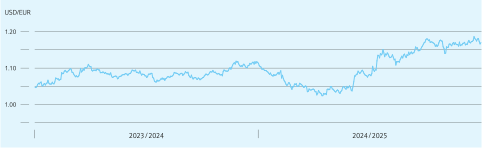
The exchange rate charts are presented on the basis of the indirect quotation format customary in the foreign exchange market. If the exchange rate falls, the foreign currency is appreciating against the euro. By contrast, if the exchange rate rises, the foreign currency is depreciating against the euro.
Oil price
Industry overview
TUI is a global provider of leisure experiences operating in the tourism sector. Developments in the international tourism market therefore impact all business areas of the Group.
The key indicators used to measure the size of the tourism sector include the number of international tourist arrivals. According to the United Nations World Tourism Organization (UNWTO), the number of international tourist arrivals grew by an annual average of 5% from 2009 to 20192. This growth was driven by a number of factors: the relatively stable global economy, a growing middle class in the emerging economies, technological progress and an easing of visa requirements.
With the outbreak and the global spread of the COVID-19 pandemic in the first quarter of calendar year 2020, almost all activities in the sector came to a standstill. As a result, international tourist arrivals declined significantly but recovered strongly in subsequent years. 2024 international tourist arrivals equaled the 2019 reference period around the globe, and in the first six months of 2025 they grew by 4%. Despite geopolitical tensions, travel demand remained stable globally, with regional variations in developments.3
| Change of international tourist arrivals | ||
|---|---|---|
| Var. % | 2025 versus 2019¹ | 2024 versus 2019¹ |
| World | + 5 | + 4 |
| Europe | + 4 | + 7 |
| Asia Pacific | + 11 | - 8 |
| Americas | + 3 | + 1 |
| Africa | + 12 | + 20 |
| Middle East | - 4 | + 29 |
| Source: UNWTO Tourism Dashboard and World Tourism Barometer, September 2025 | ||
| ¹ From January to June | ||
Travel intermediary market
A travel intermediary operates between a provider of tourism services, such as an airline or a hotel, and final customers, typically delivering distribution, packaging and/or related services. Their advantage compared with direct suppliers is generally related to their distribution and (in the case of tour operators) fulfilment and service capabilities. Travel intermediaries include tour operators, travel agents, and online travel agencies (OTAs). These business models vary substantially. All may offer their customers a component product (e.g. flight, accommodation) or a package product (comprising e.g. flight, hotel and transfers), usually through a combination of offline (i. e. travel agencies) and online channels (i.e. web and app). Booking preference has shifted to online over time, a trend which was further accelerated during the pandemic.
In order to secure flight and hotel capacity in advance, a tour operator may enter into a wholesale contract with the supplier, often involving some form of commitment to a certain amount of capacity at a specified price. Where the tour operator commits to capacity, they take on the risk of filling it; in return, they can expect the supplier to offer them a favourable rate and the opportunity to secure accommodation on an exclusive basis, as well as the ability to yield the capacity. Alternatively, tour operators can dynamically access flight and hotel supply, either direct with the supplier, or via a bedbank, or via a global distribution system. This does not involve taking risk, and provides additional choice and flexibility for the customer (for example, relating to choice of departure airport, time of flights and duration of holiday). OTAs, by contrast, typically do not commit to taking capacity, nor are they as deeply involved in the fulfilment and service of the holiday. Their offering to suppliers is a digital distribution platform with broad customer reach.
The development and adoption of generative AI is transforming the role and relevance of travel intermediaries in how travel is planned and booked, creating both opportunities and threats. For OTA and search engine bookers, AI distribution channels (e.g. chatbots, such as Chat GPT) have the potential to take significant market share. One of the key aspects to success will be shifting from just Search Engine Optimisation (SEO) to incorporate Answer Engine Optimisation (AEO) and Generative Engine Optimisation (GEO).
Airline market
The airline industry was hit particularly hard by the COVID-19 pandemic, as airlines around the world had to ground their aircraft and cancel flights due to global travel bans. Air passenger traffic rebounded significantly as restrictions were lifted with total traffic matching and surpassing 2019 numbers in February 20244. The rebound is now tapering off – demand for air travel is projected to grow by 5.8% in 2025, marking a downward revision from previous projections, as a result of lower GDP growth expectations both globally and in the US5. Although inflation and jet fuel prices have eased, headwinds remain including in terms of the supply chain. Passenger yields are expected to decline for the second year in a row, on the back of a 13% lower year on year jet fuel price in 2025, although this may not translate into weaker profitability for the industry, given current capacity constraints.
Climate change is a further challenge facing the industry. The industry is committed to achieve net zero emissions by 2050, meaning the current reliance on carbon offsetting will need to end. It is expected that Sustainable Aviation Fuel (SAF) will become the most important means for the industry to achieve its reduction targets, however, demand remains far in excess of production, with SAF produced at over 3x the cost per tonne of jet fuel6.
Hotel market
Global hotel performance remained resilient in 20247. RevPAR (revenue per available room) outperformed 2019 globally. Asia Pacific continued to lag behind its 2019 performance as a result of visa challenges and the slowing economy in China. Further, albeit modest, RevPAR growth is expected for 2025.
The hotel market comprises business and leisure hotels. Leisure hotels feature a number of characteristics distinguishing them from business hotels, including longer average lengths of stay and differences in location, room features and service offerings. From a demand perspective, the leisure hotel market in Europe comprises several smaller sub-markets catering to customers’ individual needs and preferences. The sub-markets comprise premium, comfort and budget hotels as well as family / apartment hotels and club or resort hotels. Hotel companies may offer a variety of hotels for different market segments, often defined by price segment, star rating, exclusivity or available facilities.
In Europe, in particular, there are many small, often family-run hotels, which are less upscale and have fewer financial resources. Most family-owned hotels are not branded.
Given the large number of ownership and operating models for leisure hotels and the fragmented competitive landscape which, at least in Europe, is not dominated by large hotel chains, the competitive environment differs greatly between locations. Despite this strong fragmentation, a structural change can be observed in the European hotel industry, as in nearly all regions in the world. The share held by hotel chains is increasing, as well as the focus on direct distribution and customer loyalty.
Sustainability and emissions reduction is strongly in focus for the hotels sector, with many major brands committing to emissions reduction targets and other goals including to energy efficiency, water conservation and waste reduction. Inflation is another key issue for the industry, driven by rising energy costs, higher interest rates, and labour shortages. Although hotel revenue (based on the major global brands) has been increasing, driven by the post-pandemic recovery and strong pricing, hotels may need to increase their efficiency in order to remain competitive8.
Cruise market
By the end of 2023, passenger volumes exceeded those of 2019 and are forecasted to be 27% higher by the end of 20259.
In calendar year 2024, the top five source markets based on passenger volumes were USA, Germany, the United Kingdom, Australia and Canada. The most popular destinations within that period were the Caribbean, the Mediterranean, Asia and China and Northern Europe. (CLIA 2024 Global Market Report).
Similar to the airline and hotel sectors, emissions reduction and the path to net zero are strongly in focus for the cruise industry. In addition, new regulations have been introduced, with additional International Maritime Organisation (IMO) rules on carbon intensity and the rating system having entered into force at the start of 2023, and the EU Emissions Trading Scheme (ETS) being phased in from 2024.
Experiences and attractions market
The market for experiences and attractions is a rapidly growing tourism segment and is expected to grow at a faster percentage rate than other travel market sectors (based on TUI estimates). The market is diverse, complex and highly fragmented on the supplier side, with a large share of distribution being operated offline. Intermediation and in-destination presence therefore play a key role10. These factors create opportunity, and many of the largest players in travel have entered the space, either as OTA or through B2B partnerships.
Our brand
Our red ‘smile’ logo is one of TUI's most important brand assets. The TUI Smile represents our commitment to creating moments that make our customers’ lives richer. To bring our brand to life, we use a brand model that provides a clear direction for how we want to further develop our offering and our product portfolio, what we as an organisation want to align ourselves with and how we want to be perceived.
Our vision ‘Excellence in Leisure Experiences’ is intended to make our ambitions clear to the marketplace. It extends across the entire customer journey, i.e. package holidays, trip components, hotels, flights, tours, cruises, experiences and car rental: we strive to live up to our claim at every point of contact with our guests, both in the physical and digital world. Our brand world emphasises this with a clear brand purpose and promise, as well as a distinct brand identity.
With the accelerated transformation of the Markets + Airline business, we want to offer a broader portfolio of products, services and destinations under our international brand in the future. The aim is to expand TUI's global presence and brand awareness in order to sell more products to more customers in more countries worldwide. With our strong focus on the customer experience, we remained in the top spot for brand awareness and consideration, and achieved a further increase in the NPS (Net Promoter Score, an indicator of customer satisfaction and willingness to recommend) across all core markets in financial year 202511.
The vision underlying our brand extends far beyond our customer proposition. It not only encompasses all our touchpoints with our guests, but also our employees, aligning them with the same overarching goal of creating a sustainable and consistent customer journey. To achieve this, we use our customer-centric programme ‘Makers of Happy’, our values ‘Trusted’, ‘Unique’ and ‘Inspiring’ and our employee communications with the employer brand ‘Let's TUI it’. All of this is designed to put TUI in a strong position.
Group earnings
Comments on the consolidated income statement
In the completed financial year, TUI Group’s revenue was slightly ahead of financial year 2024. This was mainly due to a higher average prices, primarily in Markets + Airline. Moreover, TUI Group’s performance is subject to significant seasonality as the tourism business is influenced by the winter and summer travel months.
In the financial year under review, TUI Group’s underlying EBIT rose by €116.9m year-on-year to €1,413.1m. On a constant currency basis, this was an improvement of €162.7m year-on-year.
| Consolidated Income Statement of TUI AG for the period from 1 Oct 2024 to 30 Sep 2025 | |||
|---|---|---|---|
| € million | 2025 | 2024 | Var. % |
| Revenue | 24,178.7 | 23,167.3 | + 4.4 |
| Cost of sales | 22,163.6 | 21,221.2 | + 4.4 |
| Gross profit | 2,015.1 | 1,946.1 | + 3.5 |
| Administrative expenses | 1,122.0 | 1,045.8 | + 7.3 |
| Other income | 26.9 | 14.4 | + 87.5 |
| Other expenses | 15.2 | 17.1 | - 11.1 |
| Impairment (+) / Reversals (-) of impairment of financial assets | 7.2 | - 0.9 | n. a. |
| Financial income | 101.0 | 109.7 | - 7.9 |
| Financial expenses | 429.0 | 518.3 | - 17.2 |
| Share of result of investments accounted for using the equity method | 463.9 | 371.7 | + 24.8 |
| Impairment (+) / Reversals of impairment (-) of net investments in joint ventures and associates | - 0.7 | 0.2 | n. a. |
| Earnings before income taxes | 1,034.2 | 861.4 | + 20.1 |
| Income taxes (expense (+), income (-)) | 192.4 | 154.0 | + 25.0 |
| Group profit | 841.8 | 707.4 | + 19.0 |
| Group profit attributable to shareholders of TUI AG | 635.9 | 507.1 | + 25.4 |
| Group profit attributable to non-controlling interest | 205.8 | 200.3 | + 2.7 |
Revenue and cost of sales
| Revenue | |||
|---|---|---|---|
| € million | 2025 | 2024 | Var. % |
| Hotels & Resorts | 1,243.8 | 1,152.4 | + 7.9 |
| Cruises | 883.4 | 840.1 | + 5.2 |
| TUI Musement | 1,044.8 | 931.0 | + 12.2 |
| Holiday Experiences | 3,172.0 | 2,923.5 | + 8.5 |
| Northern Region | 8,856.8 | 8,546.7 | + 3.6 |
| Central Region | 8,854.0 | 8,336.9 | + 6.2 |
| Western Region | 3,282.8 | 3,349.3 | - 2.0 |
| Markets + Airline | 20,993.5 | 20,232.9 | + 3.8 |
| All other segments | 13.2 | 10.9 | + 20.7 |
| TUI Group | 24,178.7 | 23,167.3 | + 4.4 |
| TUI Group (at constant currency) | 24,185.0 | 23,167.3 | + 4.4 |
In financial year 2025, TUI Group’s revenue increased by 4.4% to €24.2bn. On a constant currency basis, revenue also grew by 4.4%. In the income statement revenue is presented alongside the cost of sales, which increased by 4.4% in the period under review mainly due to higher average prices.
Gross profit
The difference between revenue and the cost of sales increased by €69.0m year-on-year to a gross profit of €2,015.1m.
Administrative expenses
Administrative expenses increased by €76.1m year-on-year to €1,122.0m (previous year €1,045.8m). The increase in administrative expenses was partly attributable to the rise in wages and salaries.
Other income and other expenses
In financial year 2025, other income mainly resulted from the disposal of ARP Group, the disposal of aircraft assets and from reclassification of exchange differences. In the previous year, other income had included in particular gains from the disposal of aircraft assets, the revaluation of leases and the disposal of shareholdings.
In financial year 2025, other expenses resulted primarily from the sale of aircraft assets and foreign currency effects. In the previous year, other expenses had included in particular losses from the disposal of aircraft assets.
Financial result
The financial result in financial year 2025 amounted to €-328.0m after €-408.5m in the previous year.
Financial income decreased by of €8.7m to €101.0m (previous year €109.7m). The decrease mainly resulted from lower interest income from foreign currency translation of financial instruments and lower interest income from bank deposits and liquid assets in money market funds mainly driven by lower interest rates.
Financial expenses decreased by €89.2m to €429.0m (previous year €518.3m). The decline is primarily attributable to lower interest expenses on bonds. The partial repurchase of the convertible bond issued in financial year 2021 resulted in additional interest expenses in the previous year. The decrease in financial expenses was partly offset by higher interest expenses for the convertible bond newly issued in the previous year and the sustainability-linked senior notes issued in the same year. Furthermore, the reduction in other interest and similar expenses was mainly due to a lower utilisation of the revolving credit facility.
Share of result of joint ventures and associates
The share of result of joint ventures and associates of €463.9m (previous year €371.7m) comprises the proportionate net profit for the year of these companies.
Earnings before income taxes
In the period under review, earnings before income taxes totalled €1,034.2m (previous year €861.4m), an improvement of €172.8m.
Group profit
In financial year 2025, Group profit amounted to €841.8m, an increase of €134.4m year-on-year (previous year €707.4m).
Share in Group profit attributable to TUI AG shareholders
In financial year 2025, the share in Group profit attributable to TUI AG shareholders amounted to €635.9m (previous year €507.1m).
Share in Group profit attributable to non-controlling interests
In the financial year under review, the share in Group profit attributable to non-controlling interests totalled €205.8m (previous year €200.3m). It mainly related to RIUSA II Group in the Hotels & Resorts segment.
Earnings per share
In financial year 2025, the share in Group profit attributable to TUI AG shareholders resulted in basic earnings per share of €1.25 (previous year €1.00).
Alternative performance indicators
The Group’s main financial KPI is underlying EBIT. We define the EBIT in underlying EBIT as earnings before interest, income taxes and income and expenses for the measurement of the Group’s interest hedges. EBIT by definition includes goodwill impairments.
Underlying EBIT is adjusted by income and expense items impacting or distorting the assessment of the operating profitability of the segments and the Group due to their level and frequency. These items include gains on disposal from investments, major gains and losses from the sale of assets and major restructuring and integration expenses. In addition, adjustments are carried for all effects from purchase price allocations, ancillary acquisition costs and conditional purchase price payments. Adjustments made in the reconciliation to underlying EBIT include goodwill impairments.
| Reconciliation to underlying EBIT of TUI Group | |||
|---|---|---|---|
| € million | 2025 | 2024 | Var. % |
| Earnings before income taxes | 1,034.2 | 861.4 | + 20.1 |
| plus: Net interest expense (excluding expense / income from measurement of interest hedges) | 337.5 | 414.9 | - 18.7 |
| less: Income from measurement of interest hedges | - 2.8 | - 1.0 | - 180.0 |
| EBIT | 1,368.9 | 1,275.3 | + 7.3 |
| Adjustments: | |||
| plus: Separately disclosed items | 23.6 | - | n. a. |
| plus: Expense from purchase price allocation | 20.6 | 20.9 | - 1.4 |
| Underlying EBIT | 1,413.1 | 1,296.2 | + 9.0 |
TUI Group’s EBIT increased by €93.6m to €1,368.9m in financial year 2025.
| EBIT | |||
|---|---|---|---|
| € million | 2025 | 2024 | Var. % |
| Hotels & Resorts | 733.9 | 669.6 | + 9.6 |
| Cruises | 481.1 | 374.3 | + 28.5 |
| TUI Musement | 76.9 | 43.8 | + 75.6 |
| Holiday Experiences | 1,291.9 | 1,087.6 | + 18.8 |
| Northern Region | 105.3 | 159.6 | - 34.0 |
| Central Region | 87.0 | 126.0 | - 30.9 |
| Western Region | - 33.3 | 8.5 | n. a. |
| Markets + Airline | 159.1 | 294.0 | - 45.9 |
| All other segments | - 82.1 | - 106.4 | + 22.9 |
| TUI Group | 1,368.9 | 1,275.3 | + 7.3 |
TUI Group’s operating EBIT adjusted for one-off effects (underlying EBIT) improved by €116.9m to €1,413.1m in financial year 2025.
| Underlying EBIT | |||
|---|---|---|---|
| € million | 2025 | 2024 | Var. % |
| Hotels & Resorts | 735.0 | 668.4 | + 10.0 |
| Cruises | 481.1 | 374.3 | + 28.5 |
| TUI Musement | 67.2 | 49.2 | + 36.7 |
| Holiday Experiences | 1,283.2 | 1,091.9 | + 17.5 |
| Northern Region | 123.2 | 165.4 | - 25.5 |
| Central Region | 98.3 | 128.1 | - 23.3 |
| Western Region | - 21.6 | 10.3 | n. a. |
| Markets + Airline | 199.9 | 303.9 | - 34.2 |
| All other segments | - 70.0 | - 99.6 | + 29.7 |
| TUI Group | 1,413.1 | 1,296.2 | + 9.0 |
| TUI Group (at constant currency) | 1,458.9 | 1,296.2 | + 12.6 |
In financial year 2025, one-off effects resulted in net expenses of €23.6m (previous year €0.0m).
For one-off effects, please see Notes to the segment data in the Consolidated financial statement.
Other segment indicators
| Reconciliation to underlying EBITDA | |||
|---|---|---|---|
| € million | 2025 | 2024 | Var. % |
| EBIT | 1,368.9 | 1,275.3 | + 7.3 |
| Amortisation and impairment (+) / reversals (-) of other intangible assets and depreciation and impairment (+) / reversals (-) of property, plants and equipment and right of use assets | 879.8 | 846.6 | + 3.9 |
| EBITDA | 2,248.6 | 2,121.9 | + 6.0 |
| Adjustments | 23.0 | - 2.2 | n. a. |
| EBITDA (underlying) | 2,271.6 | 2,119.7 | + 7.2 |
| EBITDA | |||
|---|---|---|---|
| € million | 2025 | 2024 | Var. % |
| Hotels & Resorts | 932.8 | 844.5 | + 10.5 |
| Cruises | 563.9 | 459.8 | + 22.6 |
| TUI Musement | 115.1 | 79.8 | + 44.2 |
| Holiday Experiences | 1,611.8 | 1,384.1 | + 16.5 |
| Northern Region | 413.6 | 467.3 | - 11.5 |
| Central Region | 191.3 | 228.0 | - 16.1 |
| Western Region | 114.6 | 143.9 | - 20.4 |
| Markets + Airline | 719.5 | 839.4 | - 14.3 |
| All other segments | - 82.6 | - 101.6 | + 18.7 |
| TUI Group | 2,248.6 | 2,121.9 | + 6.0 |
| Underlying EBITDA | |||
|---|---|---|---|
| € million | 2025 | 2024 | Var. % |
| Hotels & Resorts | 933.0 | 843.4 | + 10.6 |
| Cruises | 563.9 | 459.8 | + 22.6 |
| TUI Musement | 99.7 | 79.5 | + 25.4 |
| Holiday Experiences | 1,596.6 | 1,382.6 | + 15.5 |
| Northern Region | 420.2 | 461.7 | - 9.0 |
| Central Region | 201.7 | 229.3 | - 12.0 |
| Western Region | 123.7 | 143.0 | - 13.5 |
| Markets + Airline | 745.6 | 834.0 | - 10.6 |
| All other segments | - 70.5 | - 97.0 | + 27.3 |
| TUI Group | 2,271.6 | 2,119.7 | + 7.2 |
Segmental performance
Holiday Experiences
| Holiday Experiences | |||
|---|---|---|---|
| € million | 2025 | 2024 | Var. % |
| Revenue | 3,172.0 | 2,923.5 | + 8.5 |
| Underlying EBIT | 1,283.2 | 1,091.9 | + 17.5 |
| Underlying EBIT (at constant currency) | 1,312.0 | 1,091.9 | + 20.2 |
| Hotels & Resorts | |||
|---|---|---|---|
| € million | 2025 | 2024 | Var. % |
| Total revenue1 | 2,243.5 | 2,089.5 | + 7.4 |
| Revenue | 1,243.8 | 1,152.4 | + 7.9 |
| Underlying EBIT | 735.0 | 668.4 | + 10.0 |
| Underlying EBIT (at constant currency) | 758.9 | 668.4 | + 13.5 |
| Available bed nights2 (in '000) | 39,797 | 39,657 | + 0.4 |
| Riu | 14,899 | 14,570 | + 2.3 |
| Robinson | 3,479 | 3,487 | - 0.2 |
| Royalton | 6,084 | 6,190 | - 1.7 |
| Occupancy3 (in %, variance in %pts) | 84 | 82 | + 2 |
| Riu | 91 | 91 | - |
| Robinson | 76 | 74 | + 2 |
| Royalton | 85 | 83 | + 2 |
| Average daily rate4 (in €) | 97 | 93 | + 3.3 |
| Riu | 89 | 84 | + 5.4 |
| Robinson | 116 | 112 | + 3.5 |
| Royalton | 158 | 162 | - 2.3 |
| Revenue includes fully consolidated companies, all other KPIs incl. companies measured at equity. | |||
| 1 Total revenue includes intra-Group revenue | |||
| 2 Number of hotel days open multiplied by beds available (Group owned and leased hotels) | |||
| 3 Occupied beds divided by available beds (Group owned and leased hotels) | |||
| 4 Board and lodging revenue divided by occupied bed nights (Group owned and leased hotels) | |||
Our Hotels & Resorts segment consists of a diversified hotel portfolio of well recognised own and differentiated leisure brands. The segment delivered a record12 underlying EBIT of €735.0m (previous year €668.4m), an increase of €66.5m, building on the strong momentum of the previous year. On a constant currency basis, the improvement was even more substantial rising €90.5m to €758.9m. The operational improvement most notably demonstrated by Riu, was driven primarily by higher rates and occupancies based on an expanded number of available beds and supported by strong customer demand. The Canaries, Egypt, and Cape Verde proved to be the most popular short- and medium-haul destinations during the Winter season. For the Summer period, Spain, Greece, and Türkiye remained key destinations, with Egypt achieving strong growth rates. Mexico continued to attract strong year-round demand as our leading long-haul destination.
In line with our strategic expansion, we continue to grow our portfolio of twelve differentiated hotel brands in both new and existing destinations, increasing our available bed nights by 0.4% to 39.8m during the year. Our high average occupancy rate rose by a further 2%pts to 84% (previous year 82%) with particularly significant growth across our Egyptian portfolio. Average daily rate per bed improved in total by 3.3% to €97 (previous year €93).
At brand level, Riu delivered the standout result of the segment, benefiting particularly from an improved operational performance in the core Spanish markets, the Caribbean and Cape Verde. Overall average daily rate increased by 5.4% to €89 (previous year €84), whilst maintaining high occupancy rates 91% (previous year 91%).
Our Robinson club resorts achieved improved operational KPIs, with both occupancy rising 2% pts to 76% (previous year 74%) and average daily rate rising 3.5% to €116 (previous year €112). Results were however impacted by inflationary pressures in our Turkish units and also reflect the closure of our Robinson Maldives in the first half of the year to carry out planned modernisation. This forms part of our commitment to investment in the improvement of our portfolio of mainly four- and five-star club hotels.
Royalton (formerly Blue Diamond) achieved higher occupancy levels rising by 2%pts to 85% (previous year 83%), whilst average daily rates were -2.3% lower at €158 (previous year €162). Across its properties in the Caribbean and Mexico overall results were broadly in line with the previous year.
Our Other hotels, which include popular brands such as TUI Blue, TUI Magic Life and TUI Suneo, posted improved rates and higher occupancies for the reporting period, contributing positively to the segment’s overall performance.
During the financial year under review we continued to expand our Hotels & Resorts portfolio in accordance with our asset-right and scalable strategy, adding 30 hotels to our portfolio. As of 30 September 2025, 463 hotels were in operation, increasing from the 433 hotels at previous year end. As part of our global expansion during the year, we strengthened our presence in Asia with new openings in China and Cambodia and added to our significant portfolio in Africa with new hotels in Zanzibar, Egypt, Morocco and Tunisia.
| Cruises | |||
|---|---|---|---|
| € million | 2025 | 2024 adjusted¹ | Var. % |
| Revenue² | 883.4 | 840.1 | + 5.2 |
| Underlying EBIT | 481.1 | 374.3 | + 28.5 |
| Underlying EBIT (at constant currency) | 482.1 | 374.3 | + 28.8 |
| Available passenger cruise days³ (in '000) | 11,412 | 9,685 | + 17.8 |
| TUI Cruises | 8,199 | 6,449 | + 27.1 |
| Marella Cruises | 3,213 | 3,236 | - 0.7 |
| Occupancy⁴ (in %, variance in %pts) | 99 | 99 | - |
| TUI Cruises | 98 | 99 | - 1 |
| Marella Cruises | 99 | 98 | + 1 |
| Average daily rate (in €) | 235 | 231 | + 1.6 |
| TUI Cruises⁵ | 234 | 234 | - |
| Marella Cruises⁶ (in £) | 202 | 193 | + 4.3 |
| ¹ The figures for available passenger cruise days, occupancy and average daily rate for Mein Schiff and Hapag-Lloyd Cruises are presented on a combined basis under TUI Cruises. The previous year's figures have been adjusted accordingly. | |||
| ² No revenue is carried for TUI Cruises as the joint venture TUI Cruises is consolidated at equity. | |||
| ³ Number of operating days multiplied by berths available on the operated ships | |||
| ⁴ Achieved passenger cruise days divided by available passenger cruise days | |||
| ⁵ Ticket revenue divided by achieved passenger cruise days | |||
| ⁶ Revenue (stay on ship inclusive of transfers, flights and hotels due to the integrated nature of Marella Cruises) divided by achieved passenger cruise days | |||
The Cruises segment comprises our strategic joint venture TUI Cruises in Germany, operating cruise ships under the Mein Schiff and Hapag-Lloyd Cruises brands, alongside our Marella Cruises operation in UK. We continue to expand our product offering in this segment, through the delivery of new ships, capitalising on the strong trading environment and market growth predictions, particularly in Europe. Following the successful delivery of Mein Schiff 7 in June 2024, we welcomed the second of three new ships for TUI Cruises, the Mein Schiff Relax, to our fleet of now 18 vessels in March 2025. These new ships feature state-of-the-art technology for reduced emissions and incorporate the capability to utilise green methanol-based fuel, reinforcing our commitment to sustainable cruising.
Financial year 2025 marked a milestone year for the segment delivering a record13 performance driven by our enhanced and expanded product offering as well as strong demand. Underlying EBIT of €481.1m, rose strongly by €106.8m (previous year €374.3m) supported by higher passenger volumes at improved rates while maintaining occupancy levels. On a constant currency basis, underlying EBIT was up €107.8m to €482.1m.
Available passenger cruise days grew strongly by 1,727k to 11,412k (previous year 9,685k) primarily through the addition of the Mein Schiff Relax coupled with the benefit of a full year’s service of Mein Schiff 7. Average daily rates were ahead for the segment, increasing by 1.6% to €235 (previous year €231), while occupancy levels remained high at 99% (previous year 99%), demonstrating the sustained appeal of our differentiated cruise offering in both the UK and German cruise markets.
TUI Cruises targets the German speaking market, providing a comprehensive range from premium all-inclusive cruises through the Mein Schiff fleet of eight ships to luxury and expedition cruises via our five Hapag-Lloyd vessels. The introduction of Mein Schiff Relax has enhanced capacity by around four thousand additional berths for this increasing popular brand. During the financial year under review the Mein Schiff fleet offered a broad range of itineraries spanning the Canaries, Mediterranean, Arabian Peninsula, Caribbean, Central America, Asia, Northern Europe and Baltic Sea. Hapag-Lloyd’s programme focused on voyages across Europe, the Americas, Asia, Africa, and the South Pacific as well as exclusive itineraries to the Antarctic. Notably, despite our significant capacity expansion, occupancy remained broadly stable at 98% (previous year 99%) highlighting the strength of demand for our German-language products. Average daily rate improved especially for Mein Schiff, although the higher mix of Mein Schiff versus the high-end Hapag-Lloyd cruises meant overall TUI Cruises rates were in line at €234 (previous year €234).
Marella Cruises, our UK-based cruise brand, provides all-inclusive cruise experiences. During the financial year under review, Marella Cruises featured itineraries primarily to the Mediterranean, Canaries and Caribbean. Our UK cruise business delivered a strong operational improvement driven by market growth and high guest satisfaction. Occupancy increased 1%pts to 99%, (previous year 98%) and average daily rate rose 4.3% year-on-year to £202 (previous year £193) based on available passenger cruise days which were 0.7% lower at 3,213k (previous year 3,236k) due to increased routine maintenance days, including a dry dock for refurbishment of the Discovery 2.
| TUI Musement | |||
|---|---|---|---|
| € million | 2025 | 2024 | Var. % |
| Total revenue1 | 1,502.6 | 1,362.0 | + 10.3 |
| Revenue | 1,044.8 | 931.0 | + 12.2 |
| Underlying EBIT | 67.2 | 49.2 | + 36.7 |
| Underlying EBIT (at constant currency) | 71.0 | 49.2 | + 44.4 |
| 1 Total revenue includes intra-Group revenue | |||
TUI Musement, our tours and activities business, offers an extensive range of experiences (excursions, activities and tickets), transfers and multi-day tours to both sought-after city and sun & beach destinations. The segment delivered a strong performance benefiting from the growth of B2C experiences, B2B business with partners including the cruise lines, as well as increasing the volume of transfers and experiences sales through our integrated Markets + Airline business.
Underlying EBIT rose by €18.0m to €67.2m (previous year €49.2m), underlining the significant growth in this segment, the value creation of our integrated business model and the successful expansion of third-party sales through B2B partners leveraging TUI Musement platform capabilities. On a constant currency basis, underlying EBIT rose by €21.8m to €71.0m.
During the financial year under review, a total of 30.9m tour operator guest transfers were provided by the business in the destinations, representing an increase of +1% (previous year 30.5m). In addition, we sold 10.6m experiences globally, a rise of +6% (previous year 10.0m), underlining the higher customer demand for travel experiences. Our differentiated product portfolio, developed by the TUI Musement team, continues to serve as a key competitive advantage and catalyst for profitable growth. This includes our signature TUI Collection excursions and exclusive National Geographic Day Tours, which have proven particularly popular with customers. Sales of our own experiences, including our flagship TUI Collection products, grew by 6% to 5.5m. Among the most popular offerings were the Majorca Tour with Port de Soller and Lluc Monastery and the Green Canyon boat cruise in Türkiye including a visit to Manavgat market.
Markets + Airline
| Markets + Airline | |||
|---|---|---|---|
| € million | 2025 | 2024 | Var. % |
| Revenue | 20,993.5 | 20,232.9 | + 3.8 |
| Underlying EBIT | 199.9 | 303.9 | - 34.2 |
| Underlying EBIT (at constant currency) | 216.7 | 303.9 | - 28.7 |
| Direct distribution mix1 (in %, variance in %pts) | 73 | 74 | - 1 |
| Online mix2 (in %, variance in %pts) | 49 | 50 | - 1 |
| Customers (in '000) | 20,247 | 20,297 | - 0.2 |
| 1 Share of sales via own channels (retail and online) | |||
| 2 Share of online sales | |||
Markets + Airline delivered revenue growth driven by higher prices with volumes in line with the previous year. The segment faced a challenging cost and operating environment resulting in lower earnings in line with our communication during the course of the year 2025. As a result, underlying EBIT for the segment was at €199.9m, €-104.0m against the previous year (previous year €303.9m). On a constant currency basis, underlying EBIT was -€87.1m at €216.7m.
Customer volumes were broadly stable totaling 20,247k (previous year 20,297k), reflecting higher volumes in UK and Central Region against lower numbers in particular in our Western Region market. Importantly, our dynamically packaged products continued their strong growth trajectory, increasing by 11% to 3.3m and now representing a notable portion of our total product portfolio. The development and enhancement of our dynamically packaged products provide customers with greater choice and flexibility while optimising our risk capacity. Throughout the year, we maintained high average load factors across our operations, with load factor for the full year at 91% (previous year 92%).
During the year, we achieved significant progress in our digital transformation, with a focus on app-first personalisation as the main digital channel. App sales reached 10.3% of total sales, representing significant growth of 46% year-on-year. While app penetration was highest in UK, this improvement was broad-based, with all markets contributing to digital growth.
Customer demand for our short- and medium-haul destinations remained the primary driver of customer volumes, with the Canaries, Egypt and Türkiye proving popular destinations during the Winter season, complimented by Greece, the Balearics and Mainland Spain in Summer. Egypt experienced particularly strong growth throughout the year. In our long-haul portfolio, key destinations included Mexico and the Dominican Republic, with Thailand, the UAE and Zanzibar in particular reporting significant growth.
| Northern Region | |||
|---|---|---|---|
| € million | 2025 | 2024 | Var. % |
| Revenue | 8,856.8 | 8,546.7 | + 3.6 |
| Underlying EBIT | 123.2 | 165.4 | - 25.5 |
| Underlying EBIT (at constant currency) | 140.3 | 165.4 | - 15.2 |
| Direct distribution mix1 (in %, variance in %pts) | 93 | 93 | - |
| Online mix2 (in %, variance in %pts) | 69 | 70 | - 1 |
| Customers (in '000) | 7,823 | 7,817 | + 0.1 |
| 1 Share of sales via own channels (retail and online) | |||
| 2 Share of online sales | |||
Northern Region encompasses our source markets in UK and Nordics.
The segment delivered an underlying EBIT of €123.2m, €-42.2m against the previous year (previous year €165.4m). Results were primarily driven by cost pressures in a competitive environment. This was partially offset by improved pricing levels and disciplined capacity management in response to these challenges. Customer volume were virtually unchanged at 7,823k (previous year 7,817k) as a result.
Our digital transformation continued to advance throughout the year, with online distribution continuing high at 69% of total sales, broadly in line with the previous year (previous year 70%): Digital penetration was particularly high in the Nordic Region where adoption remained most advanced. Our direct distribution channels sustained the high levels of the previous year at 93%, ensuring we maintain strong direct customer relationships while reducing our dependency on third-party intermediaries. The UK market continued to spearhead our digital innovation efforts, driving app usage growth across the Group rising significantly by 45% to 19.1% to reach nearly one-fifth of all UK sales.
| Central Region | |||
|---|---|---|---|
| € million | 2025 | 2024 | Var. % |
| Revenue | 8,854.0 | 8,336.9 | + 6.2 |
| Underlying EBIT | 98.3 | 128.1 | - 23.3 |
| Underlying EBIT (at constant currency) | 97.8 | 128.1 | - 23.6 |
| Direct distribution mix1 (in %, variance in %pts) | 53 | 53 | - |
| Online mix2 (in %, variance in %pts) | 27 | 28 | - 1 |
| Customers (in '000) | 7,991 | 7,848 | + 1.8 |
| 1 Share of sales via own channels (retail and online) | |||
| 2 Share of online sales | |||
Central Region comprises Germany, Austria, Switzerland and Poland.
The segment achieved improved volumes and higher pricing levels, which helped to mitigate the impact of a more challenging and elevated cost environment. As a result, underlying EBIT of €98.3m, was €-29.9m (previous year €128.1m).
Customer volumes of 7,991k, increased 1.8% (previous year 7,848k) driven in particular by growth in our Polish market. Our distribution strategy in Central Region remained focused on optimising our channel mix, with online distribution broadly stable at 27%, reflecting the continued importance of traditional distribution channels in these markets while also recognising the growing role of digital platforms. App sales in Germany albeit still at very moderate levels, showed significant growth increasing 42% to 2.1%. Direct distribution levels remained at 53%, as we continued our ongoing initiatives to strengthen direct customer relationships, while recognising the important role that travel agency partners continue to play in these markets.
| Western Region | |||
|---|---|---|---|
| € million | 2025 | 2024 | Var. % |
| Revenue | 3,282.8 | 3,349.3 | - 2.0 |
| Underlying EBIT | - 21.6 | 10.3 | n. a. |
| Underlying EBIT (at constant currency) | - 21.4 | 10.3 | n. a. |
| Direct distribution mix1 (in %, variance in %pts) | 73 | 75 | - 2 |
| Online mix2 (in %, variance in %pts) | 54 | 55 | - 1 |
| Customers (in '000) | 4,435 | 4,632 | - 4.3 |
| 1 Share of sales via own channels (retail and online) | |||
| 2 Share of online sales | |||
Western Region comprises Belgium, the Netherlands and France.
The segment reported an underlying EBIT of €-21.6m, €-31.9m against previous year (previous year €10.3m). Overall results reflected the challenges of a competitive environment particularly in the Netherlands and Belgium, despite achieving improved pricing levels.
Customer volumes highlighted the market dynamics, finishing -4.3% year-on-year at 4,435k (previous year 4,632k). Online distribution represented 54% of sales, broadly maintaining the previous year’s level (previous year 55%). Direct distribution of 73% was -2% pts over the same period.
| All other segments | |||
|---|---|---|---|
| € million | 2025 | 2024 | Var. % |
| Revenue | 13.2 | 10.9 | + 20.7 |
| Underlying EBIT | - 70.0 | - 99.6 | + 29.7 |
| Underlying EBIT (at constant currency) | - 69.8 | - 99.6 | + 29.9 |
All other segments includes the corporate centre functions of TUI AG and the interim holdings, the Group’s real estate companies and the Group’s key tourism functions.
Results for the segments (underlying EBIT) improved by €29.5m to €-70.0m (previous year €-99.6m loss), benefiting in particular from valuation effects. On a constant currency basis, underlying EBIT rose by €29.7m to €-69.8m.
Net assets
| Development of the Group's asset structure | |||
|---|---|---|---|
| € million | 30 Sep 2025 | 30 Sep 2024 | Var. in % |
| Fixed assets | 11,736.5 | 11,331.9 | + 3.6 |
| Non-current receivables | 731.3 | 816.0 | - 10.4 |
| Non-current assets | 12,467.8 | 12,148.0 | + 2.6 |
| Inventories | 69.0 | 66.4 | + 3.9 |
| Current receivables | 2,475.6 | 2,354.1 | + 5.2 |
| Cash and cash equivalents | 3,120.2 | 2,848.2 | + 9.6 |
| Assets held for sale | 16.3 | 0.0 | n. a. |
| Current assets | 5,681.1 | 5,268.8 | + 7.8 |
| Assets | 18,148.9 | 17,416.7 | + 4.2 |
| Equity | 2,686.7 | 1,774.3 | + 51.4 |
| Liabilities | 15,462.2 | 15,642.4 | - 1.2 |
| Equity and liabilities | 18,148.9 | 17,416.7 | + 4.2 |
The Group’s balance sheet total increased by 4.2% year-on-year to €18.1bn.
Vertical structural indicators
Non-current financial assets accounted for 68.7% of total assets, compared with 69.7% in the previous year. The capitalisation ratio (ratio of fixed assets to total assets) decreased from 65.1% to 64.7% €64.7 .
Current assets accounted for 31.3% of total assets, compared with 30.3% in the previous year. The Group’s cash and cash equivalents increased by €272.1m to €3,120.2m. They thus accounted for 17.2% of total assets, as against 16.4% in the previous year.
Horizontal structural indicators
At the balance sheet date, the ratio of equity to non-current assets was 21.5%. At the previous year’s balance sheet date, this ratio had been 14.6%. The ratio of equity plus non-current financial liabilities to fixed assets was 36.2%, compared with 29.3% in the previous year.
Development of the Group’s non-current assets
| Structure of the Group's non-current assets | |||
|---|---|---|---|
| € million | 30 Sep 2025 | 30 Sep 2024 | Var. % |
| Goodwill | 2,933.6 | 2,998.7 | - 2.2 |
| Other intangible assets | 596.8 | 589.6 | + 1.2 |
| Property, plant and equipment | 4,133.3 | 3,697.4 | + 11.8 |
| Right of use assets | 2,356.3 | 2,538.7 | - 7.2 |
| Investments in joint ventures and associates | 1,716.5 | 1,507.5 | + 13.9 |
| Fixed assets | 11,736.5 | 11,331.9 | + 3.6 |
| Receivables and assets | 382.5 | 426.9 | - 10.4 |
| Deferred tax assets | 348.9 | 389.2 | - 10.4 |
| Non-current receivables | 731.3 | 816.0 | - 10.4 |
| Non-current assets | 12,467.8 | 12,148.0 | + 2.6 |
Goodwill
Goodwill amounted to €2,933.6m. a slight decline of 2.2 % compared with the previous year’s level of €2,998.7m.
For further details, please refer to the section Goodwill in the Notes.
Property, plant and equipment
At the balance sheet date, property, plant and equipment totalled €4,133.3m, up by €436.0m year-on-year. Major additions to property, plant and equipment related to the construction, acquisition and renovation of hotels in the Hotels & Resorts segment and maintenance work on cruise ships and investments in aircraft. The majority of the disposals related to the disposal of advance payments for aircraft deliveries. In addition, impairment tests were performed and some assets, primarily hotels including land, were subsequently impaired.
| Development of property, plant and equipment | |||
|---|---|---|---|
| € million | 30 Sep 2025 | 30 Sep 2024 | Var. % |
| Hotels with land | 1,967.1 | 1,950.3 | + 0.9 |
| Other buildings and land | 35.9 | 36.3 | - 1.1 |
| Aircraft | 559.0 | 505.5 | + 10.6 |
| Cruise ships | 522.7 | 455.0 | + 14.9 |
| Machinery and fixtures | 405.8 | 406.5 | - 0.2 |
| Assets under construction | 313.4 | 135.5 | + 131.3 |
| Payments on accounts | 329.4 | 208.3 | + 58.1 |
| Total | 4,133.3 | 3,697.4 | + 11.8 |
Right-of-use assets
As a lessee, TUI recognises right-of-use assets and lease liabilities in the statement of financial position in accordance with IFRS 16. Right-of-use assets relate to moveable assets such as aircraft, vehicles and cruise ships, as well as property such as hotel buildings and land, office buildings and travel agencies.
Investments in joint ventures and associates
Fifteen associates and 25 joint ventures were measured at equity. At €1,716.5m, their value increased by 13.9 % year-on-year as at the balance sheet date.
Development of the Group’s current assets
| Structure of the Group's current assets | |||
|---|---|---|---|
| € million | 30 Sep 2025 | 30 Sep 2024 | Var. % |
| Inventories | 69.0 | 66.4 | + 3.9 |
| Trade accounts receivable and other financial assets1 | 1,150.4 | 1,213.3 | - 5.2 |
| Other non-financial assets2 | 1,203.0 | 1,105.9 | + 8.8 |
| Current tax assets | 122.3 | 35.0 | + 249.6 |
| Cash and cash equivalents | 3,120.2 | 2,848.2 | + 9.6 |
| Assets held for sale | 16.3 | 0.0 | n. a. |
| Current assets | 5,681.1 | 5,268.8 | + 7.8 |
| 1 Incl. receivables from derivative financial instruments | |||
| 2 Incl. touristic prepayments | |||
Financial position of the Group
Principles and goals of financial management
Principles
TUI Group’s financial management is centrally operated by TUI AG, which acts as the Group’s internal bank. Financial management covers all Group companies in which TUI AG directly or indirectly holds an interest of more than 50%. It is based on policies covering all cash flow-oriented aspects of the Group’s business activities. In implementing a cross-border organisation approach, TUI AG has outsourced some of its treasury activities to First Choice Holidays Finance Ltd, a British Group company. However, the treasury activities are carried out on a coordinated and centralised basis.
Goals
TUI’s financial management goals include ensuring sufficient liquidity for TUI AG and its subsidiaries and limiting financial risks from fluctuations in foreign exchange rates, commodity prices and interest rates as well as default risks associated with treasury activities.
Liquidity safeguards
The Group’s liquidity safeguards consist of two components:
In the course of the annual Group planning process, TUI Group draws up a multi-annual financial budget, from which long-term financing and refinancing requirements are derived. This information and financial market observation to identify refinancing opportunities creates a basis for decision-making, enabling appropriate financing instruments for long-term corporate funding to be adopted at an early stage.
TUI uses syndicated credit facilities and bilateral bank lines as well as its liquid funds to secure sufficient short-term cash reserves. Through intra-Group cash pooling, excess cash of individual Group companies is used to finance the cash requirements of other Group companies. A weekly rolling liquidity planning system is the basis for arrangements with banks.
Limiting financial risks
The Group companies operate on a worldwide scale. TUI Group is therefore exposed to financial risks from changes in exchange rates, commodity prices and interest rates.
The key operating financial transaction risks relate to the euro, US dollar, pound sterling and Swedish krona and to changing fuel prices. They mainly result from cost items in foreign currencies held by individual Group companies, e.g. hotel procurement, aircraft fuel and bunker oil invoices or ship handling costs.
The Group has entered into derivative hedges in various foreign currencies in order to limit its exposure to risks from changes in exchange rates. Changes in commodity prices affect TUI Group, in particular, in procuring fuels such as aircraft fuel and bunker oil. Some of these price risks related to fuel procurement are hedged by derivative instruments. Where price increases can be passed on to customers due to contractual agreements, this is also reflected in our hedging behaviour.
Hedging cover is taken out ahead of the markets’ customer booking profiles. This provides a degree of certainty over input costs when planning pricing and capacity.
In order to control risks related to changes in interest rates arising on international money and capital market funding and investments of liquid funds, derivative interest hedges are used on a case-by-case basis as part of the Group’s interest management system.
In order to limit default risks from settlement payments for derivatives as well as money market investments with banks, TUI AG and First Choice Holidays Finance Ltd have defined credit rating criteria for the selection of their counterparties. Trading and transaction limits are allocated to these counterparties on the basis of the credit ratings issued by the major rating agencies. The credit ratings and the corresponding limits are regularly reviewed. In the event of changes in the fair value of derivatives or rating changes, new business with these counterparties may temporarily be suspended until the limits can be applied appropriately again.
The use of derivative hedges is based on underlying transactions; the derivatives are not used for speculation purposes.
More detailed information on hedging strategies and risk management as well as financial transactions and the scope of such transactions at the balance sheet date is provided in the Risk report and the section Financial instruments in the Notes to the consolidated financial statements.
Capital structure
| Capital structure of the Group | |||
|---|---|---|---|
| € million | 30 Sep 2025 | 30 Sep 2024 | Var. % |
| Non-current assets | 12,467.8 | 12,148.0 | + 2.6 |
| Current assets | 5,681.1 | 5,268.8 | + 7.8 |
| Assets | 18,148.9 | 17,416.7 | + 4.2 |
| Subscribed capital | 507.4 | 507.4 | - |
| Capital reserves | 7,980.4 | 7,980.4 | - |
| Revenue reserves | - 6,725.4 | - 7,531.5 | + 10.7 |
| Non-controlling interest | 924.2 | 817.9 | + 13.0 |
| Equity | 2,686.7 | 1,774.3 | + 51.4 |
| Non-current provisions | 1,431.2 | 1,515.3 | - 5.5 |
| Current provisions | 548.4 | 479.3 | + 14.4 |
| Provisions | 1,979.7 | 1,994.6 | - 0.8 |
| Non-current financial liabilities | 1,562.2 | 1,543.6 | + 1.2 |
| Current financial liabilities | 420.6 | 358.8 | + 17.2 |
| Financial liabilities | 1,982.8 | 1,902.4 | + 4.2 |
| Non-current lease liabilities | 1,768.7 | 2,057.4 | - 14.0 |
| Current lease liabilities | 685.8 | 582.4 | + 17.8 |
| Lease liabilities (IFRS 16) | 2,454.4 | 2,639.7 | - 7.0 |
| Other non-current liabilities | 424.8 | 496.7 | - 14.5 |
| Other current liabilities | 8,613.4 | 8,608.9 | + 0.1 |
| Other liabilities | 9,038.2 | 9,105.6 | - 0.7 |
| Debt related to assets held for sale | 7.1 | - | n. a. |
| Liabilities | 18,148.9 | 17,416.7 | + 4.2 |
| Capital ratios | |||
|---|---|---|---|
| € million | 30 Sep 2025 | 30 Sep 2024 | Var. %¹ |
| Non-current capital | 7,873.6 | 7,387.4 | + 6.6 |
| Non-current capital in relation to balance sheet total (%) | 43.4 | 42.4 | + 1.0 |
| Equity ratio (%) | 14.8 | 10.2 | + 4.6 |
| Equity and non-current financial liabilities | 4,248.8 | 3,317.9 | + 28.1 |
| Equity and non-current financial liabilities in relation to balance sheet total (%) | 23.4 | 19.1 | + 4.4 |
| ¹ Variation in ratios are indicated in percentage points. | |||
Overall, non-current capital increased by 6.6% to €7,873.6m. It accounted for 43.4% (previous year 42.4%) of the balance sheet total.
The equity ratio was 14.8% (previous year 10.2%). Equity and non-current financial liabilities accounted for 23.4% (previous year 19.1%) of the balance sheet total.
Equity
In the completed financial year, the capital stock of the Company was unchanged at €507,431,033.00, divided into 507,431,033 no-par value shares, each representing a pro rata amount of the capital stock of €1.00.
Provisions
Provisions mainly comprise provisions for pension obligations, tax provisions and provisions for typical operating risks classified as current or non-current, depending on expected likelihood. At the balance sheet date, they accounted for a total of €1,979.7m, up €15.0m year-on-year.
Financial and lease liabilities
| Composition of financial liabilities and lease liabilities | |||
|---|---|---|---|
| € million | 30 Sep 2025 | 30 Sep 2024 | Var. % |
| Bonds | 1,013.6 | 990.6 | + 2.3 |
| Liabilities to banks | 964.8 | 907.4 | + 6.3 |
| Other financial liabilities | 4.4 | 4.4 | - |
| Financial liabilities | 1,982.8 | 1,902.4 | + 4.2 |
| Lease liabilities | 2,454.5 | 2,639.8 | - 7.0 |
Non-current financial liabilities increased by €18.6m versus 30 September 2024 to €1,562.2m. The increase is mainly due to an increase in liabilities to banks.
For more detailed information, please refer to chapter Financial and lease liabilities in the Notes to the consolidated financial statements.
Overview of TUI’s listed bonds
The table below lists the maturities, nominal volumes and annual interest coupon of the listed convertible bonds issued in 2021 and in 2024.
| Listed bonds | |||||
|---|---|---|---|---|---|
| Capital measures | Issuance | Maturity | Initial amount in €m | Outstanding amount in €m |
Interest rate % p.a. |
| 2021 Convertible bonds | April/July 2021 | April 2028 | 589.6 | 117.6 | 5.000 |
| 2024 Sustainability-linked senior notes | March 2024 | March 2029 | 500.0 | 500.0 | 5.875 |
| 2024 Convertible bonds | July 2024 | July 2031 | 487.0 | 487.0 | 1.950 |
2021 convertible bonds
The volume of the convertible bonds issued in 2021, partly repurchased in 2024, remained at €117.6m at the balance sheet date. The outstanding €117.6m were repurchased in full on 17 November 2025.
2024 sustainability-linked senior notes
The sustainability-linked senior notes issued in 2024 remained at €500.0m.
2024 convertible bonds
The convertible bond issued in 2024 remained at €487.0m.
Syndicated credit lines of TUI AG
In March 2025, the Company refinanced the existing syndicated credit facilities. As a result, TUI AG had syndicated credit lines totalling around €2.0bn at the end of the financial year under review, including a bank guarantee facility of €190.0m. The syndicated credit facilities have a tenor of five years and will mature in March 2030.
The interest rate for cash drawdowns is variable and depends on the short-term interest rate (EURIBOR or SONIA) and TUI’s credit rating plus a margin.
At the balance sheet date, no cash drawdowns had been made on the syndicated credit facility.
2018 Schuldschein
The promissory notes (Schuldschein) issued in 2018 for an initial amount of €425.0m, which had a volume of €242.0m outstanding at the end of the last financial year, were reduced to €32.5m through further scheduled repayments of two tranches totalling €209.5m in July 2025.
2025 Schuldschein
In July and August 2025, TUI AG issued further promissory notes (Schuldschein) totalling €295.5m with tenors of three and five years.
Bank credits and lease liabilities
Liabilities to banks largely relate to TUI AG’s promissory notes (Schuldschein) worth €328.0m as well as liabilities from the funding of aircraft and hotel complexes.
Lease liabilities essentially relate to aircraft funding and hotel leases.
For further details please refer to the section Financial and lease liabilities in the Notes to the consolidated financial statements.
Other liabilities
The combined figure for other liabilities mainly includes trade payables and customer deposits. At €9,038.2m it was €67.3m up year-on-year.
Key credit facilities
Syndicated credit facilities of TUI AG
TUI AG’s syndicated credit facility of around €2.0bn included a tranche of €190.0m for bank guarantees. At the balance sheet date, no cash drawdowns had been made from this credit facility. An amount of €139.0m was drawn from this credit facility through the use of bank guarantees.
Bilateral credit facilities of TUI AG with banks
In December 2023, TUI AG agreed a credit line of €50.0m with an unlimited term with a bank. In October 2023, TUI AG agreed a further credit line of €50.0m with a term of one year with another bank, which was extended by a further year to October 2025 before expiry. In October 2025, a new credit line with a one-year term of €90.0m was agreed with that bank. Credit utilisation under both facilities is subject to floating interest rates. Each of the two credit lines can be terminated with immediate effect by either the respective bank or TUI AG. As at the balance sheet date, no amounts had been drawn from the two credit lines.
Bilateral guarantee facilities of TUI AG with banks
In October 2023, TUI AG concluded a guarantee facility of up to €430.0m with a bank in order to meet a regulatory requirement. As of 30 September 2025, an amount of €413.4m had been drawn from that facility.
In addition, TUI AG concluded further bilateral guarantee facilities totalling €54.6m for the provision of bank guarantees in the framework of its ordinary business activities. Some of the guarantees have a term of several years. A commission in the form of a fixed percentage of the maximum guaranteed amount is charged for the guarantees. As at the balance sheet date, an amount of €7.5m had been under these guarantee facilities.
Obligations from financing agreements
The Schuldschein worth a nominal amount of €328.0m, the 2021 convertible bond worth a nominal amount of €589.6m (of which €117.6m remains outstanding after the buyback in July 2024), the sustainability-linked senior notes worth a nominal amount of €500.0m, the 2024 convertible bond worth a nominal amount of €487.0m and the credit and guarantee facilities for TUI AG contain a number of obligations.
Under its syndicated credit facility worth around €2.0bn, TUI AG has a duty to comply with a certain financial covenant (as defined in the contracts). This requires compliance with a net-debt-to-EBITDA ratio, calculating TUI Group’s relative charge from financial liabilities. Net debt must not exceed 3.0 times EBITDA. The financial covenant is determined every six months. In addition, among other things, TUI’s scope for pledging or selling assets, acquiring other companies or shareholdings, or effecting mergers has been restricted.
The Schuldschein worth a nominal amount of €328.0m, the 2021 convertible bond worth a nominal amount of €589.6m (of which €117.6m remains outstanding after the buyback in July 2024), the sustainability-linked senior notes worth a nominal amount of €500.0m, the 2024 convertible bond worth a nominal amount of €487.0m and the credit and guarantee facilities for TUI AG also contain clauses typical of financing instruments of this type. Non-compliance with these obligations awards the lenders the right to call in the facilities and terminate the financing schemes for immediate repayment.
Ratings by Standard & Poor’s and Moody’s
| TUI AG ratings | ||||||
|---|---|---|---|---|---|---|
| 2021 | 2022 | 2023 | 2024 | 2025 | Outlook | |
| Standard & Poor's | CCC+ | B- | B | B+ | BB- | stable |
| Moody's | Caa1 | B3 | B2 | B1 | Ba3 | stable |
| Fitch | BB | stable | ||||
In the wake of the COVID-19 pandemic, both Standard & Poor’s and Moody’s successively lowered TUI’s rating to “CCC+” and “Caa1”, respectively, in 2020. In the course of economic recovery, continuous rating improvements have been achieved since financial year 2022.
In financial year 2025, the rating agencies Standard & Poor’s and Moody’s upgraded their TUI ratings further to “BB-” (stable outlook) (Standard & Poor’s) and “Ba3” (stable outlook) (Moody’s), reflecting TUI’s continued strong operating performance and the strategic initiatives launched in February 2025 and March 2025.
The sustainability-linked senior notes of €500.0m issued in March 2024 also obtained ratings of “BB-” (Standard & Poor’s) and “Ba3” (Moody’s).
In February 2025, rating agency Fitch published a rating for TUI AG for the first time. The initial rating of “BB (stable outlook)” reflects both TUI’s business model and market position and TUI’s financial indicators.
Financial stability target
TUI is aiming to achieve an improved credit rating to finance the further development of the Company. Due to the temporary flight ban for the Boeing 737 Max aircraft type and subsequently the effects of the COVID-19 pandemic, the ratings were lowered from the “BB” and “Ba” range to “CCC+” and “Caa1” in 2020. The improvements in operating and debt ratios associated with the end of the COVID-19 pandemic and the stabilisation of the refinancing profile have now led to an improvement in the rating to BB- (Standard & Poor’s) and Ba3 (Moody’s) as well as an initial rating of BB from Fitch. We aim to achieve further stabilisation in our current ratings in a BB range in order to further stabilise our borrowing costs and maintain our broad access to debt capital markets. As an indicator for financial stability, we have defined a net leverage ratio along the following basic lines:
| Net leverage ratio | ||
|---|---|---|
| € million | 30 Sep 2025 | 30 Sep 2024 |
| Financial debt | 1,982.8 | 1,902.4 |
| plus: Lease liabilities | 2,454.4 | 2,639.7 |
| less: Cash and cash equivalents | 3,120.2 | 2,848.2 |
| less: Other current financial assets | 12.1 | 53.4 |
| Net debt | 1,304.9 | 1,640.5 |
| EBITDA (underlying) | 2,271.6 | 2,119.7 |
| Net leverage ratio | 0.6 | 0.8 |
Due to the reduction in net debt and the improvement in our (underlying) EBITDA, our net leverage ratio improved to 0.6x in financial year 2025 (previous year: 0.8x). In the medium term, we target to improve the net leverage ratio to below 0.5x.
Please see section on Capital management in the Notes to the consolidated financial statements.
Interest and financing environment
In the financial year under review, short-term interest rates continued to decline and largely stabilised in the second half of the year. From mid-2025, the European Central Bank did not adjust interest rates any further, while the US Fed slightly lowered interest rates in September 2025 for the first time since the end of 2024.
In the course of the financial year under review, quoted credit margins (based on CDS levels) for corporates on sub-investment grades, such as TUI AG, remained largely constant.
Liquidity analysis
At the balance sheet date, TUI AG, the parent company of TUI Group, held cash and cash equivalents worth €0.5bn.
Restrictions on the transfer of liquid assets
At the balance sheet date, there were restrictions worth around €0.7bn (previous year €0.7bn) on the transfer of liquid assets within the Group that might significantly impact the Group’s liquidity, such as restrictions on capital movements and restrictions due to credit agreements concluded.
Change of control
Significant agreements taking effect in the event of a change of control due to a takeover bid are outlined in the chapter on Information required under takeover law.
See chapter Information required under takeover law
Cash flow statement
| Summary cash flow statement | ||
|---|---|---|
| € million | 2025 | 2024 |
| Net cash inflow from operating activities | + 2,058.2 | + 1,910.8 |
| Net cash outflow from investing activities | - 672.2 | - 604.3 |
| Net cash outflow from financing activities | - 1,086.1 | - 531.4 |
| Change in cash and cash equivalents with cash effects | + 299.8 | + 775.1 |
The cash flow statement shows the flow of cash and cash equivalents on the basis of a separate presentation of cash inflows and outflows from operating, investing and financing activities. The effects of changes in the group of consolidated companies and of foreign currency translation are eliminated.
In the period under review, cash and cash equivalents increased by €272.2m to €3,120.4m.
Cash inflow from operating activities
In the completed financial year, the cash inflow from operating activities totalled €2,058.2m (previous year + €1,910.8m). This amount includes interest payments received of €85.9m (previous year €88.5m), dividends of €268.1m from companies measured at equity (previous year €67.2m) and dividends of €2.8m from non-consolidated companies and other investments (previous year €0.1m). Income tax payments resulted in a cash outflow of €199.5m (previous year €152.2m).
Cash outflow from investing activities
In financial year 2025, the cash outflow from investing activities totalled €672.2m (previous year €604.3m). This amount includes a cash outflow for capital expenditure related to property, plant and equipment and intangible assets of €738.9m, of which €5.2m represents capitalised borrowing costs (previous year €0.0m). The Group recorded a cash inflow of €68.4m from the sale of property, plant and equipment and intangible assets.
TUI received €21.2m from the disposal of interests in three associates of the Musement segment, one associate and one joint venture in the Central Region source market. A capital reduction of the associate Midnight Canada, Inc. resulted in an inflow of €9.0m to TUI. The sale of money market funds generated €4.2m. TUI Group contributed €6.7m to the capital increase of the Global Hospitality Fund. During the reporting period, €29.2m was paid for the acquisition of 20% of the shares in the Swiss tour operator Bentour AG and 50% of the shares in a hotel company operating in Zanzibar.
Cash outflow from financing activities
The cash outflow from financing activities totalled €1,086.1m (previous year €531.4m). TUI AG received €295.5m from the issuance of promissory notes (Schuldschein). Transaction costs of €13.0m were incurred for the extension of TUI AG’s syndicated credit facility. Other TUI Group entities raised loans amounting to €107.3m, incurring transaction costs of €0.5m. During the financial year under review, TUI AG made scheduled repayments of two tranches of promissory notes totalling €209.5m. Further repayments of financial liabilities amounted to €837.4m, of which €580.0m related to lease liabilities. The disposal of a 20% stake in the consolidated Swedish tour operator Nazar resulted in an inflow of €0.7m. Interest payments totalled €329.7m, and dividends paid to non-controlling interests amounted to €99.5m.
| Change in cash and cash equivalents | ||
|---|---|---|
| € million | 2025 | 2024 |
| Cash and cash equivalents at the beginning of period | + 2,848.2 | + 2,060.5 |
| Changes due to changes in exchange rates | - 27.7 | + 12.5 |
| Cash changes | + 299.8 | + 775.1 |
| Cash and cash equivalents at the end of period | + 3,120.4 | + 2,848.2 |
Cash and cash equivalents comprise all liquid assets, i.e. cash in hand, bank balances and cheques.
For further information, please refer to the section on can be found in the Cash flow statement and the section on Notes to the cash flow statement.
Analysis of investments
The development of fixed assets, including property, plant and equipment, intangible assets, shareholdings and other financial investments, is presented in the section on Net assets in the Management report. Additional explanatory information is provided in the Notes to the consolidated financial statements.
| Net capex and investments | |||
|---|---|---|---|
| € million | 2025 | 2024 | Var. % |
| Gross capex | |||
| Hotels & Resorts | 353.7 | 318.5 | + 11.1 |
| Cruises | 69.4 | 53.3 | + 30.2 |
| TUI Musement | 23.6 | 23.9 | - 1.3 |
| Holiday Experiences | 446.7 | 395.7 | + 12.9 |
| Northern Region | 26.9 | 29.1 | - 7.6 |
| Central Region | 18.4 | 15.9 | + 15.7 |
| Western Region | 15.7 | 14.9 | + 5.4 |
| Markets + Airline1 | 118.1 | 72.5 | + 62.9 |
| All other segments | 126.2 | 142.2 | - 11.3 |
| TUI Group | 691.1 | 610.4 | + 13.2 |
| Net pre delivery payments on aircraft | 8.8 | 49.8 | - 82.3 |
| Financial investments | 36.2 | 78.8 | - 54.1 |
| Divestments | - 60.4 | - 136.9 | + 55.9 |
| Net capex and investments | 675.7 | 602.2 | + 12.2 |
| ¹ Including €57.1m gross capex relating to airline (previous year €12.6m) | |||
In the financial year under review, TUI Group’s gross capital expenditure amounted to €691.1m, up 13.2% year-on-year. Hotels & Resorts recorded a strong increase, driven by higher capital expenditure, particularly in Riu. The increase was also attributable to higher gross capex in our airline. The year-on-year decline in financial investments was mainly due to the pro-rata capital injection into Pep Toni Hotels S.A. included in the previous year. Divestments were significantly down year-on-year, as higher sales proceeds in Hotels & Resorts, including subsequent inflows from the sale of shares in Riu Hotels S.A. in financial year 2021, had been included in the previous year.
The table below shows a reconciliation of capital expenditure to additions to TUI Group’s other intangible assets and property, plant and equipment.
| Reconciliation of capital expenditure | ||
|---|---|---|
| € million | 2025 | 2024 |
| Gross capex | 691.1 | 610.4 |
| Additions of right-of-use assets | 4.1 | 9.6 |
| Advance payments for future aircraft deliveries | 200.6 | 102.0 |
| Other non-cash changes | 9.9 | 17.8 |
| Additions to other intangible assets, property, plant and equipment | 905.6 | 739.8 |
Investment obligations
Order commitments
Due to agreements concluded in financial year 2025 or in prior years, order commitments for investments totalled €1,952.1m as at the balance sheet date. This total included an amount of €993.5m for scheduled investments in financial year 2026.
For further details, please refer to the section Other financial commitments in the Notes to the consolidated financial statements.
Net debt
As of 30 September 2025, net debt declined by €335.6m year-on-year to €1,304.9m.
| Net debt | |||
|---|---|---|---|
| € million | 30 Sep 2025 | 30 Sep 2024 | Var. % |
| Financial debt | 1,982.8 | 1,902.4 | + 4.2 |
| plus: Lease liabilities | 2,454.4 | 2,639.7 | - 7.0 |
| less: Cash and cash equivalents | 3,120.2 | 2,848.2 | + 9.6 |
| less: Short-term interest-bearing investments | 12.1 | 53.4 | - 77.4 |
| Net debt | 1,304.9 | 1,640.5 | - 20.5 |