

Group structure
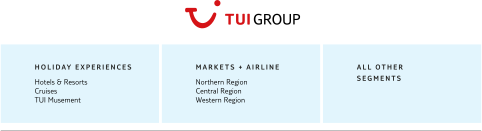 As at 30 September 2025
TUI AG parent company
TUI AG is TUI Group’s parent company headquartered in Hanover. It holds direct or, via its affiliates, indirect interests in the principal Group companies conducting the Group’s operating business in individual countries. Overall, TUI AG’s group of consolidated companies comprised 247 direct and indirect subsidiaries at the balance sheet date. A further 15 affiliated companies and 25 joint ventures were included in TUI AG’s consolidated financial statements on the basis of at equity measurement.
For details, please refer to Principles and methods of consolidation and TUI Group shareholdings in the Notes.
Organisation and management
TUI AG is a stock corporation under German law, whose basic principle is two-tiered management by two boards, the Executive Board and the Supervisory Board. The Executive and Supervisory Boards cooperate closely in governing and monitoring the Company. The Executive Board is responsible for the overall management of the Company.
The appointment and removal of Board members are based on Sections 84 et seq. of the German Stock Corporation Act (AktG) in combination with Section 31 of the German Co-Determination Act (MitbestG). Amendments to the Articles of Association are effected on the basis of the provisions of Sections 179 et seq. of the German Stock Corporation Act in combination with Section 24 of TUI AG’s Articles of Association if appplicable.
Executive Board and Group Executive Committee
As at the balance sheet date, the Executive Board of TUI AG consisted of the CEO and four other Board members.
For details please refer to the chapter Corporate governance, section Executive Board and Supervisory Board
The Executive Board is the Company’s central decision-making body. In addition, there is the Group Executive Committee (GEC), which, as a rule, participates in all Board meetings, with the exception of items dealing with personnel matters relating to the composition of the Senior Leadership Team. The GEC was set up to enhance informed, effective decision-making and to create a flat hierarchy and strong execution environment. It reflects a culture of openness and information sharing. As of 30 September 2025, it consisted of ten members (including all Executive Board members) and is chaired by the Chairman of the Executive Board.
For further details, please refer to www.tuigroup.com/en-en/investors/corporate-governance
TUI Group reporting structure1
TUI Group is a global integrated tourism group. As at 30 September 2025, its core businesses, Holiday Experiences and Markets + Airline, were clustered into the segments Hotels & Resorts, Cruises and TUI Musement as well as three regions: Northern, Central and Western Region. TUI Group also comprises All other segments. The Group’s reporting structure thus remained unchanged year-on-year in the reporting period.
Holiday Experiences
Holiday Experiences comprises our hotel, cruise and destination activities.
Hotels & Resorts
The Hotels & Resorts segment is made up of TUI Group’s diversified portfolio of Group hotel brands and hotel companies. The segment includes hotels majority-owned by TUI, joint ventures with local partners, stakes in companies giving TUI significant influence, and hotels operated under management contracts.
In financial year 2025, Hotels & Resorts comprised a total of 463 hotels with 337,699 beds. The year-on-year increase is mainly due to the signing of franchise agreements with hotels previously operated as concept hotels and to further expansion of our portfolio in line with our asset right strategy.
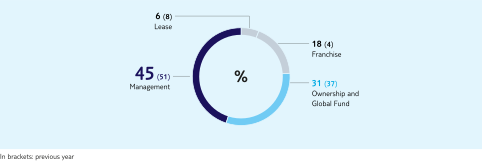
427 hotels, i. e. the majority, are in the four- or five-star categories. 45% were operated under management contracts, 31% were owned by one of the hotel companies, 18% of the hotels were managed under franchise agreements and 6% were leased.
Hotels & Resorts financing structure
| Hotels & Resorts portfolio | ||||||
|---|---|---|---|---|---|---|
| Hotel brand | 3 stars | 4 stars | 5 stars | Total hotels | Beds | Sites (selection) |
| Riu | 2 | 43 | 51 | 96 | 108,571 | Spain, Mexico, Caribbean, Cape Verde, Morocco |
| Robinson | 1 | 16 | 9 | 26 | 16,451 | Spain, Greece, Türkiye, Cape Verde, Austria, Maledives |
| Royalton | 4 | 24 | 29 | 57 | 44,794 | Dom. Rep., Jamaica, Mexico, Saint Lucia, Cuba |
| Others | 29 | 155 | 100 | 284 | 167,883 | Spain, Greece, Türkiye, Egypt |
| Total | 36 | 238 | 189 | 463 | 337,699 | |
| As at 30 September 2025 | ||||||
Hotels & Resorts beds per region
Riu is an international hotel chain, founded in 1953 with the opening of the first hotel. The Mallorca-based enterprise now primarily operates four- and five-star hotels, above all in Spain, Mexico and the Caribbean. Its three product lines Riu Classic Hotels, Riu Plaza Hotels (city hotels) and Riu Palace Hotels (premium segment) target different customer groups.
Robinson operates mainly four- and five-star club hotels and is a leading German provider of club holidays in terms of the number of resorts. Most of its clubs are located in Spain, Greece, Türkiye, the Maldives and Austria.
Royalton Hotels & Resorts (formerly Blue Diamond Resorts) is a hotel chain in the Caribbean. The Hotels & Resorts segment is composed of 57 resorts in the Caribbean and Mexico. The brand is one of the twelve core brands of the TUI Group, covering all leisure hotel categories from price-conscious to luxury.
The portfolio also includes the TUI signature hotels TUI Blue, TUI Magic Life, TUI Suneo as well as the new brand The Mora, which are reported in Others hotels. The Mora brand is designed for a new target group that is looking for modern, contemporary luxury and a high degree of flexibility in holiday arrangements. In 2024, the first hotel under the new brand opened in Zanzibar, Tanzania. The second resort is set to follow in Tunisia in financial year 2026.
TUI Blue, present in more than 23 countries, is TUI Group’s global hotel brand, targeting an international audience. In financial year 2025, TUI Blue continued its expansion into Asia, amongst other regions, opening hotels in Thailand, Indonesia, Cambodia and China.
TUI Magic Life is an all-inclusive brand, targeting an international audience seeking club holidays with different profiles in beachfront locations.
TUI Suneo offers value-for-money hotels.
Cruises
The Cruises segment comprises the joint venture TUI Cruises, which operates cruise ships under the brands Mein Schiff and Hapag-Lloyd Cruises, and Marella Cruises. With their combined fleet of 18 vessels as at the reporting date, the three cruise lines offer different service concepts to serve different target groups.
| Cruise fleet by ownership structure | |||
|---|---|---|---|
| Owned | Leased | Total | |
| TUI Cruises (joint venture) | 13 | 0 | 13 |
| Mein Schiff | 8 | 0 | 8 |
| Hapag-Lloyd Cruises | 5 | 0 | 5 |
| Marella Cruises | 4 | 1 | 5 |
| Total | 17 | 1 | 18 |
| As at 30 September 2025 | |||
TUI Cruises is a joint venture in which TUI AG and the US shipping company Royal Caribbean Cruises Ltd. each hold a 50% stake. TUI Cruises, which occupies a leading position2 in the German-speaking cruise market with its eight ships in the ‘Mein Schiff’ brand, continued to expand its fleet in financial year 2025. Following the commissioning of Mein Schiff Relax in March 2025, another newbuild, the Mein Schiff Flow, is scheduled to enter service in calendar year 2026, bringing the fleet to a total of nine ships. After the pandemic, TUI Cruises has thus continued its growth as planned.
The traditional Hapag-Lloyd Cruises brand, which is also part of TUI Cruises, is a leading provider of luxury and expedition cruises in German-speaking markets. As at the reporting date, the fleet comprised two luxury liners and three expedition cruise ships. They are the only ships worldwide to have each been awarded a five-star rating by Insight Guides Cruising & Cruise Ships 2025, an international reference for cruise ships rankings. Hapag-Lloyd Cruises has been awarded the title of Best Fleet Worldwide for the second time in a row.
With a fleet of five ships, Marella Cruises offers voyages in different segments, including family and adults only, in the UK market.
TUI Musement
The TUI Musement segment delivers local services at our holiday destinations around the world. To this end, TUI has a presence in numerous holiday destinations with its own staff. TUI Musement's business model for the distribution of experiences (excursions, activities and tickets), transers and multi-day tours is founded on an online platform open to customers and suppliers. Experiences are either developed by TUI teams or sourced locally. The products are sold to customers worldwide via TUI websites and apps, as well as through local teams and B2B partners.
TUI Musement serves three customer groups:
- TUI customers: Providing services to our guests in the destination via tour reps as well as via the TUI App and the TUI Experience Centre.
- Strategic B2B customers: Digital and on-site services for partners from various sectors of the travel industry, such as airlines, cruise lines, ground transport, OTAs, hotels and tour operators.
- B2C open market clients: Global distribution of experiences and tours for travellers.
Markets + Airline
Our Markets + Airline business breaks down into three regions: Northern Region (tour operators and airline in the UK, Ireland and the Nordics), Central Region (tour operators and airline in Germany and tour operators in Austria, Poland and Switzerland) and Western Region (tour operators and airline in Belgium and the Netherlands as well as tour operators in France).
Each of the three regions has sales and marketing structures offering our customers attractive holiday experiences. Our sales activities operate through both online and offline channels. The travel agencies include Group-owned agencies as well as joint ventures and agencies operated by third parties. In order to offer our customers a wide choice of accommodation, our source market organisations can draw on a substantial portfolio of TUI hotels. They also have access to third-party bed capacity, some of which has been contractually committed.
Our own flying capacity continues to play a key role in our business model. Thanks to a combination of Group-owned and third-party capacity, we offer tailored travel programmes for each individual source market region and can respond flexibly to changes in customer preferences. Balanced management of flight and hotel capacity enables us to develop destinations and optimise margins for both service providers.
All other segments
‘All other segments’ includes the corporate centre functions of TUI AG and the interim holdings, the Group’s real estate companies and the Group’s key tourism functions.
Research and development
As a tourism service provider, the TUI Group does not engage in research and development activities in the same way as manufacturing companies. A corresponding sub-report is therefore not required.
Value-oriented Group management
Management system and key performance indicators
A standardised management system has been created to implement value-driven management across TUI Group and its individual business areas. The value-oriented management system is an integral part of consistent Group-wide controlling and planning processes.
Our key financial performance indicators for tracking our earnings position are revenue and underlying EBIT. Accordingly, underlying EBIT represents the segment indicator as defined by IFRS 8.
We define the EBIT in underlying EBIT as earnings before interest, taxes and expenses for the measurement of the Group’s interest hedges. EBIT by definition includes amortisation / impairment of goodwill.
Underlying EBIT has been adjusted for income and expense items which, due to their level and frequency, impact or distort the assessment of operating profitability of the segments and the Group. These one-off items include gains and losses on disposal of investments, major gains and losses from the disposal of assets, and major restructuring and integration expenses. The indicator is additionally adjusted for all effects from purchase price allocations, ancillary acquisition costs and conditional purchase price payments. The reconciliation to underlying EBIT also adjusts for goodwill impairments.
To track the Group’s financial position, we identified net capital expenditure and financial investments as well as TUI Group’s net financial position as key performance indicators. In addition, we monitor the Group’s leverage ratio as a further indicator of financial stability.
Key management variables used for regular value analysis are Return On Invested Capital (ROIC) and Economic Value Added. ROIC is presented alongside the with the Weighted Average Cost of Capital before tax (WACC).
We regard specific carbon emissions (in g CO2/rpk) from our aircraft fleet as the most relevant non-financial key performance indicator.
To track business performance in our segments in the course of the year, we also monitor other non-financial performance indicators, such as the customer numbers in tour operation, capacity or passenger days, occupancy and average prices in Hotels & Resorts and Cruises.
For further information about operating performance indicators, please refer to the sections on Segmental performance.
Cost of capital
The cost of capital is calculated as the weighted average cost of capital (WACC). While the cost of equity reflects the return expected by investors from TUI shares, the cost of debt is based on the average borrowing costs of TUI Group. The cost of capital always shows pre-tax costs, i.e. costs before corporate and investor taxes. The expected return determined in this way corresponds to the same tax level as the underlying EBIT included in ROIC. For financial year 2025, we expect a cost of capital of 10.83% (previous year: 10.87%) for TUI Group.
ROIC and Economic Value Added
ROIC is calculated as the ratio of underlying earnings before interest and taxes (underlying EBIT) to average invested interest-bearing capital (invested capital).
Given its definition, this performance indicator is not influenced by any tax or financial factors and has been adjusted for one-off effects. From a Group perspective, invested capital is derived from liabilities, which consists of equity (including non-controlling interests) and the balance of interest-bearing liabilities and interest-bearing assets with an adjustment for the seasonality of the Group’s net financial position. The cumulative amortisation of purchase price allocations is then added to invested capital.
Apart from ROIC as a relative performance indicator, Economic Value Added is used as an absolute value-oriented performance indicator. Economic Value Added is calculated as the product of ROIC less associated pre-tax capital costs (WACC) multiplied by interest-bearing invested capital.
In the year under review, TUI Group’s ROIC amounted to 26.53% (previous year: 24.88%). Taking into account the Group's weighted average cost of capital of 10.83%, this resulted in an Economic Value Added of €836.2m (previous year: €729.9m).
| Invested Capital | |||
|---|---|---|---|
| € million | Notes | 2025 | 2024 |
| Equity | 2,686.7 | 1,774.3 | |
| Subscribed capital | (24) | 507.4 | 507.4 |
| Capital reserves | (25) | 7,980.4 | 7,980.4 |
| Revenue reserves | (26) | -6,725.4 | -7,531.5 |
| Non-controlling interest | (28) | 924.2 | 817.9 |
| plus interest bearing financial liability items | 5,296.2 | 5,665.9 | |
| Pension provisions and similar obligations | (29) | 618.5 | 664.3 |
| Non-current financial liabilities | (31), (39) | 1,562.2 | 1,543.6 |
| Current financial liabilities | (31), (39) | 420.6 | 358.8 |
| Derivative financial instruments | (39) | 240.4 | 459.4 |
| Lease liabilities (IFRS 16) | (31), (39) | 2,454.4 | 2,639.7 |
| less financial assets | 2,798.4 | 2,482.1 | |
| Derivative financial instruments | (39) | 116.9 | 30.8 |
| Cash and cash equivalents | (22), (39) | 3,120.2 | 2,848.2 |
| Other financial assets | 61.3 | 103.1 | |
| Seasonal adjustment1 | -500.0 | -500.0 | |
| less overfunded pension plans | 95.0 | 75.4 | |
| = Invested Capital before addition of effects from purchase price allocation | 5,089.5 | 4,882.8 | |
| Invested Capital excluding purchase price allocation previous year | 4,882.8 | 4,844.7 | |
| Ø Invested capital before addition of effects from purchase price allocation2 | 4,986.1 | 4,863.7 | |
| Invested Capital before addition of effects from purchase price allocation | 5,089.5 | 4,882.8 | |
| plus effects from purchase price allocation | 324.7 | 355.2 | |
| Invested Capital | 5,414.2 | 5,237.9 | |
| Invested Capital previous year | 5,237.9 | 5,181.1 | |
| Ø Invested Capital2 | 5,326.0 | 5,209.5 | |
| 1 Adjustment to net debt to reflect a seasonal average cash balance | |||
| 2 Average between values at start and end of year | |||
| ROIC | |||
|---|---|---|---|
| € million | 2025 | 2024 | |
| Underlying EBIT | 1,413.1 | 1,296.2 | |
| Ø Invested Capital1 | 5,326.0 | 5,209.5 | |
| ROIC (%) | 26.53 | 24.88 | |
| Weighted average cost of capital (WACC, %) | 10.83 | 10.87 | |
| Value added | 836.2 | 729.9 | |
| 1 Average value based on balance at beginning of year and year-end | |||
Group performance indicators used in the Executive Board remuneration system
STI-relevant EBIT at constant currency
Group earnings before interest and taxes (EBIT) on a constant currency basis, weighted at 75%, are used to determine annual variable remuneration (STI) for the Executive Board. EBIT is quantified on a constant currency basis in order to avoid any distortion caused by currency-driven translation effects when measuring actual management performance.
Group earnings before interest (including the result of the measurement of the Group’s interest hedges) and taxes on a constant currency basis developed as follows in the financial year under review:
| Reconciliation EBIT | |
|---|---|
| € million | 2025 |
| EBIT | 1,368.9 |
| FX effects from translation at budget rates | 17.1 |
| EBIT at budget rates | 1,386.0 |
STI-relevant total cash flow
The second Group indicator taken into account in the Short Term Incentive - STI in accordance with the remuneration system is the cash flow figure ‘total cash flow before dividends’, which is included in the calculation with a weighting of 25%. For these purposes, total cash flow before dividends is generally calculated using a simplified approach based on the management cash flow statement. TUI Group's EBIT is likewise adjusted for foreign exchange effects for this purpose.
The total cash flow for financial year 2025 amounts to €299.8m and corresponds to the change in cash and cash equivalents. For the STI compensation system, a total cash flow before dividends of €527.9m was determined. This figure consists of the total cash flow (€299.8m) plus dividends paid by subsidiaries to non-controlling interests (€99.5m) and minus inflows from the unbudgeted disposal of short-term money market funds (€4.2m). The cash outflow from the repayment of promissory note loans (€209.5m) at maturity was added back. The cash inflow from the issuance of a promissory note loan that was not used for the planned refinancing of existing debt was deducted by €76.8m.
LTI-relevant earnings per share
Since the beginning of financial year 2024, the average development of earnings per share from continuing operations (LTI-relevant EPS) has been taken into account when calculating the long-term remuneration of active members of the Management Board (Long Term Incentive – LTI). Reported EPS as a performance target is defined as the reported undiluted earnings per share from continuing operations recognised in TUI Group’s approved and audited consolidated financial statements.
Earnings per share from continuing operations (LTI-relevant EPS, non-diluted earnings per share) developed as follows in the financial year under review:
| Earnings per share | |||
|---|---|---|---|
| 2025 | 2024 | ||
| Group profit for the year attributable to shareholders of TUI AG | € million | 635.9 | 507.1 |
| Weighted average number of shares | 507,431,033 | 507,431,033 | |
| Basic earnings per share | € | 1.25 | 1.00 |
| Diluted earnings per share | |||
| 2025 | 2024 | ||
| Group profit for the year attributable to shareholders of TUI AG | € million | 635.9 | 507.1 |
| Adjusted Group profit for the year attributable to shareholders of TUI AG | € million | 653.7 | 509.9 |
| Weighted average number of shares | 507,431,033 | 507,431,033 | |
| Weighted average number of shares (diluted) | 558,160,199 | 516,717,520 | |
| Diluted earnings per share | € | 1.17 | 0.99 |
For the purpose of determining the long-term compensation for members of the Management Board who left before or during financial year 2025, the average development of the basic pro forma adjusted earnings per share from continuing operations in accordance with the compensation system agreed with these members of the Management Board will continue to be taken into account.
Basic pro forma underlying earnings per share developed as follows in the period under review:
| Pro forma underlying earnings per TUI Group shares | ||
|---|---|---|
| € million | 2025 | 2024 |
| Underlying EBIT | 1,413.1 | 1,296.2 |
| less: Net interest expense | -334.7 | -413.8 |
| Underlying profit before tax | 1,078.5 | 882.4 |
| Income taxes (18% assumed tax rate) | 194.1 | 158.8 |
| Underlying Group profit | 884.3 | 723.6 |
| Minority interest | 205.8 | 200.3 |
| Underlying Group profit attributable to TUI AG shareholders | 678.5 | 523.3 |
| Numbers of shares at financial year end (in million) | 507.4 | 507.4 |
| Underlying earnings per share (€) | 1.34 | 1.03 |