

The remuneration report explains the remuneration of the members of the Executive Board of TUI AG and the remuneration of the members of the Supervisory Board in accordance with the Charter. The underlying remuneration systems are based in particular on the recommendations of the German Corporate Governance Code (GCGC) and the requirements of the German Stock Corporation Act (AktG). In addition, the remuneration report contains the information required by Section 162 AktG.
Executive Board and Executive Board remuneration
Approval of the remuneration system by shareholders
Following preparations by the Presiding Committee, the Supervisory Board of TUI AG approved a revised remuneration system for the members of the Executive Board in December 2023. This applies retroactively from the beginning of financial year 2024, i.e. from 1 October 2023. The revised remuneration system applies to active members of the Executive Board. The exceptions are former members of the Executive Board with current service agreements or those whose service agreements have already ended but who still have remuneration entitlements against TUI AG, for example from variable remuneration components. These are Mr Joussen, Mr Burling, Dr Eller, and Mr Rosenberger. There was no migration to the amended remuneration system for these former members of the Executive Board.
In accordance with the German Stock Corporation Act, the Supervisory Board must submit the remuneration system to the Annual General Meeting for approval in the event of any significant changes, but at least every four years. As part of the resolution passed on 13 February 2024, the Annual General Meeting approved the revised remuneration system for the members of the Executive Board with 88.94% of the votes cast. In accordance with the German Stock Corporation Act, the Executive Board and Supervisory Board must also prepare an annual remuneration report that must meet certain requirements (Section 162 AktG). The auditor must check whether the remuneration report contains all the information required by law within the meaning of Section 162 AktG and also issue an audit opinion. Pursuant to Section 120a (4) AktG, the audited remuneration report must be submitted to the Annual General Meeting for approval. The prepared and audited remuneration report within the meaning of Section 162 AktG for financial year ending 30 September 2024, was approved by the shareholders of TUI AG on 11 February 2025, with 59.52% of the votes cast. The decision of the Annual General Meeting on the approval of the remuneration report is of a recommendatory nature. The Supervisory Board has examined in detail the criticism expressed by some investors and proxy advisors regarding the remuneration report 2024 and remuneration system for the Executive Board in the run-up to the Annual General Meeting 2025. Criticisms regarding the remuneration report are addressed below with additional explanations compared to the remuneration report for financial year 2024, such as a more detailed textual and graphical presentation of facts. The report also addresses aspects that were viewed critically in the public discussion surrounding the remuneration system for the Executive Board. This concerns, among other things, the level of detail in the presentation of executive remuneration adjustments, the design of long-term variable remuneration for members of the Executive Board, pension benefits for Executive Board members, and the retrospective disclosure of targets in relation to variable remuneration.
Composition of the Executive Board
In financial year 2025, the Executive Board consisted of the following members.
- Sebastian Ebel: CEO
- Mathias Kiep: CFO
- Peter Krueger: CSO & CEO HEX
- Sybille Reiss: CPO / Labor Director
- David Schelp: CEO Markets + Airline
General principles
On the recommendation of the Presiding Committee, the Supervisory Board determines the remuneration of the individual members of the Executive Board in accordance with Section 87 para. 1 sentence 1 AktG. The Supervisory Board also regularly reviews the remuneration system for the Executive Board.
In particular, the following principles are taken into account:
- Comprehensibility and transparency
- Economic situation, success and sustainable development of the Company
- Linking the shareholders' interest in value enhancement and profit distribution with corresponding performance incentives for the members of the Executive Board
- Competitiveness in the market for highly qualified managers
- Appropriateness and orientation towards the tasks, responsibilities and success of each individual member of the Executive Board, also in a relevant environment of comparable international companies, taking into account typical practice in other large German companies
- Linking a significant portion of total remuneration to the achievement of ambitious long-term performance targets
- Appropriate relationship between the amount of the fixed remuneration and the performance-related remuneration
- Appropriateness in horizontal and vertical comparison
The remuneration system and the service agreements of the members of the Executive Board stipulate in particular,
- how the target total remuneration is determined for the individual members of the Executive Board and what amount the total remuneration may not exceed (maximum remuneration),
- the relative share of fixed remuneration on the one hand and short-term variable and long-term variable remuneration components on the other in the target total remuneration,
- which financial and non-financial performance criteria are decisive for the granting of variable remuneration components,
- what the link is between the achievement of the previously agreed performance criteria and the variable remuneration,
- in what form and when the member of the Executive Board can dispose of the variable remuneration amounts.
Like the previous remuneration system, the remuneration system adopted by the Supervisory Board in December 2023 and approved by the Annual General Meeting 2024 contains a compliance malus and clawback provision that applies to both the STI and the LTI. Accordingly, in the event of a serious breach by the beneficiary of the principles contained in the company's Code of Conduct or of duties of care in the management of the company during the assessment period of the corresponding variable remuneration components, the company may reduce the amounts paid out, cancel them completely or reclaim them in full or in part after payment. The Supervisory Board decides on this on a case-by-case basis at its due discretion and must take particular account of the severity of the breach and the amount of the financial or reputational damage caused by it in its decision.
In financial year 2025, the Supervisory Board did not make use of the option to withhold or reclaim variable remuneration components.
In addition, the Supervisory Board may temporarily deviate from the provisions of the remuneration system, including the remuneration structure and the individual remuneration components, in exceptional circumstances. Any deviations and the reasons for them are disclosed and explained in the remuneration report.
In financial year 2025, the Supervisory Board did not make use of the option to temporarily deviate from the compensation system.
Remuneration adjustments in the Executive Board
At its meeting in February 2023, the Supervisory Board reappointed Mr Krueger for a further three years with effect from 1 January 2024. The Supervisory Board also discussed the level of Mr Krueger's remuneration and resolved in July 2023 to adjust his target amounts to the level of long-standing members of the Executive Board as part of the extension of his appointment. In July 2023, the Supervisory Board also extended the appointment of Ms. Reiss to the Executive Board by further three years with effect from 1 July 2024. With regard to the target amounts, the same system was applied as for Mr Krueger. The increases are moderate and reflect the high value placed on executives at TUI. The remuneration increase also follows a long-established two-stage approach for members of the Executive Board. This approach provides for a defined remuneration package for the first three-year appointment and an increase in target remuneration in the event of a service agreement extension (see also the chart below). Both remuneration levels have remained unchanged for several years, which is a clear sign of stability and predictability.
Target direct remuneration for Executive Board members (excluding CEO): Initial appointment vs service agreement renewal
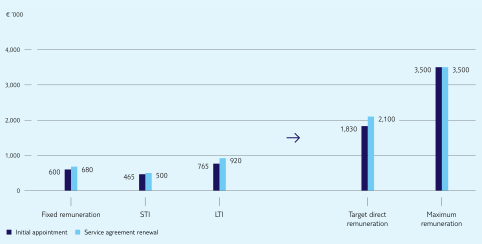
The Supervisory Board of TUI AG is convinced that this system represents an effective approach in a highly competitive market for highly qualified executives. The remuneration structure is a key component in attracting, motivating, and retaining suitable employees. Peter Krueger and Sybille Reiss are highly valued members of TUI’s management team. The extension of their appointments and the associated increase in their remuneration are in the best interests of the company. In the opinion of the Supervisory Board, they are justified and in line with the company's target of creating long-term value. The Supervisory Board also conducted its annual review of Executive Board remuneration and pensions for financial year 2025. It concluded that the level of Executive Board remuneration and pensions is appropriate from a legal perspective and in accordance with Section 87 (1) of the German Stock Corporation Act (AktG).
In financial year 2023, the consulting firm hkp group was commissioned to prepare an expert opinion on the market conformity of the amount and structure of the target remuneration for the members of the Executive Board of TUI AG – including the amount of a remuneration package for the initial appointment and one for the service agreement renewal. The external consultant's findings confirmed the Supervisory Board's assessment that the amount of Executive Board remuneration for financial year 2023 complies with the provisions of Section 87 (1) of the German Stock Corporation Act (AktG) and the recommendations of the German Corporate Governance Code (GCGC). The Supervisory Board did not commission a corresponding opinion on the market conformity of the remuneration level for the members of the Executive Board for financial years 2024 and 2025 in order to assess its appropriateness. The reason for this is that the target remuneration for newly appointed and reappointed members of the Executive Board did not exceed the level of existing members of the Executive Board and was not above the pre-COVID-19 level.
In addition, the Executive Board was reduced in size in financial year 2023. As a result, the total remuneration for the Executive Board of TUI AG has decreased.
I. Remuneration of the Executive Board in financial year 2025
In financial year 2025, the remuneration structure for the members of the Executive Board consisted of (1) fixed remuneration, (2) a performance-related annual bonus (Short Term Incentive - STI), (3) virtual shares in TUI AG under the Long Term Incentive (LTI), (4) fringe benefits and (5) pension benefits. The following table provides an overview of the individual components of the applicable remuneration system approved by the Annual General Meeting for the members of the Executive Board appointed at the balance sheet date and the structure of the individual remuneration components.
Overview of the remuneration system for active members of the Executive Board
Below is a summary graphic representation of the current remuneration system. This is followed by a detailed explanation of the individual remuneration components.
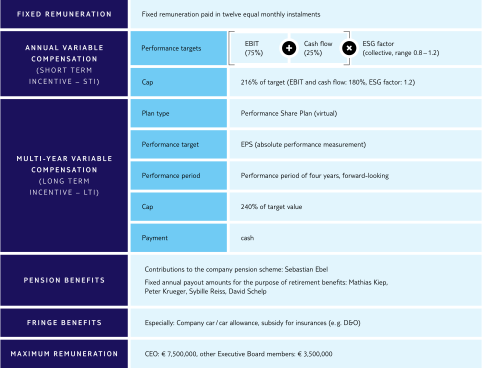
Target total remuneration
Target
The target total remuneration of the members of the Executive Board was determined as follows
Composition of the target total remuneration of the members of the Executive Board
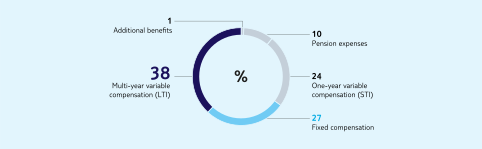
| Target total remuneration | |||
|---|---|---|---|
| € '000 | Fixed remuneration¹ | STI | LTI |
| Sebastian Ebel | 1,100.0 | 1,270.0 | 1,830.0 |
| Mathias Kiep | 600.0 | 465.0 | 765.0 |
| Peter Krueger | 680.0 | 500.0 | 920.0 |
| Sybille Reiss | 680.0 | 500.0 | 920.0 |
| David Schelp | 600.0 | 465.0 | 765.0 |
| ¹ Fixed amount, no cap applied | |||
(1) Fixed remuneration
Target
Fixed remuneration paid in twelve equal instalments in arrears at the end of each month, taking into account the applicable tax and social security regulations.
Together with the other remuneration components, the fixed remuneration forms the basis for attracting and retaining the highly qualified members of the Executive Board required for the development and implementation of the corporate strategy.
Intra-group mandates
No separate remuneration / offset against fixed remuneration
Mandates outside the Group
No offsetting against fixed remuneration, subject to approval by the Supervisory Board
(2) STI
Target
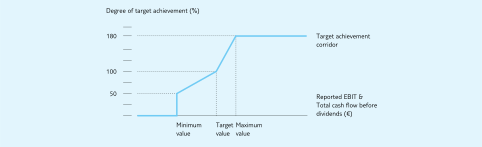
The STI is designed to motivate the members of the Executive Board to achieve ambitious and challenging financial, operational, strategic, and sustainability targets during a financial year. The targets reflect the corporate strategy and are aimed at increasing the value of the company. In particular, by linking it to the reported EBIT, the one-year variable remuneration is tied to the achievement of a key Group performance indicator in the respective financial year. As a result, target achievement – and thus the achievable remuneration – is closely linked to performance (“Pay for Performance”).
Description STI
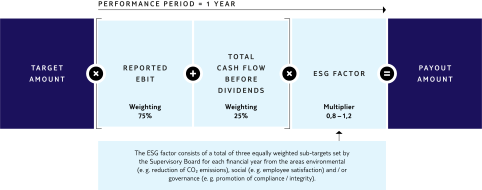
Target amount
Contractually agreed, individual target amount
Overall target achievement
- Total target achievement of the financial ratios
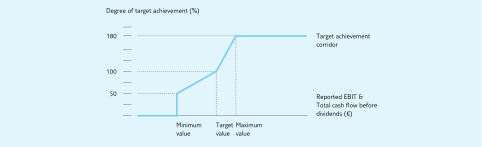
- Interpolation of financial ratios: 0 % - 180 %
- ESG factor: 0.8 - 1.2
- Adjustment element in accordance with section G.11 GCGC
- Compliance malus and clawback
Group key figure 1
Reported EBIT
Target achievement
Actual vs. target value based on constant currency
Target achievement corridor
Minimum, target and maximum values are set by the Supervisory Board for each financial year
Target Achievement corridor EBIT in %
Weighting
75%
Group key figure 2
Total cash flow before dividends
Target achievement
Actual vs. target value
Target achievement corridor
Minimum, target and maximum values are set by the Supervisory Board for each financial year
Target achievement corridor cash flow in %
Weighting
25 %
ESG factor
Target
The Supervisory Board sets a total of three equally weighted sub-targets from the areas of environmental, social and/or governance (ESG) as sustainability targets for each financial year and all members of the Executive Board.
Target achievement corridor
0.8 - 1.2
(3) LTI
Target
The aim is to increase the value of the company and shareholder value in the long term by setting ambitious targets that are closely linked to the company's earnings and share price performance. By linking remuneration to earnings per share (EPS) and share price performance, the interests and expectations of shareholders are aligned with the remuneration of the Executive Board. The four-year performance period helps to ensure that the actions of the Executive Board in the current financial year are also geared toward the long-term development of the company. This means that the achievement of targets and thus the remuneration that can be earned is closely linked to performance (“pay for performance”).
The Supervisory Board takes seriously the criticism expressed in the run-up to the Annual General Meeting 2025 regarding the existing structure of the LTI, in which the achievement of targets depends solely on a financial performance criterion. With regard to the current structure of the LTI, it should be noted that the achievement of targets is determined on the one hand by the EPS ratio, but on the other hand also depends significantly on the performance of the TUI share price. The Supervisory Board is of the opinion that the current structure of the LTI reconciles the interests of shareholders and members of the Executive Board. In addition to this, share ownership obligations for active members of the Executive Board were introduced with the Share Ownership Guidelines (SOG).
The Supervisory Board will also take into account feedback from investors and proxy advisors in its considerations during the next regular review of the remuneration system for the Executive Board, which is generally scheduled for financial year 2028. The Supervisory Board has decided against an unscheduled adjustment of the remuneration system for the Executive Board due to the recent revision and the high approval rate for this revised system at the Annual General Meeting 2024. The Supervisory Board has carefully weighed this decision and is also aware of its responsibility towards the members of the Executive Board of TUI AG to ensure appropriate continuity and reliability with regard to remuneration – also in terms of the steering function of the remuneration system.
Description LTI
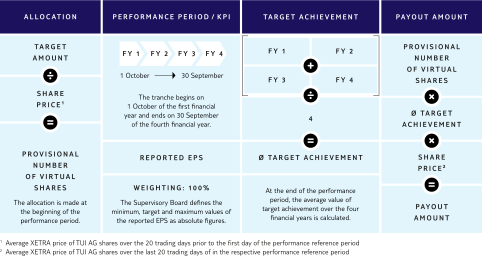
Target amount
Contractually agreed individual target amount
Total target achievement
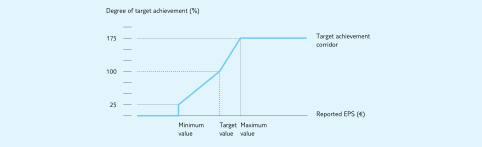
- Interpolation key figure: 0% - 175%
- Compliance malus and clawback
Group key figure
Reported EPS
Target achievement
Actual vs. target value of average annual EPS over the performance period
Target achievement corridor
Minimum, target and maximum values are set by the Supervisory Board for each financial year
Target achievement corridor EPS in %
Shares
- Allocation of a provisional number of virtual shares, calculated as the quotient of the agreed individual target amount and the average Xetra share price of TUI AG for the twenty trading days prior to the first day of the performance period.
- The final number of virtual shares is calculated as the product of the provisional number of virtual shares and the degree of target achievement of the key figures.
Payout
Multiplication of the final number of virtual shares by the average Xetra share price of TUI AG over the last twenty trading days prior to the end of the performance period.
(4) Fringe benefits
Target
The fringe benefits should be competitive in the market for highly qualified members of the Executive Board so that TUI can attract suitable candidates to the company and retain them in the long term. Furthermore, an attractive working environment should be created for the members of the Executive Board.
- Reimbursement of travel expenses for business trips
- Accident insurance
- Subsidy for health and long-term care insurance
- Assumption of costs for medical check
- Criminal law protection and D&O insurance
- Company car / car allowance
(5) Maximum remuneration
Target
- CEO: €7,500 k
- Other members of the Executive Board: €3,500 k
- Contractually defined upper limit for total remuneration (incl. fixed remuneration, STI, LTI, [company] pension scheme and fringe benefits). If the contractually defined upper limit for total remuneration is exceeded, the LTI is reduced proportionately in the inflow. The contractually defined upper limit for total remuneration corresponds to the respective maximum total remuneration for the members of the Executive Board determined by the Supervisory Board.
| Maximum remuneration | ||||
|---|---|---|---|---|
| € '000 | Fixed remuneration1 | STI | LTI | Maximum total remuneration |
| Sebastian Ebel | 1,100.0 | 2,743.2 | 4,392.0 | 7,500.0 |
| Mathias Kiep | 600.0 | 1,004.4 | 1,836.0 | 3,500.0 |
| Peter Krueger | 680.0 | 1,080.0 | 2,208.0 | 3,500.0 |
| Sybille Reiss | 680.0 | 1,080.0 | 2,208.0 | 3,500.0 |
| David Schelp | 600.0 | 1,004.4 | 1,836.0 | 3,500.0 |
| 1 Fixed amount, no cap applied | ||||
(6) Severance payment cap in the event of early termination of contract
Target
- Severance payment limited to the value of two years’ remuneration
- No change of control clauses agreed
(7) Pension benefits
Target
Highly qualified members of the Executive Board who are necessary for the development and implementation of the corporate strategy should be recruited and retained. Pension benefits and pension subsidies should be competitive in the market for highly qualified members of the Executive Board and offer them an appropriate level of provision in retirement. Pension benefits for new appointments were already converted to a fixed annual pension payment without interest in 2021. The level of the payout amounts has remained unchanged since its introduction. The pension benefits were also part of the considerations of the consulting firm hkp group in financial year 2023. The firm was commissioned to prepare an expert opinion on the market conformity of the amount and structure of the target remuneration for the members of the Executive Board of TUI AG – including the amount of a remuneration package for the first appointment and one for subsequent appointments. The external consultant's findings confirmed the Supervisory Board's assessment that the amount of Executive Board remuneration is in line with market conditions and not unreasonable within the meaning of Section 87 (1) of the German Stock Corporation Act (AktG) and thus complies with the recommendations of the German Corporate Governance Code (GCGC).
Contributions to the company pension scheme
- Mr Ebel: € 454.5 k per year. In the case of Mr Ebel, the resulting pension can be paid when he reaches the age of 62, if the pension event has occurred
Fixed annual payment amounts for the purpose of retirement benefits
- Mr Kiep: € 230.0 k per year
- Mr Krueger: € 230.0 k per year
- Ms Reiss: € 230.0 k per year
- Mr Schelp: € 230.0 k per year
(8) Share Ownership Guidelines
- From the beginning of financial year 2025, the members of the Executive Board are obliged to acquire shares of TUI AG up to a defined minimum amount and to hold them for a defined period of time.
- The purpose of the shareholding obligation is to strengthen the joint interests of the Executive Board and shareholders.
- The amount of the shareholding obligation is determined as a percentage of the fixed remuneration: Chairman of the Executive Board: 150%, other members of the Executive Board: 100%.
- A stake of 25% of the STI payout amount (net) must be invested in shares each year until the minimum amount is reached.
- The shares must be held until the end of the period of service or (in the event of premature termination of the period of service and continuation of the service agreement) until the end of the service agreement.
Overview of remuneration components to be applied to departed members of the Executive Board
The revised remuneration system does not apply to former members of the Executive Board with remuneration entitlements. The previous remuneration system continues to apply to them. Compared to the revised remuneration system, the main difference is the structure of the variable components of the STI and the LTI. As former members of the Executive Board are only entitled to remuneration in respect of the LTI, the following presentation is limited to this remuneration component.
Description LTI
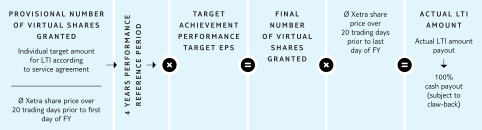
Target amount
Contractually agreed individual target amount
Total target achievement
- Interpolation key figure: 0 % - 175 %
- Adjustment: EPS < € 0.50
- Compliance malus and clawback
Group key figure
EPS
Target achievement
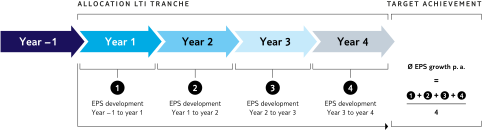
EPS p. a. on the basis of four weighted annual amounts
Allocation of virtual shares
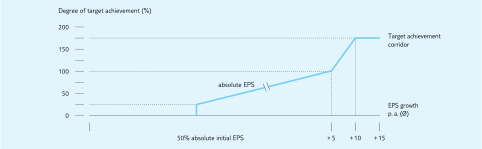
Target achievement corridor
Ø 50 % Start EPS to Ø 10 % p. a
Target achievement corridor EPS in %
Shares
- Allocation of a provisional number of virtual shares, calculated as the quotient of the agreed individual target amount and the average Xetra share price of TUI AG for the twenty trading days prior to the first day of the performance period.
- The final number of virtual shares is calculated as the product of the provisional number of virtual shares and the degree of target achievement of the key figures.
Payment
Multiplication of the final number of virtual shares by the average Xetra share price of TUI AG over the last twenty trading days in the respective performance period.
I.1 Pension provisions for appointed members of the Executive Board under TUI AG'S pension scheme
The pension obligations for the appointed members of the Executive Board in accordance with IAS 19 amounted to € 8,655.9 k as at 30 September 2025 (previous year: € 7,700.9 k). Of this amount, € 4,031.8 k (previous year: € 4,122.8 k) related to entitlements earned by Mr Ebel in the framework of his service for the TUI Group until 31 August 2006.
| Pensions and the amounts spent or accrued for this purpose by the appointed member of the Executive Board under TUI AG's pension plan | ||||
|---|---|---|---|---|
| Addition to/ reversal from pension provisions | Net present value | |||
| € '000 | 2025 | 2024 | 30.09.2025 | 30.09.2024 |
| Sebastian Ebel | 1,046.0 | 571.2 | 4,624.1 | 3,578.1 |
For Mr Ebel's pension obligations, corresponding assets were transferred to a trustee in accordance with the contractual agreement in order to finance the pension rights and secure them in the event of a security case.
I.2 Benefits in the event of premature termination of board membership
The payments to be made to a member of the Executive Board on premature termination of his or her service agreement without good cause may not exceed the value of the remuneration for the remaining term of the service agreement and in any case may not exceed two years' remuneration (severance payment cap).
The severance payment cap is calculated on the basis of the target direct remuneration (fixed remuneration, target amount of the STI and target amount of the LTI) for the past financial year and, if applicable, the expected target direct remuneration for the current financial year. If the service agreement is terminated for cause, the members of the Executive Board do not receive any benefits.
If the appointment of a member of the Executive Board is revoked, the respective service agreement shall also end. If the revocation is not based on a reason that also constitutes good cause for termination of the service agreement without notice, the service agreement shall end at the end of a period of up to 24 months to the end of the month or at the end of the term of the service agreement, if it ends earlier.
In the event of premature termination of the service agreement, the STI and payments from the LTI are regulated as follows:
- STI:
- If the service agreement is terminated by the company before the end of the one-year performance period for good cause for which the member of the Executive Board is responsible, or if the member of the Executive Board resigns without good cause, the entitlement to the short-term incentive for the relevant performance period lapses without replacement or compensation.
- In all other cases of premature termination of the service agreement before the end of the one-year performance period, the STI is paid out pro rata temporis.
- LTI:
- Entitlements under the LTI lapse without replacement or compensation for all tranches not yet paid out if the service agreement is terminated extraordinarily by TUI AG before the end of the performance period for good cause for which the Executive Board member is responsible or by the Executive Board member without good cause.
- If the service agreement ends before the end of the performance period for other reasons, the entitlements from the LTI for tranches not yet paid out are retained. The tranche for the current financial year is reduced pro rata temporis. The amount paid out is calculated in the same way as if service agreement were continued.
TUI AG is entitled to release the members of the Executive Board in connection with the ending of the service agreement, in particular following the termination of this service agreement, irrespective of the party declaring the termination, or following the conclusion of a termination agreement, in whole or in part from the obligation to perform work with continued payment of remuneration. The release shall be initially irrevocable for the duration of any remaining vacation entitlements, which are thus settled. Subsequently, the release shall be maintained until the end of the service agreement. It is revocable if questions arise in connection with the handling of the employment relationship or if temporary activity becomes necessary for operational reasons. The service agreement is not otherwise affected by this.
The service agreements of the members of the Executive Board do not contain any change of control clauses.
I.3 Benefits and benefit commitments to members of the Executive Board who have left the Executive Board in financial year 2025
No members left the Executive Board of TUI AG in financial year 2025.
II. Overview: Individual remuneration of the members of the Executive Board
II.1 Achievement of targets
The following describes how the performance criteria were applied and the targets for the variable remuneration components were achieved in financial year 2025.
II.1.1 STI
Multiplying the target amounts by the weighted target achievement levels for EBIT and cash flow and the ESG factor results in the amount taken into account for the payment of the STI for each member of the Executive Board.
Description STI
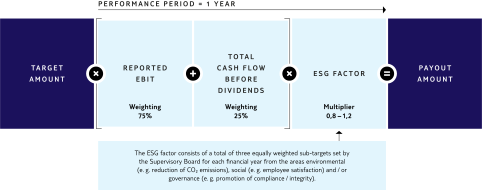
The Supervisory Board has determined that the targets for reported EBIT and cash flow have been achieved. The financial indicators were taken into account with a weighting factor of 75% for reported EBIT and 25% for cash flow. Reported EBIT increased significantly compared to the previous year and the plan, resulting in a target achievement rate of 114%. The cash flow remained slightly below the target value, resulting in a target achievement rate of 91%. This results in a weighted overall target achievement rate of 108.25%. The Supervisory Board took note of the desire expressed in the run-up to the Annual General Meeting 2025 for greater transparency with regard to the subsequent disclosure of targets for variable remuneration on the part of individual proxy advisors and investors. The members of the Supervisory Board evaluated how the disclosure of targets could be improved. In this regard, it is crucial that the minimum, target, and maximum values of the Group's financial key figures in the STI are based on the planning for the respective financial year – in this case, financial year 2025. The target value was defined as the planned value of the respective key figure. The ambitious corridors set for both financial Group key figures are in line with the continuous and consistent further development of the targets pursued in the previous year. The Supervisory Board also discussed the subsequent disclosure of the absolute target values and came to the conclusion that this would not be possible without disclosing sensitive business information and planning details. In the interests of the company and thus in the interests of its shareholders, the Supervisory Board has decided not to disclose this information.
The following table refers to the ESG factor in the STI. It shows the ESG sub-targets set for financial year 2025: increasing customer satisfaction as measured by the Net Promoter Score, increasing employee satisfaction as measured by the Engagement Index of the annual employee survey, and reducing CO2 emissions based on the targets of the TUI Sustainability Agenda 2030. The latter is published on the company's website and has been reviewed by the Science Based Targets Initiative in January 2023. The Supervisory Board has decided to leave the performance criteria for the ESG sub-targets unchanged from the previous year, as they are derived from the corporate strategy and are in line with the materiality analysis. At the same time, maintaining the ESG sub-targets ensures continuity, especially since the targets are derived from long-term objectives for the Group, such as the TUI Sustainability Agenda 2030. This means that the achievement of targets and thus the achievable remuneration is closely linked to performance (“pay for performance”). The achievement of the ESG sub-targets in financial year 2025 is shown below.
| ESG targets | |||
|---|---|---|---|
| Metric | Target | Performance | |
|
1A: Reduction of CO2 emissions: Airline |
g CO₂e pro rpk (Scope 1 and 3) | - 6.9% vs. FY 2019 | -7.8% vs. FY 2019 |
|
1B: Reduction of CO2 emissions: Hotels |
t CO₂e (Scope 1 and 2) | - 15.0% vs. FY 2019 | -17.5% vs. FY 2019 |
|
1C: Reduction of CO2 emissions: Cruises |
t CO₂e (Scope 1 and 3) | - 3.0% vs. FY 2019 | -5.5% vs. FY 2019 |
| 2: Customer satisfaction | Net Promoter Score (NPS) in % | + 2% points | + 2% points |
| 3: Employee satisfaction | Engagement Index | Benchmark + 2 | Benchmark + 6 |
While the target of reducing CO₂ emissions in the airline sector was exceeded, it was significantly surpassed in the Hotels & Resorts and Cruises segments. The ambitious target regarding employee satisfaction was also clearly exceeded, while the sub-target for customer satisfaction was precisely met. Following its evaluation, the Supervisory Board concluded that, with regard to the ESG factor, a multiplier of 1.1 should be applied for the members of the Executive Board of TUI AG.
Thus, in financial year 2025, remuneration has been granted and is owed within the meaning of § 162 para. 1 sentence 1, sentence 2 no. 1 of the German Stock Corporation Act (AktG) from the STI for financial year 2025. The value of the STI therefore corresponds to the amount for the STI for financial year 2025, which will not be paid out until financial year 2026 in accordance with the service agreement. Overall, multiplying the target amounts by the weighted target achievement levels for EBIT and cash flow as well as the ESG factor results in an STI for the members of the Executive Board that is in the opinion of the Supervisory Board commensurate with the results for the financial year.
II.1.2 LTI
The provisions of the remuneration system applicable up to and including financial year 2023 shall govern the payment of the LTI tranche 2022-2025.
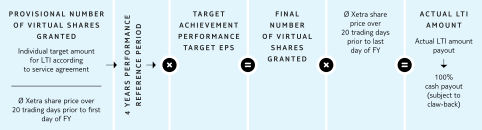
The allocation of the LTI tranche was based on an average share price of TUI AG of €3.62. At the end of the performance period, the average share price of TUI AG was €8.021. In accordance with the applicable remuneration system and following the end of the remuneration restrictions in financial year 2023, the Supervisory Board has set absolute target values for EPS and minimum and maximum values for determining the percentage target achievement for the LTI tranche. For past financial years with negative EPS, a target achievement of 0 was defined. For the respective remaining terms, the absolute EPS target values were determined on the basis of the original approved planning at the beginning of the respective performance period. For financial years 2022 and 2023, the target achievement for the LTI tranche 2022-2025 was 0.00%. For financial year 2024, the target achievement was 39.42%, and for financial year 2025, it was 56.36%. This results in an average annual target achievement of 23.95% for the performance period. For the LTI tranche 2022-2025, this means that remuneration has been granted and is owed within the meaning of Section 162 (1) sentence 1, sentence 2 no. 1 of the German Stock Corporation Act (AktG). The value of the LTI tranche 2022-2025 therefore corresponds to the amount for the LTI, whose four-year term ended on 30 September 2025, but which, according to the service agreement, will not be paid out until financial year 2026.
II.2 Loans or advances
As in the previous year and previous years, no loans or advances were granted to the members of the Executive Board in financial year 2025.
II.3 Application
II.3.1 "Remuneration granted and owed" within the meaning of section 162 para. 1 sentence 1 AktG in financial year 2025
Pursuant to Section 162 para. 1 sentence 1 and sentence 2 no. 1 AktG, all fixed and variable remuneration components "granted and owed" to the individual members of the Executive Board in financial year 2025 must be disclosed. The values stated for both the STI and the LTI for financial year 2025 relate to the remuneration components "granted and owed" in the respective financial year in accordance with Section 162 para. 1 sentence 1 AktG. They thus include all benefits earned in the respective financial year. The value of the STI therefore corresponds to the amount for the STI for financial year 2025, which will not be paid out until financial year 2026 in accordance with the service agreement. The value of the LTI tranche 2022-2025 therefore corresponds to the amount for the LTI whose four-year term ended on 30 September 2025, but which would not be paid out until financial year 2026 in accordance with the service agreement.
In financial year 2025, the members of the Executive Board neither received nor were promised benefits from third parties with regard to their activities on the Executive Board.
| Active members of the Executive Board of TUI AG - Remuneration 'granted and owed remuneration' pursuant to section 162 (1) sentence 1 AktG | ||||||||||||
|---|---|---|---|---|---|---|---|---|---|---|---|---|
|
Sebastian Ebel CEO since 1 October 2022 |
Mathias Kiep Member of the Executive Board since 1 October 2022 |
Peter Krueger Member of the Executive Board since 1 January 2021 |
||||||||||
| € '000 | in %1 | € '000 | in %1 | € '000 | in %1 | € '000 | in %1 | € '000 | in %1 | € '000 | in %1 | |
| 2024 | 2025 | 2024 | 2025 | 2024 | 2025 | |||||||
| Fixed remuneration | 1,100.0 | 40.6 | 1,100.0 | 40.7 | 600.0 | 45.8 | 600.0 | 42.8 | 660.0 | 46.3 | 680.0 | 42.9 |
| Fringe benefits2 | 18.0 | 0.7 | 18.0 | 0.7 | 19.7 | 1.5 | 18.0 | 1.3 | 18.0 | 1.3 | 18.0 | 1.1 |
| Total | 1,118.0 | 41.3 | 1,118.0 | 41.3 | 619.7 | 47.3 | 618.0 | 44.1 | 678.0 | 47.6 | 698.0 | 44.0 |
| STI | 1,253.8 | 46.3 | 1,512.3 | 55.9 | 459.1 | 35.1 | 553.7 | 39.5 | 485.0 | 34.0 | 595.4 | 37.6 |
| LTI | ||||||||||||
| LTI Tranche (2021-2024) | 52.0 | 1.9 | 32.4 | 2.3 | ||||||||
| LTI Tranche (2022-2025) | 74.3 | 2.7 | 61.8 | 3.9 | ||||||||
| Others | 0.0 | 0.0 | 0.0 | 0.0 | 0.0 | 0.0 | 0.0 | 0.0 | 0.0 | 0.0 | 0.0 | 0.0 |
| Claw back according to § 162 para. 1 sen. 2 no. 4 AktG3 | 0.0 | 0.0 | 0.0 | 0.0 | 0.0 | 0.0 | 0.0 | 0.0 | 0.0 | 0.0 | 0.0 | 0.0 |
| Total | 2,423.8 | 89.6 | 2,704.6 | 100.0 | 1,078.8 | 82.4 | 1,171.7 | 83.6 | 1,195.4 | 83.9 | 1,355.1 | 85.5 |
| Pension/service costs4 | 282.8 | 10.4 | 0.0 | 0.0 | 230.0 | 17.6 | 230.0 | 16.4 | 230.0 | 16.1 | 230.0 | 14.5 |
| Total remuneration | 2,706.6 | 100.0 | 2,704.6 | 100.0 | 1,308.8 | 100.0 | 1,401.7 | 100.0 | 1,425.4 | 100.0 | 1,585.1 | 100.0 |
| 1 The relative shares stated here refer to the remuneration components ‘granted and owed’ in the respective financial year in accordance with section 162 (1) sentence 1 AktG. They thus include all benefits actually granted in the respective financial year, irrespective of the financial year for which they were paid to the Executive Board members. The relative shares are therefore not comparable with the relative shares in the description of the remuneration system pursuant to section 87a (1) no. 3 AktG, which will be submitted to the Annual General Meeting together with this Remuneration Report. The shares stated in the remuneration system refer to the respective target values. | ||||||||||||
| 2 Without insurance from group contracts | ||||||||||||
| 3 The service agreements of the members of the Executive Board include – in accordance with the remuneration system adopted by the Supervisory Board in December 2023 – a compliance malus and clawback provision. In financial year 2025 TUI AG did not use this provision. | ||||||||||||
| 4 For Mr Ebel service costs according to IAS 19, therefore not constituting ‘awarded and owed’ remuneration’ within the meaning of section 162 (1) sentence 1 AktG. For Mr Kiep, Mr Krueger, Mrs Reiss and Mr Schelp payments for pension contribution and therefor part of ‘awarded and owed’ remuneration within the meaning of Section 162 (1) sentence 1 AktG . | ||||||||||||
| Remuneration 'granted and owed remuneration' pursuant to section 162 (1) sentence 1 AktG | ||||||||
|---|---|---|---|---|---|---|---|---|
|
Sybille Reiss Member of the Executive Board since 1 July 2021 |
David Schelp Member of the Executive Board since 1 January 2024 |
|||||||
| € '000 | in %1 | € '000 | in %1 | € '000 | in %1 | € '000 | in %1 | |
| 2024 | 2025 | 2024 | 2025 | |||||
| Fixed remuneration | 620.0 | 46.0 | 680.0 | 42.9 | 450.0 | 45.9 | 600.0 | 42.8 |
| Fringe benefits2 | 18.0 | 1.3 | 18.0 | 1.1 | 13.5 | 1.4 | 18.0 | 1.3 |
| Total | 638.0 | 47.4 | 698.0 | 44.0 | 463.5 | 47.3 | 618.0 | 44.1 |
| STI | 467.7 | 34.7 | 595.4 | 37.6 | 344.3 | 35.1 | 553.7 | 39.5 |
| LTI | ||||||||
| LTI Tranche (2021-2024) | 10.8 | 0.8 | ||||||
| LTI Tranche (2022-2025) | 61.8 | 3.9 | ||||||
| Others | 0.0 | 0.0 | 0.0 | 0.0 | 0.0 | 0.0 | 0.0 | 0.0 |
| Claw back according to § 162 para. 1 sen. 2 no. 4 AktG3 | 0.0 | 0.0 | 0.0 | 0.0 | 0.0 | 0.0 | 0.0 | 0.0 |
| Total | 1,116.5 | 82.9 | 1,355.1 | 85.5 | 807.8 | 82.4 | 1,171.7 | 83.6 |
| Pension/service costs4 | 230.0 | 17.1 | 230.0 | 14.5 | 172.5 | 17.6 | 230.0 | 16.4 |
| Total remuneration | 1,346.5 | 100.0 | 1,585.1 | 100.0 | 980.3 | 100.0 | 1,401.7 | 100.0 |
| 1 The relative shares stated here refer to the remuneration components ‘granted and owed’ in the respective financial year in accordance with section 162 (1) sentence 1 AktG. They thus include all benefits actually granted in the respective financial year, irrespective of the financial year for which they were paid to the Executive Board members. The relative shares are therefore not comparable with the relative shares in the description of the remuneration system pursuant to section 87a (1) no. 3 AktG, which will be submitted to the Annual General Meeting together with this Remuneration Report. The shares stated in the remuneration system refer to the respective target values. | ||||||||
| 2 Without insurance from group contracts | ||||||||
| 3 The service agreements of the members of the Executive Board include – in accordance with the remuneration system adopted by the Supervisory Board in December 2023 – a compliance malus and clawback provision. In financial year 2025 TUI AG did not use this provision. | ||||||||
| 4 For Mr Ebel service costs according to IAS 19, therefore not constituting ‘awarded and owed’ remuneration’ within the meaning of section 162 (1) sentence 1 AktG. For Mr Kiep, Mr Krueger, Mrs Reiss and Mr Schelp payments for pension contribution and therefor part of ‘awarded and owed’ remuneration within the meaning of Section 162 (1) sentence 1 AktG . | ||||||||
In accordance with the future reporting requirements of the CSRD and ESRS, the proportion of variable remuneration that depends on sustainability-related targets and/or impacts must be disclosed. The company has decided to comply with the requirements in this report ahead of schedule and understands that, in this context, the proportion of remuneration attributable to ESG targets in relation to the total variable remuneration granted in financial year 2025 must be disclosed. The remuneration granted and owed for the STI and LTI in the reporting year amounted to €1,586.6 k for Mr Ebel, €657.2 k for Mr Krueger and Ms Reiss, and €553.7 k for Mr Kiep and Mr Schelp. Based on an ESG factor of 1.1, Mr Ebel's remuneration attributable to ESG targets anchored in the STI amounted to €151.2 k, while Mr Krueger's and Ms Reiss's remuneration amounted to € 59.5 k and Mr Kiep's and Mr Schelp's remuneration amounted to €55.4 k. This means that the proportion of variable remuneration that depended on sustainability-related targets and/or impacts in financial year 2025 was 9.5% for Mr Ebel, 9.1% for Mr Krueger and Ms Reiss, and 10.0% for Mr Kiep and Mr Schelp.
The Supervisory Board has set a sub-target for the ESG factor in the STI of reducing CO2 emissions for financial year 2025 and is therefore also incorporating climate-related considerations into the remuneration of the members of the Executive Board of TUI AG. According to the company's understanding, in accordance with the future reporting requirements of the CSRD, the proportion of remuneration linked to climate-related considerations must be set in relation to the total remuneration granted and owed in the reporting year. The latter can be found in the tables above for the members of the Executive Board. Of this amount, €50.4 k for Mr Ebel, €19.8 k for Mr Krueger and Ms Reiss, and €18.5 k for Mr Kiep and Mr Schelp were attributable to climate-related targets anchored in the STI. This means that the proportion of variable remuneration dependent on climate-related considerations in financial year 2025 was 1.9% for Mr Ebel, 1.3% for Mr Krueger and Ms Reiss, and 1.3% for Mr Kiep and Mr Schelp.
| Proportion of variable remuneration linked to sustainability-related targets or climate-related considerations in financial year 2025 | |||||
|---|---|---|---|---|---|
| € '000 |
Sebastian Ebel |
Mathias Kiep | Peter Krueger | Sybille Reiss | David Schelp |
| Variable remuneration granted and owed (STI & LTI) | 1,586.6 | 553.7 | 657.2 | 657.2 | 553.7 |
| Proportion of variable remuneration in the STI that is dependent on ESG targets (%) | 9.5 | 10.0 | 9.1 | 9.1 | 10.0 |
| Total remuneration granted and owed | 2,704.6 | 1,401.7 | 1,585.1 | 1,585.1 | 1,401.7 |
| Proportion of remuneration linked to climate-related considerations (sub-target “Reduction of CO2 emissions” in the ESG factor of the STI) (%) | 1.9 | 1.3 | 1.3 | 1.3 | 1.3 |
II.3.2 Compliance with the maximum remuneration as remuneration caps
For financial year 2025, in addition to the maximum amounts for the one-year and multi-year variable remuneration in accordance with Section 87a para. 1 sentence 2 no. 1 AktG, a maximum amount for the remuneration for the financial year as a whole (including fringe benefits and pension commitments) is also provided for. This maximum remuneration is € 7.5 m for the CEO and € 3.5 m for an ordinary member of the Executive Board and relates to the remuneration granted for a financial year. If the remuneration for financial year 2025 exceeds the aforementioned maximum limit, the LTI will be reduced accordingly. As the multi-year variable remuneration component is not available until the third year after the end of the reporting year due to the four-year performance period, a final report on compliance with the maximum remuneration for financial year 2025 can only be provided in the remuneration report for financial year 2028.
With the end of the performance period of the LTI tranche 2022-2025, compliance with the maximum remuneration for financial year 2022 has now also been determined. It should be noted that no member of the Executive Board exceeded the defined maximum remuneration amounts in financial year 2022.
II.3.3 Comparison of the annual change in the remuneration of the members of the Executive Board with the development of earnings and the average remuneration of employees of TUI AG
The following table shows a comparison of the percentage change in the remuneration of the members of the Executive Board with the development of TUI AG's earnings and the average remuneration of employees on a full-time equivalent basis compared with the previous financial year. The remuneration of the members of the Executive Board shown in the table reflects the benefits earned in the respective financial year. For active members of the Executive Board, these values for financial year 2025 correspond to the values shown in the table "Remuneration granted and owed within the meaning of section 162 (1) sentence 1 AktG".
As a matter of principle, the development of earnings is presented on the basis of the development of TUI AG's profit for the year in accordance with section 275 (2) no. 17 of the German Commercial Code (HGB). Since the remuneration of the members of the Executive Board is also largely dependent on the development of Group key performance indicators, the development of the TUI Group's underlying EBIT for financial years 2020, 2021, 2022, 2023, 2024 and 2025 as reported in the consolidated financial statements are also presented as the TUI Group's earnings performance.
The comparison with the development of average employee remuneration is based on the average remuneration of TUI AG's workforce. Since the employee and remuneration structures in the subsidiaries are diverse, in particular with regard to employees abroad, it is appropriate to base the comparison of the development of average remuneration only on the workforce of TUI AG. The remuneration of all employees, including senior executives within the meaning of section 5 (3) German Works Council Constitution Act (Betriebsverfassungsgesetz – BetrVG), was taken into account. Where employees also receive remuneration as members of TUI AG's Supervisory Board, this remuneration was not taken into account. To ensure comparability, the remuneration of part-time employees was extrapolated to full-time equivalents.
| Comparison of annual change to Executive Board remuneration according to section 162 (para 1) no. 2 AktG | |||||
|---|---|---|---|---|---|
| Annual change | 2025 vs 2024 | 2024 vs 2023 | 2023 vs 2022 | 2022 vs 20216 | 2021 vs 2020 |
| Executive Board remuneration1 | |||||
| Sebastian Ebel (CEO since 1 October 2022) | 10% | -10% | 252% | 0% | 4% |
| Mathias Kiep (CFO since 1 October 2022) | 7% | -9% | |||
| Peter Krueger 7 | 11% | -1% | 70% | 33% | |
| Sybille Reiss 7 | 18% | -6% | 70% | 300% | |
| David Schelp (CEO M+A since 1 January 2024) | 43% | ||||
| Friedrich Joussen (CEO until 30 September 2022) | -95% | -4% | 80% | 0% | 5% |
| David Burling (CEO M+A until 5 January 2024) | -82% | -74% | 70% | 0% | 7% |
| Frank Rosenberger (CIO until 31 October 2022) | -79% | -78% | 56% | -1% | 5% |
| Horst Baier (CFO until 30 September 2018)2 | 5% | 5% | 7% | 0% | 5% |
| Birgit Conix (CFO until 31 December 2020) | -100% | -100% | -32% | ||
| Dr Elke Eller (CHRO until 30 June 2021) | -94% | -100% | -97% | -1% | |
| Earnings performance | |||||
| TUI AG3 | 153% | 133% | 3% | -8% | 78% |
| TUI Group4 | 9% | 33% | 139% | 120% | 31% |
| Average employee remuneration on FTE basis | |||||
| Company employees5 | 2% | -2%8 | 31% | 10% | 6% |
| 1 Remuneration granted and owed within the meaning of section 162 (1) sentence 1 AktG (fixed remuneration, STI, LTI, fringe benefits and fixed annual pension payment for Mr Burling, Mr Kiep, Mr Krueger, Ms Reiss and Mr Schelp). In addition to the active members of the Executive Board, those former Executive Board members were taken into account who still received remuneration from their active activities within the comparison period. | |||||
| 2 Mr Baier received a payout from his pension plan in financial years 2020 to 2025. In financial year 2021, he received a final payout from the remuneration paid and owed from the 2017/2020 LTI tranche. | |||||
| 3 Annual result within the meaning of section 275 para 2 no. 17 HGB | |||||
| 4 Underlying EBIT of TUI Group for financial years 2025, 2024, 2023, 2022, 2021 and 2020 | |||||
| 5 This development 2025 vs 2024 reflects the higher target achievement of variable compensation components compared to the previous year. | |||||
| 6 The comparison for financial years 2021 and 2022 was based on the amended definition of remuneration granted and owed pursuant to section 162 (1) no. 2 AktG. | |||||
| 7 Pro rata remuneration in financial year 2021 | |||||
| 8 Due to the slightly higher actual target achievement, which could only be calculated at the beginning of FY 2025, there is a slight deviation compared to the previous year in the variable remuneration, which resulted in a retrospective adjustment of the percentage rate. | |||||
Review of the appropriateness of Executive Board compensation and pensions
Following preparations by the Presiding Committee, the Supervisory Board conducted its annual review of the Executive Board remuneration and pensions for financial year 2025. It concluded that the amount of Executive Board remuneration and pensions is appropriate from a legal perspective in accordance with Section 87 (1) of the German Stock Corporation Act (AktG).
The Supervisory Board regularly consults external advisors to assess the appropriateness of Executive Board remuneration and pension. This involves evaluating the ratio between the level and structure of Executive Board remuneration and the remuneration of senior management and the workforce as a whole from an external perspective (vertical comparison). In addition to a status quo analysis, the vertical comparison also takes into account the development of remuneration ratios over time. On the other hand, the level and structure of remuneration are assessed on the basis of TUI AG's positioning in a comparative market (horizontal comparison). The entire group of companies listed on the DAX and MDAX was used as the comparison group. These companies have similar requirements in terms of strategy and international presence and allow for cross-industry comparability. In addition to fixed remuneration, the horizontal comparison also includes short- and long-term remuneration components and the amount of company pension plans.
In financial year 2023, the consulting firm hkp group was commissioned to prepare an expert opinion on the appropriateness of the remuneration of the members of the Executive Board. The partner of the hkp group responsible for conducting the survey was not dependent on the Executive Board of TUI AG or the company. The findings of the external consultant confirmed the Supervisory Board's assessment that the level of Executive Board remuneration in financial year 2023 complies with the requirements of section 87(1) of the German Stock Corporation Act (AktG) and the recommendations of the GCGC. The Supervisory Board did not commission any corresponding expert opinion on the market conformity of the remuneration level for members of the Executive Board for financial years 2024 and 2025 to assess its appropriateness. The reason for this is that the target remuneration for newly appointed and reappointed members of the Executive Board did not exceed the level of existing members of the Executive Board and was not above the pre-COVID-19 level.
II.3.4 Status of the Share Ownership Guidelines (SOG)
Since the beginning of financial year 2025, members of the Executive Board have been required to purchase TUI AG shares up to a specified minimum amount and hold them for a defined period of time. The following table provides an overview of the degree of compliance as of 30 September 2025, for the individual members of the Executive Board1
| Status of Share Ownership Guideline (SOG) (as at 30.9.2025) | |||||
|---|---|---|---|---|---|
| SOG target | Share ownership as per 30 September 2025 | ||||
| Member of Executive Board | In % of fixed re-muneration | in kEUR | in kEUR | In % of fixed re-muneration | SOG target achieved? |
| Sebastian Ebel | 150% | 1,650 | 514 | 31% | Buildup |
| Mathias Kiep | 100% | 600 | 111 | 19% | Buildup |
| Peter Krueger | 100% | 680 | 746 | 110% | Fulfilled |
| Sybille Reiss | 100% | 680 | 98 | 14% | Buildup |
| David Schelp | 100% | 600 | 37 | 6% | Buildup |
III.3.5 Benefits to former members of the Executive Board
Total pension payments for former members of the Executive Board and their surviving dependants amounted to € 6,744.7 k in financial year 2025 (previous year: € 6,641.6 k). Of this amount, 1,059.0 k in financial year 2025 was attributable to Michael Frenzel, who left the Executive Board on 31 March 2014, and € 1,177.3 k to Horst Baier, who left the Executive Board on 30 September 2018. The remaining payments related to former members of the Executive Board who left TUI AG's Executive Board more than ten years ago.
Pension provisions for former members of the Executive Board and their surviving dependants amounted to € 57,517.5 k (previous year: €63,793.6 k) at the balance sheet date, measured in accordance with IAS 19 - excluding the entitlements of Mr Ebel of € 4,031.8 k (previous year: €4,122.8 k), which he earned in the framework of his service for the TUI Group prior to 31 August 2006.
TUI AG and Dr Eller have agreed to the early termination of her position on the Executive Board and as Labor Director as of 30 June 2021. Upon termination, TUI AG has concluded a termination agreement with Dr Eller. Among other things, the termination agreement provided for the continuation of the service agreement until the regular termination date, i.e. until 14 October 2021. TUI AG had agreed with Dr Eller to pay her remuneration in accordance with the service agreement until the termination date of the service agreement. For the LTI tranche 2022-2025, an LTI of €2.7 k is granted for financial year 2022.
On 24 June 2022, Mr Joussen exercised his right to resign from his office as a member of the Executive Board prematurely as of 30 September 2022. During the 24-month expiry period, TUI AG has given an assurance that the service agreement will be processed in accordance with the service agreement until the termination date. For the LTI tranche 2022-2025, an LTI of €147.7 k is granted for financial year 2022.
TUI AG and Mr Rosenberger have agreed on the premature termination of his Executive Board mandate with effect from the end of 31 October 2022. On the occasion of the termination, TUI AG concluded a termination agreement with Mr Rosenberger. The subject matter of the termination agreement included the continuation of the service agreement until the end of the regular termination date, i.e. until the end of 31 December 2023. TUI AG had promised Mr Rosenberger that his remuneration would be processed in accordance with the service agreement until the termination date of the service agreement. For the LTI tranche 2022-2025, an LTI of €61.8 k is granted for financial year 2022.
TUI AG and Mr Burling have agreed on the premature termination of his Executive Board mandate with effect from the end of 5 January 2024. On the occasion of the termination, TUI AG concluded a termination agreement with Mr Burling. The subject matter of the termination agreement included the continuation of the service agreement until the end of the resignation date, i.e. until the end of 5 January 2024. For the LTI tranche 2022-2025, an LTI of €74.3 k is granted for financial year 2022.
Supervisory Board and Supervisory Board Remuneration
Confirmation of the remuneration system by the shareholders
In accordance with the German Stock Corporation Act, the Annual General Meeting of a listed company must pass a resolution on the remuneration system for the members of the Supervisory Board at least every four years. A resolution confirming the existing remuneration is also permissible. Such a resolution was passed by the Annual General Meeting on 11 February 2025. The existing remuneration system for the members of the Supervisory Board was submitted for approval without any changes and was approved with 99.26% of the votes cast. In addition, the prepared and audited remuneration report pursuant to Section 162 of the German Stock Corporation Act (AktG) for the financial year ending 30 September 2024, was approved by TUI AG shareholders on 11 February 2025, with 59.52% of the votes cast. The criticism expressed by investors and proxy advisors in the run-up to the Annual General Meeting 2025 related exclusively to the remuneration system for the Executive Board. The Supervisory Board of TUI AG therefore currently sees no reason to question the remuneration system for the Supervisory Board or the corresponding reporting.
Composition of the Supervisory Board
In accordance with the Charter, the Supervisory Board of TUI AG comprised a total of 20 members in financial year 2025. At the Annual General Meeting on 11 February 2025, the terms of office of three members of the Supervisory Board representing the shareholders came to an end. Dr Jutta Dönges and Janina Kugel were re-elected by the Annual General Meeting 2025. Prof. Edgar Ernst did not stand for re-election. He was succeeded by Pepijn Rijvers.
Mr Peter Bremme resigned from the Supervisory Board at the end of 31 December 2024. Mr Rainald Thannisch was appointed as an employee representative to the Supervisory Board by court order on 6 January 2025.
Mr Pepijn Rijvers informed the company on 5 June 2025, that he was resigning from his position as a member of the Supervisory Board of TUI AG with immediate effect. Mr Johan Lundgren was appointed by court order on 24 June 2025, as a shareholder representative to the Supervisory Board of TUI AG to fill the vacancy. The application for court appointment was submitted in accordance with the German Corporate Governance Code (GCGC).
| Composition of the Supervisory Board | |
|---|---|
| Dr Dieter Zetsche | Member since 13 February 2018, Chairman |
| Frank Jakobi¹ | Member since 15 August 2007, Deputy-Chairman |
| Ingrid-Helen Arnold | Member since 11 February 2020 |
| Sonja Austermühle¹ | Member since 1 April 2022 |
| Christian Baier | Member since 31 May 2022 |
| Andreas Barczewski¹ | Member since 10 May 2006 |
| Peter Bremme¹ | Member since 2 July 2014 until 31 December 2024 |
| Dr Jutta Dönges | Member since 25 March 2021 |
| Prof Dr Edgar Ernst | Member since 9 February 2011 until 11 February 2025 |
| Wolfgang Flintermann¹ | Member since 13 June 2016 |
| María Garaña Corces | Member since 11 February 2020 |
| Stefan Heinemann¹ | Member since 21 July 2020 |
| Janina Kugel | Member since 25 March 2021 |
| Johan Lundgren | Member since 24 June 2025 |
| Helena Murano | Member since 31 May 2022 |
| Mark Muratovic¹ | Member since 25 March 2021 |
| Coline McConville | Member since 11 December 2014 |
| Pepijn Rijvers | Member since 11 February 2025 until 5 June 2025 |
| Anette Strempel¹ | Member since 2 January 2009 |
| Rainald Thannisch¹ | Member since 6 January 2025 |
| Joan Trían Riu | Member since 12 February 2019 |
| Tanja Viehl¹ | Member since 25 March 2021 |
| Stefan Weinhofer¹ | Member since 9 February 2016 |
| ¹ Employee representatives | |
I. Remuneration of the Supervisory Board in financial year 2025
The rules and remuneration of the members of the Supervisory Board are set out in section 18 of TUI AG's Charter, which are permanently accessible to the public on the internet. In accordance with recommendation G.18 sentence 1 of the German Corporate Governance Code, the Supervisory Board does not receive any variable remuneration. Sustainability targets are therefore not taken into account in the remuneration of the Supervisory Board. Furthermore, the Supervisory Board has no voluntary commitment to purchase shares in the company. Supervisory Board remuneration is reviewed at appropriate intervals. The time expected to be required for the performance of duties and the practice in companies of comparable size, industry, and complexity is taken into account.
(1) Fixed remuneration Supervisory Board
Target
The aim is to attract and retain highly qualified members of the Supervisory Board. This promotes the efficiency of the Supervisory Board's work and the long-term development of TUI AG.
- Chairman: € 270.0 k
- Deputy-Chairman: € 180.0 k
- Member: € 90.0 k
- In each case plus the sales tax due on the remuneration
In accordance with the provisions of TUI AG's Charter, retired members of the Supervisory Board shall receive fixed remuneration (pro rata temporis) from TUI AG for the last time immediately after the end of the financial year in which they resigned for the duration of their membership of TUI AG's Supervisory Board. After the final payment of the fixed remuneration (pro rata temporis), retired Supervisory Board members shall no longer receive remuneration from TUI AG for their former Supervisory Board activities.
(2) Fixed remuneration Committees
Presiding Committee
- Chairman: € 42.0 k
- Member: € 42.0 k
Audit Committee
- Chairman: € 126.0 k
- Member: € 42.0 k
Nomination Committee
- None
Transaction Committees
- None
(3) Attendance fees
- Supervisory Board: € 1.0 k per meeting
- Presiding Committee: € 1.0 k per meeting
- Audit Committee: € 1.0 k per meeting
- Nomination Committee: € 1.0 k per meeting
- Transaction Committee: none
(4) Maximum remuneration
As the remuneration of the members of the Supervisory Board is not made up of variable but exclusively of fixed components, there is no need to set a maximum total remuneration for the members of the Supervisory Board. The provisions of the German Stock Corporation Act (AktG) expressly only stipulate a maximum remuneration for the members of the Executive Board, but not for the members of the Supervisory Board.
(5) D&O
Target
In addition, the members of the Supervisory Board are included in a pecuniary damage liability insurance policy (so-called D&O insurance) taken out by the Company in the interest of the Company at an appropriate amount. The premiums for this are paid by the Company. There is no deductible.
I.1 "Remuneration granted and owed" within the meaning of section 162 para. 1 sentence 1 AktG in financial year 2025, total
Pursuant to Section 162 (1) sentence 1, sentence 2 no. 1 AktG, all fixed and variable remuneration components ‘granted and owed’ to the individual members of the Supervisory Board in financial year 2025 must be disclosed. The values stated refer to the remuneration components ‘granted and owed’ in the respective financial year pursuant to Section 162 (1) sentence 1 AktG. They thus include all benefits earned in the respective financial year, regardless of whether they were received by the members of the Supervisory Board in the respective financial year. In terms of value, the amounts for financial year 2025 are therefore also taken into account, which, according to the Charter, will only be paid out in financial year 2026. The remuneration granted and owed to the Supervisory Board includes the fixed remuneration earned for financial year 2025 although, according to the Charter, it will only be paid in financial year 2026. The attendance fees, on the other hand, are usually paid immediately after the respective meetings, hence the attendance fees for the Supervisory Board meetings in 2025 were also paid in financial year 2025.
| Total remuneration granted and owed to the Supervisory Board | ||
|---|---|---|
| € '000 | 2025 | 2024 |
| Fixed remuneration | 2,064.5 | 2,070.0 |
| Remuneration for committee memberships | 672.5 | 672.0 |
| Attendance fees | 235.0 | 154.0 |
| Total remuneration for TUI AG Supervisory Board mandate | 2,972.0 | 2,896.0 |
| Remuneration for Supervisory Board mandates in the Group | 42.7 | 34.9 |
| Total | 3,014.7 | 2,930.9 |
Travel costs and expenses of € 43.2 k (previous year: € 42.7 k) were also reimbursed. The remuneration of the Supervisory Board in financial year 2025, together with the reimbursement of travel costs and expenses, therefore amounted to € 3,057.9 k (previous year: € 2,973.6 k).
I.2. "Remuneration granted and owed" within the meaning of section 162 para. 1 sentence 1 AktG in financial year 2025, individually
Pursuant to Section 162 (1) sentence 1, sentence 2 no. 1 of the German Stock Corporation Act (AktG), all fixed and variable remuneration components ‘granted and owed’ to the individual members of the Supervisory Board in financial year 2025 must be disclosed. The values stated refer to the remuneration components ‘granted and owed’ in the respective financial year pursuant to Section 162 (1) sentence 1 AktG. They thus include all benefits earned in the respective financial year, regardless of whether they were received by the members of the Supervisory Board in the respective financial year. In terms of value, the amounts for financial year 2025 are therefore also taken into account, although according to the Charter, they will only be paid out in financial year 2026.
| Granted and owed remuneration of the Supervisory Board (individual) in FY 2025 | |||||||||
|---|---|---|---|---|---|---|---|---|---|
| Fixed remuneration | Remuneration for committee | Attendance fees | Remuneration for Supervisory Board mandates in the Group | ||||||
| € '000 | € '000 | in % | € '000 | in % | € '000 | in % | € '000 | in % | Total |
|
Dr Dieter Zetsche (Chairman) |
270.0 | 71.8 | 84.0 | 22.3 | 22.0 | 5.9 | 376.0 | ||
|
Frank Jakobi (Deputy Chairman) |
180.0 | 63.4 | 84.0 | 29.6 | 20.0 | 7.0 | 284.0 | ||
| Ingrid-Helen Arnold | 90.0 | 92.8 | 0.0 | 7.0 | 7.2 | 97.0 | |||
| Sonja Austermühle1 | 90.0 | 69.0 | 31.5 | 24.1 | 9.0 | 6.9 | 130.5 | ||
| Christian Baier | 90.0 | 61.6 | 42.0 | 28.8 | 14.0 | 9.6 | 146.0 | ||
| Andreas Barczewski | 90.0 | 72.1 | 0.0 | 7.0 | 5.6 | 27.8 | 22.2 | 124.8 | |
| Peter Bremme2 | 22.5 | 59.2 | 10.5 | 27.6 | 5.0 | 13.2 | 38.0 | ||
| Dr Jutta Dönges3 | 90.0 | 36.0 | 137.7 | 55.1 | 22.0 | 8.8 | 249.7 | ||
| Prof. Dr Edgar Ernst4 | 32.8 | 31.2 | 61.1 | 58.3 | 11.0 | 10.5 | 104.9 | ||
| Wolfgang Flintermann | 90.0 | 92.8 | 0.0 | 7.0 | 7.2 | 97.0 | |||
| María Garaña Corces | 90.0 | 93.8 | 0.0 | 6.0 | 6.3 | 96.0 | |||
| Stefan Heinemann | 90.0 | 61.6 | 42.0 | 28.8 | 14.0 | 9.6 | 146.0 | ||
| Janina Kugel | 90.0 | 92.8 | 0.0 | 7.0 | 7.2 | 97.0 | |||
| Johan Lundgren5 | 24.3 | 96.0 | 0.0 | 1.0 | 4.0 | 25.3 | |||
| Coline McConville | 90.0 | 70.4 | 26.8 | 21.0 | 11.0 | 8.6 | 127.8 | ||
| Helena Murano | 90.0 | 92.8 | 0.0 | 7.0 | 7.2 | 97.0 | |||
| Mark Muratovic | 90.0 | 55.9 | 42.0 | 26.1 | 14.0 | 8.7 | 14.9 | 9.3 | 160.9 |
| Pepijn Rijvers6 | 28.8 | 93.5 | 2.0 | 30.8 | |||||
| Anette Strempel | 90.0 | 62.1 | 42.0 | 29.0 | 13.0 | 9.0 | 145.0 | ||
| Rainald Thannisch7 | 66.3 | 93.0 | 5.0 | 71.3 | |||||
| Joan Trían Riu8 | 90.0 | 71.0 | 26.8 | 21.2 | 10.0 | 7.9 | 126.8 | ||
| Tanja Viehl | 90.0 | 92.8 | 0.0 | 7.0 | 7.2 | 97.0 | |||
| Stefan Weinhofer | 90.0 | 61.6 | 42.0 | 28.8 | 14.0 | 9.6 | 146.0 | ||
| Total | 2,064.5 | 68.5 | 672.5 | 22.3 | 235.0 | 7.8 | 42.7 | 1.4 | 3,014.6 |
| ¹ Pro rata temporis view of remuneration for membership in the Presiding Committee as of 1 January 2025 | |||||||||
| ² Pro rata temporis view of all remuneration components until 31 December 2024 | |||||||||
| ³ Pro rata temporis view of remuneration for chairmanship in the Audit Committee as of 11 February 2025 | |||||||||
| ⁴ Pro rata temporis view of all remuneration components until 11 February 2025 | |||||||||
| ⁵ Pro rata temporis view of all remuneration components as of 24 June 2025 | |||||||||
| ⁶ Pro rata temporis view of all remuneration components from 11 February 2025 until 5 June 2025 | |||||||||
| ⁷ Pro rata temporis view of all remuneration components as of 6 January 2025 | |||||||||
| ⁸ Pro rata temporis view of remuneration for membership in the Presiding Committee as of 11 February 2025 | |||||||||
I.3 Comparison of the annual change in the remuneration of the members of the Supervisory Board with the development of earnings and the average remuneration of TUI AG employees
The following table discloses a comparison of the percentage change in the remuneration of the members of the Supervisory Board with the development of TUI AG's earnings and the average remuneration of employees on a full-time equivalent basis compared with the previous financial year. The remuneration of the members of the Supervisory Board included in the table reflects the amounts earned in the respective financial year. For financial year 2025, these values correspond to the values shown in the table "Remuneration granted and owed within the meaning of Section 162 (1) sentence 1 AktG". If members of the Supervisory Board had previously belonged to the Executive Board of TUI AG and had received remuneration for this, this would not be included in the comparative presentation. However, this does not apply to any member of the Supervisory Board.
The development of earnings is generally presented on the basis of the development of TUI AG's profit for the year in accordance with section 275 (2) no. 17 of the German Commercial Code (HGB).
The comparison with the development of average employee remuneration is based on the average remuneration of TUI AG's workforce. Since the employee and remuneration structures in the subsidiaries are diverse, in particular with regard to employees abroad, it is appropriate to base the comparison of the development of average remuneration only on the workforce of TUI AG. The remuneration of all employees, including senior executives within the meaning of section 5 (3) of the German Works Constitution Act (BetrVG), was taken into account. Employee remuneration did not include remuneration received by employees as members of TUI AG's Supervisory Board. To ensure comparability, the remuneration of part-time employees was extrapolated to full-time equivalents.
| Comparison of annual change to Supervisory Board remuneration according to section 162 para 1 no. 2 AktG | |||||
|---|---|---|---|---|---|
| Annual change | 2025 vs. 2024 | 2024 vs. 2023 | 2023 vs. 2022 | 2022 vs. 20216 | 2021 vs. 2020 |
| Supervisory Board remuneration1 | |||||
| Dr Dieter Zetsche | 2% | -2% | -18% | 2% | 17% |
| Frank Jakobi | 2% | -3% | -13% | -3% | 18% |
| Ingrid-Helen Arnold | 3% | -5% | 2% | -5% | 91% |
| Sonja Austermühle | 39% | -16% | 84% | ||
| Christian Baier | 4% | -4% | 198% | ||
| Andreas Barczewski | 9% | -5% | 1% | -22% | -6% |
| Peter Bremme2 | -73% | -5% | 2% | -5% | 9% |
| Dr Jutta Dönges | 32% | -3% | -7% | 111% | |
| Prof. Dr Edgar Ernst2 | -62% | -3% | -13% | 4% | 15% |
| Wolfgang Flintermann | 3% | -6% | 3% | -8% | 16% |
| María Garaña Corces | 2% | -5% | 2% | -6% | 96% |
| Angelika Gifford2 | -47% | ||||
| Stefan Heinemann | 4% | -6% | 3% | 12% | 814% |
| Dr Dierk Hirschel2 | -46% | ||||
| Janina Kugel | 3% | -6% | 3% | 81% | |
| Peter Long2 | -46% | ||||
| Vladimir Lukin2 | -100% | -54% | 47% | ||
| Johan Lundgren | 100% | ||||
| Coline McConville | 37% | -7% | -29% | -8% | 10% |
| Alexey Mordashov2 | -100% | -96% | 8% | ||
| Helena Murano | 3% | -6% | 210% | ||
| Marc Muratovic | 3% | -5% | 2% | 92% | |
| Michael Pönipp2 | -34% | ||||
| Pepijn Rijvers2 | 100% | ||||
| Carola Schwirn2 | -62% | 16% | |||
| Anette Strempel | 3% | -5% | 2% | -5% | 8% |
| Rainald Thannisch | 100% | ||||
| Joan Trían Riu | 35% | -6% | 3% | -8% | 16% |
| Tanja Viehl | 3% | -6% | 3% | 78% | |
| Stefan Weinhofer | 4% | -6% | 3% | 12% | 44% |
| Earnings performance | |||||
| TUI AG3 | 153% | 133% | 3% | -8% | 78% |
| TUI Group4 | 9% | 33% | 139% | 120% | 31% |
| Average employee remuneration on FTE basis | |||||
| Company employees5 | 2% | -2%7 | 31% | 10% | 6% |
| 1 Table includes all members of the Supervisory Board that have been activce during the 5-year comparison period. Changes airse in particular from the date of entry into the Supervisory Board, committee membership, the respective date of resignation and the number of meetings. | |||||
| 2 Former members of the Supervisory Board | |||||
| 3 Annual result within the meaning of section 275 (2) no. 17 HGB | |||||
| 4 Adjusted EBIT of the TUI Group for financial years 2025, 2024, 2023, 2022, 2021 and 2020 | |||||
| 5 The development takes into account the higher target achievement of variable remuneration components compared to the previous year. | |||||
| 6 The comparison for 2021 and 2022 was based on the amended definition of remuneration granted and owed pursuant to Section 162 (1) no. 2 AktG. | |||||
| 7 Due to the slightly higher actual target achievement, which could only be calculated at the beginning of the FY 2025, there is a slight deviation in the variable remuneration, which resulted in a retrospective adjustment of the percentage rate. | |||||
Apart from the work performed by the employee representatives in the framework of their employment contracts, the members of the Supervisory Board did not provide any personal services, such as consulting or agency services, for TUI AG or its subsidiaries in financial year 2025 and therefore did not receive any additional remuneration for such services.